Pokhara Metropolitan City Should Not Be Divided: Lekhnath Area Separation is Legally Impossible, Financially Inappropriate, and Practically Counterproductive
The main essence of federalism is to make local levels strong, self-reliant, and capable of service delivery. Expanding services to the doorstep of the people and carrying out development works in a way that establishes the identity of one's geography is the primary responsibility of the local government. Although the slogan 'Singha Durbar in every village' is chanted, administrative, political, and financial authority has not been delegated. Nevertheless, some questions have also been raised about federalism in the short period of the federal system.
In accordance with the spirit of the constitution, there are increasing public complaints that expected achievements in public service and development work have not been made. Due to this, debates and discussions about the restructuring of federalism have not been uncommon.
Recently, a draft of 'Criteria for Re-adjustment of Number and Boundaries of Rural Municipalities and Municipalities and Wards, Merger, and Review of Municipality Classification, 2083' came from the Ministry of Federal Affairs and General Administration. The draft criteria, issued by the ministry on April 16th with a short deadline of only 3 days, does not intend to increase the number of local levels or divide them into small municipalities. Its main objective is to reduce administrative burden, increase administrative effectiveness, and manage the number of local levels.
An attempt is being made to mislead the general public by presenting this circular as a tool for division, which is contrary to the actual spirit and the essence of the criteria.
Around this time, the debate about separating the former Lekhnath Municipality area from Pokhara Metropolitan City has also occasionally come up for discussion. However, serious matters like the governance structure, boundaries, and number of local levels should be analyzed not based on emotions or political maneuvering, but on the basis of constitutional provisions, legal limits, financial strength, and practical realities.
Observing this debate closely from the experience of working as the coordinator of the Infrastructure Development Committee of Pokhara Metropolitan City and from the position of a politician, the debate to separate the former Lekhnath from the metropolis at this time appears legally flawed, financially counterproductive, and practically challenging. The matter of re-adjusting the number and boundaries of local levels is not something that can be accomplished solely by a ministry's circular or a municipality's general decision. For this, the Constitution of Nepal and existing laws have prescribed strict and specific procedures.
According to Article 295 (3) of the Constitution of Nepal, only a commission formed for the determination of the number and boundaries of rural municipalities, municipalities, and wards, or a special arrangement, can make the final decision. The draft criteria formulated by the federal government is not a complete law in itself; it is only a policy roadmap. Therefore, we must understand the constitutional limits. Another major legal issue is based on the Local Self-Governance Act, 2074. Section 3 (5) of the Act states that the number and boundaries of local levels cannot be altered from one year prior to the local level elections until the elections are completed. At a time when less than a year remains until the next local level elections, initiating a debate on boundary re-adjustment is legally completely prohibited and irrelevant.
According to the provisions of Section 4 of the Act, minimum criteria for population, infrastructure, and annual internal revenue required to be declared a metropolitan city or sub-metropolitan city are specified. Even if Lekhnath were to be separated, it would have to revert to its old status (municipality), for which the required internal revenue and infrastructure would need to be re-evaluated. Ignoring the complexity of the existing legal process and taking steps without study will only lead to legal crises.
While engaging in such debates, along with the legal complexities and compulsions, we must not forget financial federalism and the burden of administrative costs. For any local level to be strong, its financial self-reliance is the main condition. We need to mathematically examine how separating the former Lekhnath area will affect the financial health of this area. Establishing a new municipality or reverting to the old status will significantly increase operational costs (current expenditure) in employee administration, office management, vehicles, and other administrative areas. At a time when the country's economy is adopting a policy of reducing administrative expenditure, it is not wise to create additional administrative burdens.
A large portion of the total revenue of Pokhara Metropolitan City is collected from Pokhara's core urban areas, the tourism industry, and commercial activities. The internal revenue collection of the former Lekhnath area is comparatively small. While remaining within the metropolis, Lekhnath has been receiving development budgets from the integrated financial resources of the entire metropolis. As the coordinator of the Infrastructure Development Committee myself, I have closely observed the size of the budget allocated for the development of this area. Due to the reputation and resources of the integrated metropolis, the scale of development projects currently underway in this area would not be possible solely based on equalization and conditional grants received from the federal and provincial governments if it were a separate municipality. From a financial perspective, this step could be suicidal for Lekhnath.
While discussing municipality division, another aspect not to be forgotten is infrastructure development and larger plans. According to modern urban development principles, infrastructure projects should not be divided into small units but should be implemented under a comprehensive master plan. The Greater Pokhara campaign, which was discussed at the time of its establishment, is still equally relevant and indispensable. Pokhara and Lekhnath are geographically connected. Large infrastructure projects such as drinking water projects, waste management, sewage systems, integrated transportation systems, and environmental conservation can only be effectively implemented by encompassing both areas. If these two areas separate, there is a risk that large projects will be left incomplete due to lack of coordination and scattered resources.
Instead, we need to think about bringing forgotten issues into discussion and strengthening unity further. Pokhara is called the city of lakes. The metropolis should and has adopted a strategy to develop lakes such as Phewa and Begnas, along with Rupa, Gunde, Newrenee, Khaste, and Gunde as a larger tourism area. This branding will definitely help in promoting tourism in Lekhnath. If this division occurs, it will fragment the integrated brand and can negatively impact the tourism sector of Lekhnath, which we must be aware of.
Public Mandate and Democratic Legitimacy
In a democratic system, public mandate is necessary for any major policy or geographical change. In the last election, no political party carried the agenda of dividing Pokhara Metropolitan City. The current representatives do not have a public mandate for this division. Voters have cast their votes for the development of an integrated metropolis, not for its fragmentation. Such a step without public mandate disrespects democratic values and norms. We are and should be clear about this. Such debates without adequate preparation can clearly divide society. While one group emotionally wants to separate, another large segment is in favor of unity for stability and prosperity.
Making hasty decisions without sufficient deliberation and scientific study can increase polarization in society, which can weaken years of social harmony and mutual cooperation. This is a very sensitive issue. However, there has been no formal discussion or deliberation at any level among the incumbent ward chairpersons, executive members, and other representatives of the former Lekhnath area on this matter. Nor has any technical, economic, or social feasibility study been conducted on this subject. Presenting the agenda of division on a whim without any concrete study and without building a consensus is immature politics.
- Did Lekhnath not get an opportunity?
Those who argue for division are seeking their own leadership. Is the argument that the former Lekhnath area has not received adequate representation in the metropolis factually correct? After becoming an integrated metropolis, in both terms (first Man Bahadur GC, second Dhanraj Acharya), the leadership of Pokhara has been held by individuals with political and geographical backgrounds from the former Lekhnath area. This area also has strong representation in the executive and legislative bodies. This proves that Lekhnath has always had a leading role in the policy-making and budget allocation of the metropolis. In such a favorable situation, talking about separation is weakening one's own political and administrative access. Budget data also shows that separating Lekhnath from Pokhara is like hitting one's own foot with an axe.
An annual budget of around 1 billion rupees is allocated and implemented in the wards of the former Lekhnath area. Would road construction from Talchowk to Begnas Lake, Shisua to Khudi, Punditar to Baghmara, etc., have happened if it were separated from Pokhara? Let's imagine, will Lekhnath receive the same opportunities it is receiving now if it separates? If not, what is the reason for separation? Therefore, the debate to separate the former Lekhnath area from Pokhara Metropolitan City is legally impossible, financially inappropriate, and practically counterproductive.
Our problem may not be with geographical unity, but rather with the effective implementation of administrative decentralization. Mechanisms should be created to deliver services provided by the metropolis center even more effectively from the administrative center of the former Lekhnath.
The need of the hour is not division, but internal reform. It is appropriate to exert pressure to ensure financial autonomy, administrative convenience, and equitable distribution of resources within the metropolis. It is appropriate to audit the ongoing debate factually by the majority of stakeholders. It would be the best and most far-sighted decision today for all stakeholders to cooperate for the overall development and unity of Pokhara-Lekhnath, standing on facts and legal grounds rather than being swayed by emotions. Even if division is to happen, this is not the appropriate time; debating when the time comes and making a meaningful decision will be people-oriented.
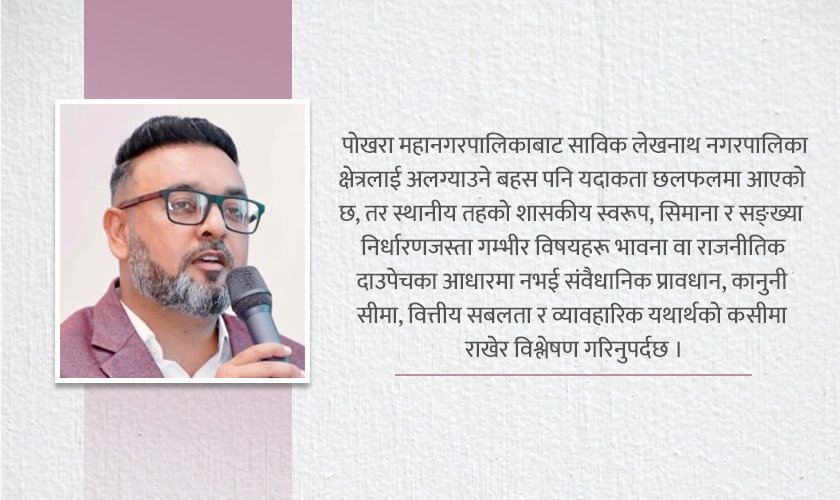
(The author is the Chairman of Ward No. 26 of Pokhara Metropolitan City and Coordinator of the Infrastructure Development Committee.)
This specific news has been automatically translated by AI. As a result, there may be some inaccuracies or language errors.