Rice Planting Concludes Amidst Monsoon Rains and Saune Sankranti Preparations
The planting of paddy in most terraced fields has been completed due to timely rains. Our planting, which started in the mud on Asar 10, was also finished within the same month. The final patch for planting was in the field near our house. As it had been empty for a few days after harvesting maize, the bunds were quite eroded due to the heavy rain.
While leveling, the roots of the Chitrey Bansho plant caused trouble. Nevertheless, leveling is easier than in Shrawan. After a little effort, the bund looked quite large. I leveled the bund with a rake, ensuring it was full of water.
I prefer plowing with oxen to digging with a spade in Asar; Krishna Dai did the work of digging and plowing. As it was the last day of planting, the plowing oxen were particularly energetic. After leveling the bund, I removed the yoke from the oxen that were harnessed. After finishing the leveling, I propped the plow on the field bund.
There is a large spring near Madhav Dai's field in Khundruka. Water brought from there through a canal was channeled from between the banyan and pipal trees at the Chautaro.
Due to the slope and bunds, small waterfalls were formed as the water flowed. I scooped up the nearby flowing water with my palms and washed off the mud stuck to the horns, tails, and bodies of the oxen. Although they don't speak, animals understand everything; their faces were glowing.
I untied the prepared paddy seedlings, took two bunches, and bathed both oxen alternately from head to tail. I apologized for any physical discomfort caused by the plowing or other work throughout the monsoon. This is a traditional and affectionate custom of ours.
In one field of the terraced area, the green maize is still fresh as it was sown late. Roasted fresh maize, mixed with salt and ginger leaves, eaten with beaten rice pounded in a mortar, would be very tasty. Saune Sankranti is a joyous festival. Being able to celebrate Saune Sankranti after overcoming the risk of monsoon floods is a moment of happiness and celebration for relatives and friends. There is a deep secret within this; the festival season that begins with Saune Sankranti continues until Poush 15.
Three to four days before Saune Sankranti, children would bring bundles of reeds and tubers from the grass they grazed while herding cattle in the afternoon. The preparation of materials for casting away skin diseases on Saune Sankranti was also done by children – cooperation and competition!
Bellauri, Panisaro, Guhyasaro were found on steep cliffs, especially on the cliffs of Andheri Khola. Climbing rocks covered in moss due to monsoon rain was risky as feet could slip, so one had to be careful, holding onto plants to lighten the body while climbing. Bellauri, Panisaro, Guhyasaro had to be collected.
The Lutey plant was found everywhere in the fields below the terraces. The plants were uprooted, made into small bundles, and collected. The Kurilo and Kukurdaino plants, however, only grew in the New House; that New House was carefully nurtured by Aunt. On Saune Sankranti day, everyone in the village would take them from there.
Those medicinal herbs found in the forest have their own significance. As we are worshippers of nature, pujas are performed according to the festivals. This has been passed down through generations.
Bellauti, oranges, lemons, and plums were also collected. A maize plant with two cobs from the field was also brought. After a day's hard work, the materials for the Lutey ritual were ready.
It is a popular belief that placing tender fruits and flowers with the puja materials ensures they do not wither or rot.
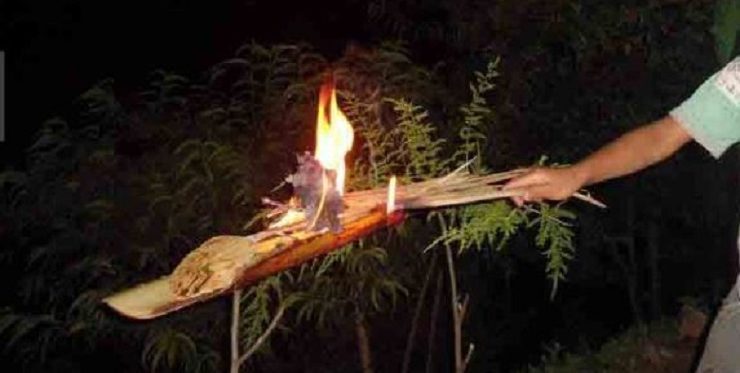
Evening fell slightly. Preparations for the Saune Sankranti puja began. It was customary for everyone to perform puja with Lutey materials on the edge of their courtyard. After completing the puja rituals, the reeds were burned. The maize plant with its cobs was roasted in the same fire.
There was a tradition of throwing embers from the burning wood in the Raanko in four directions. During this process, holding embers in hand, facing towards Saurabas in the foothills of Rainaskot, they were thrown saying, 'Lutoputo lai ja hai' (Take away the skin diseases). Similarly, embers were thrown in all four directions towards Kudule and the upper village.
It was the night of Saune Sankranti. It would be dark. There was no electricity like today. Lights were lit using kerosene in Tuki (earthen lamps). Faint communication of stars in the sky. Twinkling of fireflies. Greenery everywhere. As evening began to deepen, the sight of the Raanko fires burning in the clustered Siunghari Gurung settlement, visible from the porch of the house, was captivating. Like the twinkling sight of the Kathmandu Valley viewed from the Chandragiri hill.
There was a custom of shouting while throwing embers in opposite directions towards the settlement, signaling to each other. It was believed that after casting away the skin diseases, one would feel better, as itching of hands and feet and skin eruptions often occur while working in the mud.
The uniqueness of Nepali society and all the festivals we celebrate have special significance. As the current generation is somewhat distant from the soil, paths, and flour, our traditions are on the verge of disappearing. Especially after migration from the hills, not only settlements but also our arts and culture are being destroyed. It is the duty of all of us to preserve this.
This specific news has been automatically translated by AI. As a result, there may be some inaccuracies or language errors.