Self-immolation incidents highlight systemic failures in Nepal
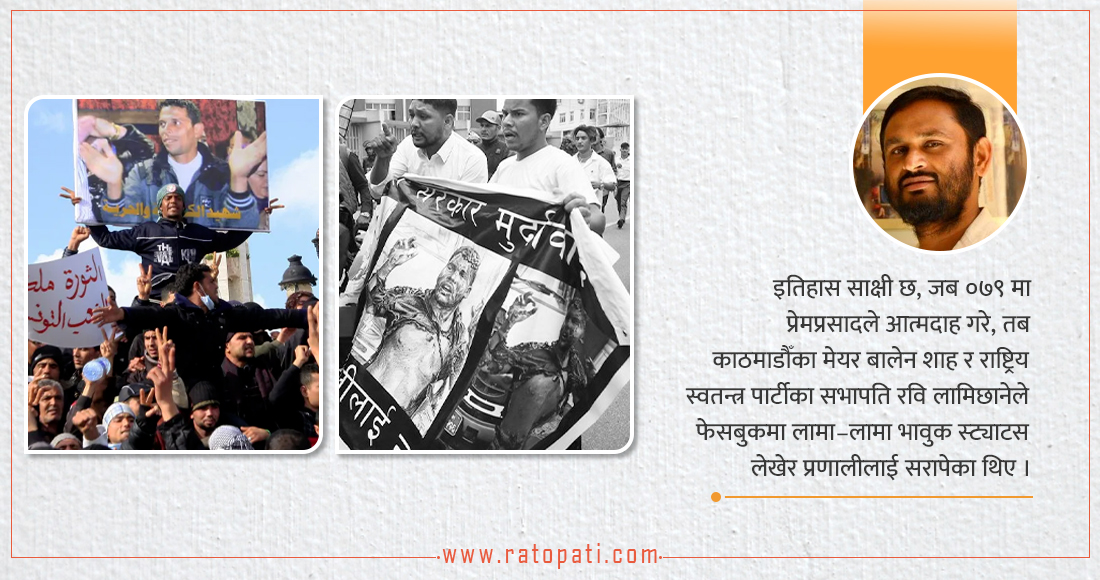
The time for Nepali youth to write emotional statuses on Facebook and TikTok or clap at others' suffering is over; rise up, take to the streets, and change the cruel system!
History is not just made in parliamentary debates and documents or in Singha Durbar's files and reports. Sometimes, history is also made from the burning body of a citizen in the middle of the street and the flames and smoke emanating from it.
In December 2010, 26-year-old youth Mohamed Bouazizi of Tunisia self-immolated in the courtyard of the governor's office. The powerful lines of the famous Pakistani poet Faiz Ahmed Faiz became even more relevant and potent:
'Hum dekhenge
Lazim hai ki hum bhi dekhenge
Woh din ki jis ka wada hai
Jo loh–e–ajal mein likha hai
Jab zulm–o–sitam ke koh–e–garan
Rui ki tarah ud jayenge
Sab taj uchhale jayenge
Sab takht giraye jayenge .'
As this poem predicted, Bouazizi's self-immolation sent the crowns of the dictatorial regimes of the Arab world, which had not changed even after the end of the Cold War, flying into the air and toppled thrones.
Perhaps the common Nepalis have not forgotten that in December 2079 BS, Prem Prasad Acharya, 37, from Ilam, chose the path of death by pouring petrol on himself in the middle of the road in New Baneshwor, with the parliament building as a witness. The state might have considered it an 'isolated' incident.
However, as historian Sam Wilkin described in his book 'History Repeating: Why Populists Rise and Governments Fail', history is cruel and repeats itself after a certain time. In the eyes of the current rulers, that incident was the result of the failure of elderly leaders deeply immersed in looting, factionalism, and corruption under the guise of Marxism, socialism, and Maoism.
But, less than three and a half years after Prem Prasad's death, last Thursday, while a 'youth-led government' was in power, Ganesh Nepali, a youth from Mugu and a participant in the 'Jana Andolan', self-immolated at the entrance of the Department of Passports in Tripureshwor, in the same manner as Bouazizi of Tunisia and Prem Prasad of Ilam.
Alas, the series of sorrow, irony, and tragedy did not stop there. Before Ganesh Nepali could breathe his last at Bir Hospital, on Friday, Vivek Mandal, another youth from Sisautiya, Godaita Municipality-10, Sarlahi district, who holds a postgraduate degree in science (MSc), attempted self-immolation by pouring petrol on himself. Not only that, on Saturday morning, 45-year-old businessman Ashwin Raut, residing in Buddhanagar, Kathmandu-10, also self-immolated in his own home.
As of writing this article, Ganesh Nepali, Ashwin Raut, and Vivek Mandal have all met their tragic end.
The self-immolation of three torchbearers, young men, and enlightened citizens of the country within three days is not a simple personal coincidence or an accidental explosion of mental weakness. It cannot be assumed that they had mental problems. This is a sign that it is becoming a trend.
This is a direct result of the state's institutional cruelty, inhumane bureaucracy, and the 'police state' created by the 'new' power structure. This article will focus on this very issue.
First, if we look at the incident of Ganesh Nepali, it is the result of the cruelty of a 'fine-oriented' and 'penalty-oriented' governance system. Although initial reports stated that Ganesh Nepali was in line to get a passport, the actual fact is even more heartbreaking and infuriating.
25-year-old Ganesh was not there to get a passport. He was a working rider (driver) living by the sweat of his brow in his own country, who had perhaps dropped off a passenger in Tripureshwor and was waiting for another ride. But the 'penalty-oriented' vulture-like eyes of the municipal police and traffic saw him. He was not parked; he was a moving wheel in a moving life. But the state put a 'wheel-lock' on that wheel and publicly humiliated him in the name of a fine.
When the state itself becomes a oppressor, snatching citizens' livelihoods and trampling on their self-respect, citizens have nothing left to lose but their lives.
They are now continuing that Balen-era 'penalty-oriented and punitive' policy with even more cruelty. For the three-tiered government, citizens are no longer people, but merely 'receipts' for collecting fines.
The seed of this inhumanity was sown with the populism that emerged with the rise of Balen Shah as mayor of Kathmandu Metropolitan City in the name of 'Clean Kathmandu'. During Mayor Balen Shah's tenure, in the name of strengthening the municipal police, a policy structure was created to impose severe fines and taxes on small street vendors, cart vendors, the poor class earning a living by doing business on the sidewalks, and riders.
They are now continuing that Balen-era 'penalty-oriented and punitive' policy with even more cruelty. For the three-tiered government, citizens are no longer people, but merely 'receipts' for collecting fines. The act of kicking the hearths of elderly mothers selling corn on the sidewalk and snatching their carts was marketed as 'heroism' on social media.
The cruel culture of clapping at the suffering of the poor on TikTok and Reels is now being seen as its logical and final consequence on the streets of Tripureshwor and the alleys of Buddhanagar.
On the other hand, Vivek Mandal from Sarlahi, who holds a postgraduate degree in science, worked as a school teacher for a few years but lost his job a year ago due to local political infighting and was unemployed. Unemployment is the main reason for his self-immolation.
Thus, to understand the self-immolations and attempts thereof by Prem Prasad Acharya, Ganesh Nepali, Vivek Mandal, and Ashwin Raut, we need to understand an incident from about a decade and a half ago. In December 2010, in the small Tunisian city of Sidi Bouzid, 26-year-old Mohamed Bouazizi, a graduate who supported his family by selling fruits.
He had no means to lobby, nor money to bribe corrupt municipal officials. Just as a female municipal police officer put a 'wheel-lock' on Ganesh Nepali's bike, one day the local female municipal police officer snatched Bouazizi's cart, threw his weighing scale onto the street, and slapped him in public.
The 'Jasmine Revolution' established that if the state continuously attacks the citizens' stomachs and self-respect, even a small spark can destroy an entire empire.
Unable to bear the humiliation of having his livelihood snatched and his self-respect trampled, Bouazizi poured petrol on himself and self-immolated in the courtyard of the governor's office. Bouazizi's burning body became a symbol of the shared anger of millions of oppressed youth in Tunisia, suffocating under the cruel dictatorial regime.
It caused an unprecedented political earthquake throughout the Arab world, which the world knows as the 'Jasmine Revolution' or the Arab Spring. Bouazizi's martyrdom not only toppled Tunisian dictator Zine El Abidine Ben Ali's 23-year rule but also swept away cruel rulers like Egypt's Hosni Mubarak and Libya's Muammar Gaddafi.
The 'Jasmine Revolution' established that if the state continuously attacks the citizens' stomachs and self-respect, even a small spark can destroy an entire empire. Looking at the background and struggles of Nepal's Prem Acharya, Ganesh Nepali, Vivek Mandal, and Ashwin Raut, one sees the spirit and anger of Tunisia's Mohamed Bouazizi within them.
Thus, why do Bouazizi, Prem Prasad, and Ganeshs choose the path of self-immolation? Or what forces or circumstances compel them to make such a tragic decision? To comprehend such tragedies, we must delve into the deep and hidden corners of socio-economic and psychological thought.
The world-renowned French sociologist Émile Durkheim, in his famous work 'Suicide', explains 'suicide' as follows: 'Suicide is not purely an individual act. It is an irrefutable measure of how sick or near-death the structure within society and the state is.'
According to Durkheim, when the established laws and regulations in society cannot do justice to citizens' aspirations and the state becomes merely an oppressor, a state of 'anomie', i.e., lawlessness and social emptiness, arises. Nepal's current gig economy, labor market, and middle-class business sector are victims of this 'anomie'. Despite working day and night, citizens cannot even maintain their minimum self-respect, let alone fulfill their household responsibilities. They are getting entangled in the web of debt day by day.
Poverty is being added to poverty. However, some pro-government and ruling party MPs are making the absurd argument that 'laws are made for security, not for citizen protection'.
Regarding suicide, another famous political economist, Albert Hirschman, has an established social theory that links suicide to exit, voice, and loyalty. Hirschman says, 'When citizens are dissatisfied with the system or the state, they either rebel by organizing or choose to leave (exit) that system.'
Tunisia's Mohamed Bouazizi, Nepal's Prem Prasad, and today's Ganesh, Vivek, and Ashwin; all are victims ground in the mill of unbearable mental pain (psychache) and administrative humiliation.
Last year, the youth rebellion on August 29-30 was the peak of citizen voice. It set fire to the executive, judiciary, and legislative bodies, destroying them, and from their ashes, the Rastriya Swatantra Party (RSP) gained power. But when, even with a youth-majority government in power, the character of policy and bureaucracy did not change, the behavior of the police did not change, then the organized voice of people like Ganesh Nepali turned into individual isolation.
The incident of Ganesh Nepali happening outside the entrance of the Department of Passports is symbolic in itself. The Department of Passports is the primary point of departure from the country. When a working youth has no place to raise their 'voice' in their own country, and even the path to leave the country with dignity is clouded by administrative hassle and brokerage, they reach the terrifying decision to exit life itself. The self-immolations of Vivek Mandal and Ashwin Raut are the result of the state closing all doors of 'voice' and 'exit'.
According to psychologist Edwin Shneidman, people do not die to embrace death; rather, they take the final step to stop the unbearable mental pain and humiliation in their minds, which he termed 'psychache' and 'cognitive tunnel vision'.
Tunisia's Mohamed Bouazizi, Nepal's Prem Prasad, and today's Ganesh, Vivek, and Ashwin; all are victims ground in the mill of unbearable mental pain (psychache) and administrative humiliation. Self-immolating at the door of parliament or government offices, or right under the nose of the state, is 'the ultimate protest'.
By burning their bodies, they are challenging the deaf and blind state, saying, 'Your state is so cruel and shameless that it is better to burn to ashes than to endure your insults and suffering.'
History bears witness that when Prem Prasad self-immolated in 2079 BS, Kathmandu Mayor Balen Shah and Rastriya Swatantra Party Chairman Rabi Lamichhane wrote long, emotional statuses on Facebook, condemning the system. Rabi Lamichhane even called Prem Prasad's suicide note his 'political manifesto'. Balen Shah also strongly criticized the failure of the state machinery, stating that the state was the root cause of the self-immolation.
But what is the reality today? As soon as they tasted power, Rabi Lamichhane and the new faces of RSP have become blind followers of that same oppressive system. Last Friday, when Home Minister Sudhan Gurung, showing Ganesh Nepali's corpse in parliament, said, 'The metropolitan police put the wheel-lock, what is the federal government's fault?', the same new and young MPs who entered parliament with slogans of change were seen thumping the table in his support.
The Home Minister cannot evade responsibility by blaming the local government.
Of course, when Balen Shah raised the issue of Nepal-India borders in a highly insensitive manner, saying 'We have also encroached on India's borders', those MPs also applauded him.
This has revealed a terrible truth: being young in age does not guarantee being young in thought and thinking. It is evident everywhere that these new faces are indulging in self-absorption even more than the old parties.
The Home Minister cannot evade responsibility by blaming the local government. Article 232 of the Constitution of Nepal envisages the relationship between the federal, provincial, and local levels. It is mentioned that the relationship between the three levels will be based on the principles of cooperation, coexistence, and coordination.
But, unfortunately, Singha Durbar does not want to transfer its authority to the provinces, nor do the provinces want to transfer it to the local levels. When the state views citizens merely as 'machines for collecting fines' instead of granting them rights, such tragedies arise due to a lack of coordination.
The burning bodies of Prem Prasad Acharya, Ganesh Nepali, Vivek Mandal, and Ashwin Raut have taught a historic lesson to the common youth and enlightened citizens of Nepal. Now, merely waiting for another 'investigation committee' or going into depression in hiding is not an option. If the system is to be reformed, it is not by burning alone in a room or a street corner, but by organized and peaceful ideological rebellion to shake the roots of this cruel regime.
The time for Nepali youth to write emotional statuses on Facebook and TikTok or clap at others' suffering is over. Like the youth of Tunisia, every rider, delivery boy, small sidewalk vendor, and oppressed and unemployed youth in villages and cities of Nepal must unite and create pressure for policy reform.
This pressure is not for violence or anarchy. It is a peaceful, resistant consciousness against the cruel character of the state machinery that considers citizens merely as 'machines for collecting taxes/fines'.
If the rulers in Singha Durbar and the young MPs thumping tables in parliament do not understand the heat of this fire in time, they must understand: the unemployment of Vivek Mandals and the 'wheel-lock' on Ganesh Nepali's bike today will turn their chariot of power into smoke forever tomorrow.
The anger of Ganesh, Vivek, and Ashwin has already sounded the bugle for a peaceful 'Jasmine Revolution' in Nepal. Because, who will speak for the poor jasmine for you!
(Dr. Kushwaha, who holds a doctorate from India's Jawaharlal Nehru University, is the Director of the Good Governance School Research.)
This specific news has been automatically translated by AI. As a result, there may be some inaccuracies or language errors.



_6FSvCrCShE.jpg)