Girija Prasad Koirala: A Pillar of Nepal's Democratic Movement
Nepal's political history is not a straight line; it is a complex but meaningful journey filled with ups and downs, struggles, bloody movements, agreements, and transformations. At the center of this journey are sometimes institutions, sometimes ideologies, and sometimes personalities who redefine not just time, but the very fundamental structure of the state.
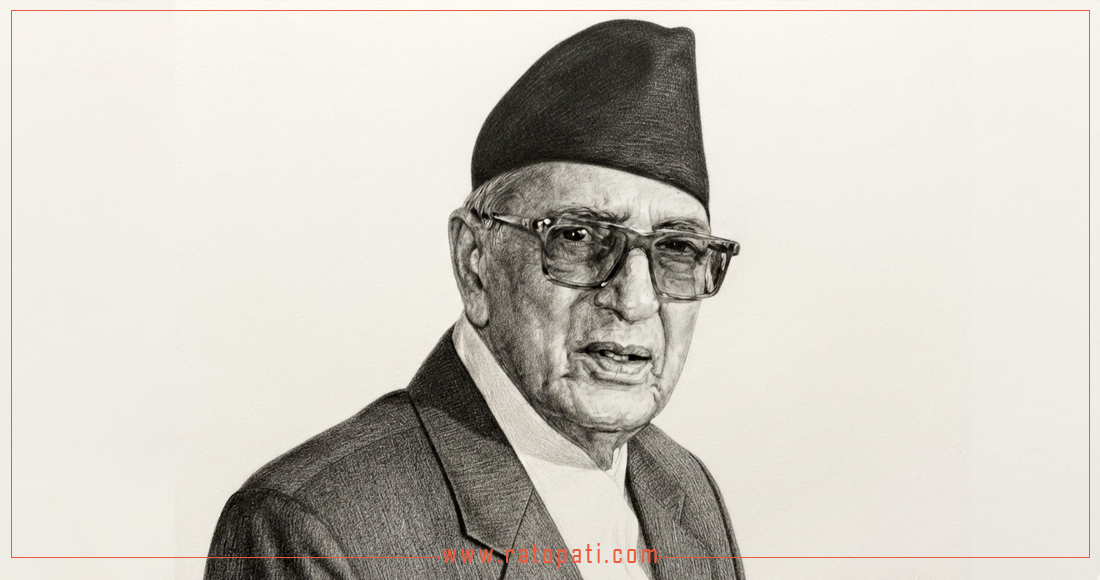
Girija Prasad Koirala is such a historical personality whose life is so deeply intertwined with Nepal's democratic movement that understanding him means understanding Nepal's modern political history.
The first decisive turning point in Nepal's democratic consciousness was the 2007 revolution. With the end of the Rana regime on Falgun 7, 2007, the door to people's rights and multi-party practice opened for the first time in Nepal. This was not just a change of power; it was an awakening of social consciousness. At this time, Girija Prasad Koirala was in his childhood, but the political environment of the Koirala family gave him the opportunity to understand the relationship between the state, power, and people's rights from an early stage.
This became the foundation of his entire political life after this seed was sown. However, the democratic practice that began after 2007 could not be long-lasting. In 2017, King Mahendra dissolved parliament and implemented the Panchayat system. This was one of the harshest turns in Nepal's democratic history.
Political parties were banned, leaders were jailed, and democratic practice was completely prohibited. During this period, democracy survived only as an idea. It was during this time that Girija Prasad Koirala entered active political struggle, focusing on building organizations, movements, and underground political practice.
The period from 2020 to 2030 BS was a time of reorganization and resistance for Nepal's democratic movement. Political parties were active, albeit divided, both inside and outside the country. During this time, political consciousness spread to the grassroots level. The student movement of 2036 BS and public pressure forced King Birendra to announce a referendum.
In the movement, Girija Prasad Koirala played a significant role in organizing the movement, political coordination, and strategic direction while being at the leadership level of the Nepali Congress.
The referendum of Jestha 10, 2036 BS was the first major experiment in political participation in Nepal. Although the Panchayat system remained, it did not weaken democratic consciousness; rather, it strengthened it.
Girija Prasad Koirala's political style clearly evolved during this period – organizational leadership, strategic thinking, and movement management. He was not just an emotional activist but also established himself as a political strategist. 2046 BS is the most decisive turning point in Nepal's democratic history.
The people's movement that began on Falgun 7, 2046 BS was successful with the end of the Panchayat system on Chaitra 26, 2046 BS. This movement was not just a political change; it was an explosion of long-standing public dissatisfaction. In this movement, Girija Prasad Koirala played a significant role in organizing the movement, political coordination, and strategic direction while being at the leadership level of the Nepali Congress.
The period after 2046 BS was a time of re-establishment of Nepal's multi-party democracy. However, this period was characterized more by instability than stability. Frequent changes in government, political disagreements, and institutional weaknesses challenged democracy. During this period, Girija Prasad Koirala became Prime Minister and tried to strengthen democratic institutions through his experience in state governance.
To understand this period, the Gita is very relevant, 'Karmanye vadhikaraste Ma phaleshu kadachana.' This means you have the right to action, but not to its fruits. Democracy is also a continuous process, not a final achievement obtained once. For this reason, continuous effort was needed to institutionalize democracy even after 2046 BS.
2052 BS is another decisive turning point in Nepal's political history. The Maoist armed conflict began on Falgun 1, 2052 BS. This pushed Nepal into a long civil war. Violence, mistrust, and political division deepened between both the state and the rebels.
The 2062/063 people's movement was the decisive final turning point in Nepal's democratic history, and at the center of this historical turning point was a name that was constantly present – Girijababu.
During this period, democracy was in crisis. On one hand, a violent rebellion; on the other, a weak state structure. Girija Prasad Koirala became Prime Minister several times during this period and attempted to resolve the conflict. Although resolution was difficult in the initial stages, this experience later became the basis for the peace process. During this time, he made all parties understand that long-term solutions are possible not just through the use of force, but through political dialogue.
The Royal Massacre of Jestha 19, 2058 BS is the most serious psychological and political shock in Nepal's political history. After the assassination of King Birendra's family, the country fell into a deep crisis. This event weakened trust in the monarchy and further increased political instability. It was during this time that the relationship between democracy and monarchy began to be redefined.
The 2062/063 people's movement was the decisive final turning point in Nepal's democratic history, and at the center of this historical turning point was a name that was constantly present – Girijababu.
The movement that began on Chaitra 24, 2062 BS was not just a crowd on the streets; it was the voice of the people suppressed for decades, which was given direction by the courage and risky decisions of the political leadership. When democratic forces stood together under Girijababu's leadership, the country once again stirred, realizing that change was not just a dream but possible.
During those 19 days of the movement, as the streets of Kathmandu echoed with slogans, tears, and blood, Girijababu's name lived not just in political speeches but also in the trust within people's hearts. On Vaishakh 11, 2063 BS, when the movement reached a decisive victory and the power of the monarchy weakened, that victory was not just a political achievement; it was the result of Girijababu's firm decision. On that day, many eyes shed tears – some of joy, some from the fatigue of a long struggle.
The first breath of peace returned to the war-weary villages. At that moment, Girijababu's decision became a human relief connected to history.
The basis of this movement was the 12-point agreement of Mangsir 7, 2062 BS, in the formation of which Girijababu's political foresight and risk-taking ability were decisive. Establishing cooperation between the seven political parties and the Maoists was not an ordinary political step at that time. It was a courageous bridge connecting a time filled with mistrust, conflict, and bloodshed.
Only after that bridge was built under Girijababu's leadership did the country begin to see the path of peace from the path of war. Subsequently, the Comprehensive Peace Accord was signed on Mangsir 5, 2063 BS, which ended the armed conflict. This agreement, in which Girijababu played a role, was not just a signature on paper; it was an attempt to wipe the tears of thousands of mothers and fathers who had lost their children or were searching for the disappeared.
The first breath of peace returned to the war-weary villages. At that moment, Girijababu's decision became a human relief connected to history.
The formation of the Constituent Assembly (2064 BS) and subsequently the promulgation of the constitution in 2072 BS transformed Nepal into a federal democratic republic. In all these processes, Girijababu's political intervention, consensus-building ability, and transitional leadership were extremely important. The constitution was not just a legal document; it was a shared dream built over decades of struggle, sacrifice, and Girijababu's leadership, where people's rights were written not just in words but also in structures.
Today, when we remember the 2062/063 movement, Girijababu's role is not just a chapter in history; it is a thread of emotion that has tied together all the pain, hope, and tears of the movement.
Remembering the struggle associated with his name still weighs heavily on the heart today because it was not just a story of power change. It was a painful but glorious delivery that gave a new birth to the country, in which Girijababu was a key co-traveler. The Buddha's saying, 'Na hi verena verani sammantīdha kudachana,' is very relevant in this peace process. Violence cannot be ended by violence, but only by dialogue and agreement.
Girija Prasad Koirala's role was decisive in this entire process. He not only led the movement but also showed the ability to bring opposing forces to the same table. This is why he is also called a 'consensus-building leader.' His personal life was as full of struggle as his political life. He was simple, emotional, and responsible towards relationships within his family. But the pressure of nation-building did not allow him to limit himself to personal life. According to his close ones, he was firm in his decisions but humane in his behavior. Although emotionally sensitive, he was very firm politically.
Ultimately, democracy is not a permanent state; it is a living journey of continuous practice, continuous vigilance, and continuous responsibility. It was this truth that Girija Prasad Koirala, through his entire life, made us realize.
Another important aspect of his life is sacrifice. He dedicated many political opportunities, personal comforts, and family time in the name of the nation. This is why his life became a symbol of public life, not personal life. The Vedic mantra 'A no bhadraḥ kratavo yantu viśvataḥ' is a fundamental value of democracy – respect for diverse ideas.
Girija Prasad Koirala's political practice also appears to be based on this principle. Today's generation is enjoying the benefits of democracy but is moving away from the history of its struggle. The movements of 2007, 2046, and 2062/063 are not just political events; they are the foundation of civil rights.
Ultimately, democracy is not a permanent state; it is a living journey of continuous practice, continuous vigilance, and continuous responsibility. It was this truth that Girija Prasad Koirala, through his entire life, made us realize. He made power, struggle, failure, criticism, and resurgence part of the same long journey, making a significant contribution towards making democracy not just a system of governance but the soul of national consciousness.
His life is such a sensitive chapter in Nepal's democratic history where pain and hope flow in the same heartbeat. Where decisions become not just political strategies but deep responsibilities tied to the nation's future. From the difficult days of the movement to the sensitive moments of the peace accord, each of his steps tried to save the country from division and lead it towards unity.
That leadership sometimes appeared harsh, sometimes controversial, but at its core was always the same unwavering belief – Nepal must achieve, protect, and continuously safeguard democracy.
Therefore, remembering him as the 'Rishi of Democracy' is not just reverence; it is gratitude towards history and a warning for the future. Because democracy weakens if forgotten, but only becomes strong if remembered and continuously practiced, capable of giving a bright future to the coming generations.
This specific news has been automatically translated by AI. As a result, there may be some inaccuracies or language errors.