Nepal's Monetary Policy Faces Balancing Act Amidst Fiscal Ambitions and Economic Realities
The two main pillars of a country's overall economic operation are fiscal policy and monetary policy. Fiscal policy sets the roadmap for political priorities and economic expansion, while monetary policy is responsible for maintaining overall economic stability, price stability, and financial discipline. Failure to coordinate these two policies risks pushing the economy towards imbalance. As Nepal Rastra Bank stands at this policy challenge crossroads in formulating the monetary policy for the upcoming fiscal year, it must balance the government's expansionary fiscal ambitions with the ground-level economic realities.
The ambitious target of achieving a 7 percent economic growth rate is set in the massive budget of Rs 21 kharba 24 arba for the upcoming fiscal year, presented in parliament. According to the established principles of macroeconomics, when the government attempts to increase public spending and market demand through policy, it is natural for price increases and pressure on the external sector to occur. In such a situation, if the central bank adopts an excessively loose policy under pressure from political actors and stakeholders, the economy risks further imbalance, and if it adopts a completely contractionary policy, there is a risk of further stagnation of domestic economic activity.
The current reality is that while there is more than Rs 13 kharba in investable funds accumulated in the banking system, the contraction in overall demand in the real sector indicates structural stagnation in the economy. The continuous sluggishness of the capital market and the weak investor morale, even as interest rates have fallen to historic lows, further clarify this recession. On one hand, the sluggish private sector and capital market are awaiting immediate policy facilitation, while on the other hand, the trade deficit of over Rs 14 kharba and the potential pressure of consumer price inflation remain. Therefore, the discussion on the policy direction to be set by the central bank, standing on this contradictory ground of fiscal policy's expansionary ambition and domestic recession, the expectations of the private sector, the limits of possible relief, and the steps to be taken to protect the country's broader economic stability amidst monitoring of international financial standards (FATF) is the main focus of this article.
- Budget's Ambition and the Central Bank's Dilemma
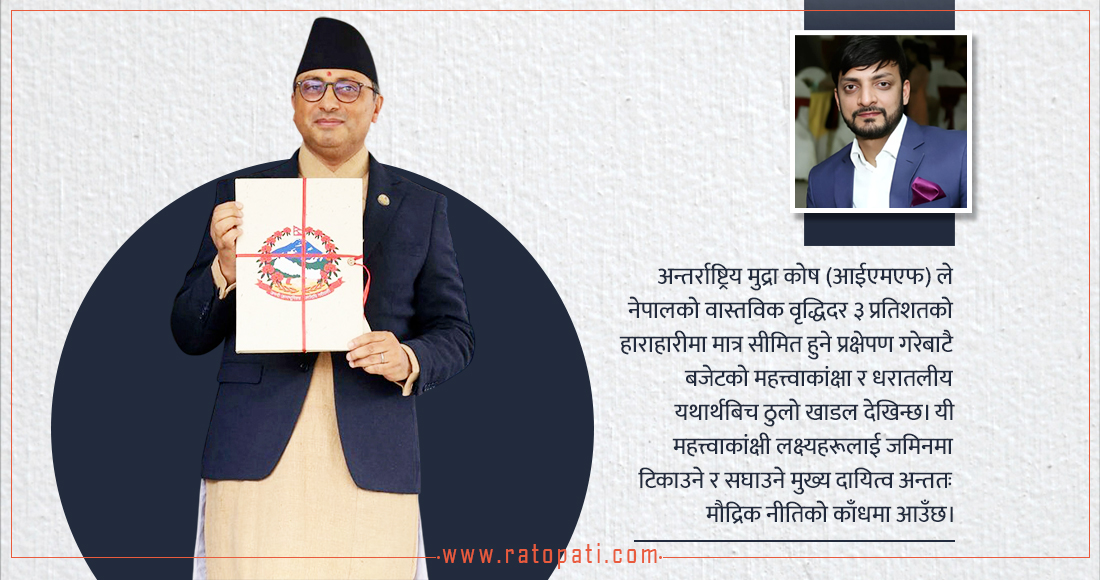
Due to the expansionary tendency of fiscal policy, the central bank is always caught in a policy dilemma. The budget for the upcoming fiscal year has put forward popular policies such as 'Investment Express', rapid amendment of laws, NRNs in the stock market, 'Sovereign Wealth Fund', and 'AI Hub', setting a target of 7 percent economic growth. However, the IMF's projection that Nepal's actual growth rate will be limited to around 3 percent shows a large gap between the budget's ambition and the ground reality. The main responsibility for grounding and supporting these ambitious goals ultimately falls on the shoulders of monetary policy.
Despite the budget setting high goals, the government's capacity to spend capital is as dismal as ever, which means development spending will again lag behind. Moreover, the unallocated budget of over Rs 90.30 arba, kept under various headings without specifying titles and programs, adds to the risk of fiscal opacity. The voices are growing that allocating such a large sum without adequate study and DPR, to be spent arbitrarily later based on political influence, is against the discipline of public financial management.
This Rs 90 billion, without programs outside parliament, if scattered haphazardly in the market, will only create unproductive demand. On the other hand, while the 21 percent salary increase for government employees and the revision of income tax limits increase disposable income in the hands of the general public, Nepal's weak production base is likely to create severe pressure of 'demand-pull inflation', i.e., price hikes. In a situation where the current consumer inflation is 5.04 percent, the expansionary nature of the budget challenges the government's goal of keeping inflation within 6 percent. In such a situation, if an excessively loose monetary policy is introduced merely for a year of cheap applause or political satisfaction, it could lead to a bigger crisis in the long run. Therefore, there is pressure on Rastra Bank to bring a structural policy with at least a 5-year long-term vision rather than short-term relief.
- Demands and Suggestions from the Private Sector and Industrial Sector
Amidst this policy dilemma created by the budget, the umbrella organizations of the private sector (Federation, Confederation, and Chamber) have presented their business suggestions to Baluwatar for making the economy dynamic in the upcoming monetary policy. Their suggestions are focused on providing immediate relief to the market suffering from recession and boosting investor morale. With more than Rs 13 kharba of investable funds piled up in the banking system, the average interest rate has already fallen to a single digit. However, despite this cheap interest rate, the demand for credit in the market has not increased, so the focus of businessmen is on stabilizing the current cheap interest rate through policy and further reducing the actual cost of credit by lowering the premium rate.
Specifically, their main suggestion is to make credit cheaper by strictly regulating the premium rate added by banks to the base rate and limiting it to a maximum of 1 percent. In addition, there are demands to set a target of at least 20 percent credit expansion in the upcoming fiscal year, reduce the bank rate to 5 percent, and limit the spread rate of banks to a maximum of 3.5 percent.
The most significant policy hurdle for businessmen, the 'Working Capital Loan Directive', its practical revision or postponement is their main agenda. The industrialists argue that this directive's strict conditions have affected the market's cash cycle, so it should be postponed or revised for now. Suggestions have also been made to provide special refinancing and collateral-free concessional loans under a special package to save small, medium, and micro-enterprises (SMEs) severely affected by the recession, and to extend the blacklist period to reduce the pressure of loan recovery.
Meanwhile, the Nepal Bankers' Association (NBA) has also submitted a 21-point demand to the Governor, advocating for the ability to add or subtract premium rates based on the borrower's risk. Furthermore, the banks' demand is to reduce the mandatory provision of investing at least 5 percent of total loans in the deprived sector to 4 percent. Banks claim that it is becoming difficult to meet this quota as the demand from small and deprived sector borrowers in the market is shrinking.
- Crisis-Ridden Sectors and the Central Bank's Potential Relief Preparations
Considering the serious impact on the market and the logical suggestions from the private sector, indications are that the Rastra Bank is preparing to provide special relief and policy 'shelter' to some crisis-ridden sectors. Specifically, preparations are underway to adopt some practical flexibility in the provision of immediately blacklisting the construction sector, which is facing financial crisis due to non-payment by the government in time or delays in loan repayment. This policy flexibility seems necessary as the entire infrastructure development is at risk if this blacklisting is done before the cash flow of construction entrepreneurs becomes smooth.
Similarly, preparations are underway for loan restructuring and rescheduling for other productive and service sectors directly hit by the recession. Preparations are being made to extend the loan repayment period for the tourism sector, especially large hotels and resorts, and to provide a one-time loan rescheduling facility for sectors like real estate (housing and land) and heavy industries such as cement, iron, and steel.
To improve asset markets and revive transactions, the central bank has indicated plans to review the loan-to-value ratio, revise and ease the existing cap on share collateral loans (margin lending) as per investor suggestions, and slightly modify the strict limit on vehicle loans to boost the market. While such steps will help stimulate the market in the short term, the central bank also needs to be equally vigilant about how much they contribute to sectors that increase the economy's actual productivity and how they prevent short-term speculation in unproductive sectors.
- The Real Problem of the Market and Policy Challenges
It is natural for the private sector and struggling entrepreneurs to ask for relief during this recessionary period. However, looking at the internal situation of the market, the problem is not just with interest rates. Currently, banks have ample funds, and interest rates are very cheap. Despite this, the main reason for the lack of new investment is the absence of customers to buy goods in the market and the lack of policy stability. Therefore, the understanding that investment will increase solely due to falling interest rates is not complete. While businessmen may want to share their risks with the banking sector, monetary policy must maintain a balance between business relief and financial discipline.
There is pressure from all sides to increase the flow of money in the market, taking advantage of the ease in the external sector (foreign currency) when liquidity is abundant domestically. However, before disbursing funds in this manner, the reality of the country's financial resources cannot be ignored. Using the budget's announced 'Sovereign Fund' concept and the sufficient foreign exchange reserves due to remittances to stimulate the market or for unproductive sectors or haphazard infrastructure development can be very risky. According to the data for the first 10 months of the current fiscal year, the country's trade deficit has reached Rs 14 kharba 43 arba 68 crore, where the share of our exports compared to imports is very weak. The direct meaning of this is that our foreign exchange foundation is not permanent and self-earned but only a temporary result of reduced imports and increased remittances. If such reserves are 'locked' in long-term infrastructure, there is a risk that the country's balance of payments (BOP) will fall into crisis and inflation will go out of control at the slightest external shock.
- Sensitivity of International Financial Standards (FATF)
Along with this pressure on the domestic market and foreign currency, the most sensitive aspect to consider when formulating monetary policy is the reality that Nepal is at risk of being on the Financial Action Task Force (FATF) 'grey list'. Looking at the regulation and supervision system of the financial sector, the Rastra Bank is currently under extreme international scrutiny. In such a situation, making established rules lenient under pressure from industrialists can be counterproductive. If there is even a slight compromise on international standards related to bank regulation, supervision, loan classification, and anti-money laundering, Nepal faces the danger of directly falling into the 'black list'.
Currently, industrialists are urging for the revision of the working capital loan rule and reduced supervision of banks. However, if the Rastra Bank again tries to be too liberal for cheap popularity or business pressure, the risk of Nepal moving directly from the grey list to the black list is high. If Nepal is blacklisted, the country's banking credibility will weaken internationally, the legal banking channel for remittances will be affected, banks will hesitate to accept LCs (Letters of Credit), and foreign trade will be disrupted, further plunging the economy into crisis. Therefore, the Rastra Bank should not take the risk of abolishing the working capital loan directive or violating international loan classification rules (like IFRS 9) to provide temporary relief to industrialists.
- Conclusion: What Should Be the Monetary Path?
The core spirit of the autonomy and authority given to the central bank by the Nepal Rastra Bank Act, 2058, is to bind the political ambitions of fiscal policy (budget) within economic limits. When Singha Durbar chooses the path of distributing money in the market and playing the politics of growth rates through the budget, Baluwatar must act as the 'restraint of parliament' to save financial stability. The upcoming monetary policy can be neither completely hawkish nor completely dovish. It must be a serious, conscious, and progressive effort to balance fiscal policy.
The first priority of monetary policy should be to create concrete channels to direct the excess liquidity of Rs 11 kharba piled up in banks away from stock market and real estate speculation and towards information technology (IT), manufacturing industries, agriculture, and export-oriented sectors. The Rastra Bank must completely reject the pressure to reach a total credit expansion target of 20 percent and keep it within a prudent limit of 12 to 14 percent. However, in doing so, no compromise should be made with financial discipline and international standards (FATF conditions). Instead of the suicidal path of loosening rules to temporarily please businessmen or bankers, 'financial stability' that strengthens the economy in the long run by keeping the foundation of the banking system strong should be the main mantra of the upcoming monetary policy. This time, foregoing the temptation of short-term political applause and saving the country's economic foundation will be considered the greatest wisdom and national duty for Baluwatar.
This specific news has been automatically translated by AI. As a result, there may be some inaccuracies or language errors.