Rastriya Swatantra Party Lacks Alternative Politics, Analyst Claims


I do not consider the Rastriya Swatantra Party (RSP) an alternative political party. I consider it a new party. At the same time, it is a political alternative. It has become a party for people who could not fit into old parties or who wished for a new party.
But in what sense is it an alternative politics? If it is alternative politics, it should be able to offer an alternative to our traditional values, beliefs, culture, character, distortions, and anomalies, the things considered bad, right? I don't see any alternative to that.
There is no novelty in its ideology either. Currently, it has started saying 'social democracy' after removing 'constitutional socialism'. The term 'constitutional socialism' itself was misleading; it is not a political concept at all. Therefore, the debate on 'social democracy' has been within the Nepali Congress for a long time, much before the RSP. Moreover, even UML, leaving Marxism, Leninism, Maoism, although it has not removed them from its name.
But they say that 'multi-party people's democracy' is also a type of social democratic program. Therefore, concepts like constitutional socialism or social democracy do not offer any significant new principles. The debate on more important principles is also becoming very narrow worldwide. They are overlapping with each other.
Therefore, debating whose principle is what is also becoming futile in today's world. For example, ideologies like 'End of History', 'End of Ideology' have not been formed. I do not give much importance to what they write in their documents regarding principles, nor do I analyze based on that.
My focus is on how the government and the party they are running are working in practice. And, regarding the party convention, new and alternative parties, which go for mass democracy or elections among party members as European parties do, the RSP did not do that either.
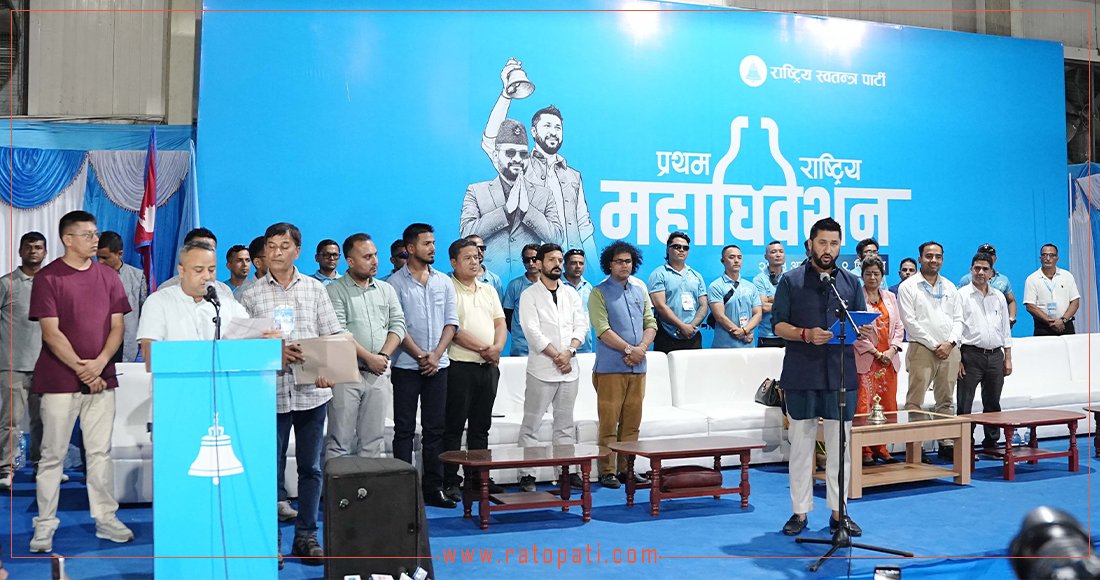
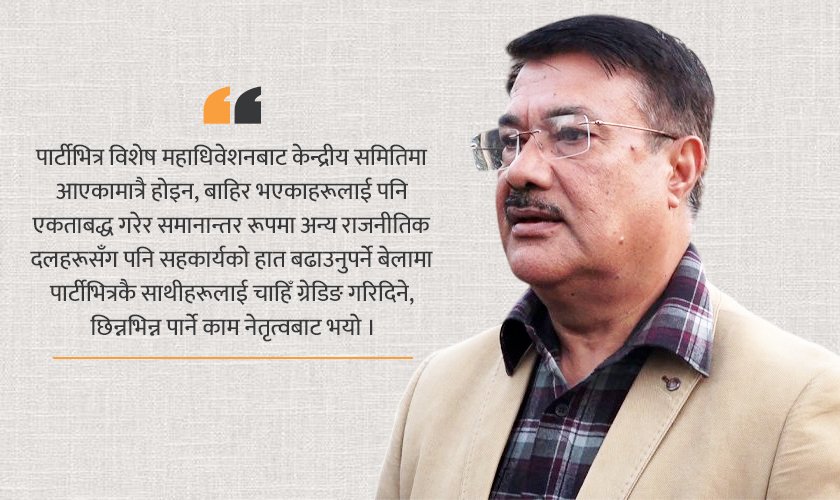
If it had 500,000 party members like other parties, and if the chairman and central committee were elected from those 500,000, it would have been something new in democracy. It would have been an intensification of democracy, an practice of something that has been happening worldwide but not in Nepal. It also called a convention of about 4,000 people, and it could not manage it well; chaos was seen within it. The very next day, people started leaving the convention venue dissatisfied. Out of the approximately 4300 people, only about 2900 voted for the central committee.
Only about 1300 votes were cast for the officials. If no one challenges the legality of that convention and the Election Commission accepts it, then it was a convention. Otherwise, it was not a convention at all, and its legality would be questioned.
The legality is bound to be questioned when even 50 percent did not vote. Firstly, I don't know what it is legally, but politically and morally, its validity is questionable.
Secondly, being a new and modern party like theirs, they should have been able to conduct the convention in a technology-friendly manner, related to the timetable.
Thirdly, in intra-party democracy, it was seen that they tried their best to make the senior leader and chairman unopposed. They also made bylaw provisions accordingly. That was also not a new or good thing. If democracy is to be intensified, all key positions should be competitive. There were even reports that a person who announced their candidacy for chairman had their name removed from the convention representatives. If that is true, that is also not a good thing.
According to media reports, they imposed a very high nomination fee to prevent people from becoming candidates. While Rs 10,000 was sufficient to contest in the federal parliament, they set Rs 21,000 to contest for the central committee.
Worldwide, one supporter and one proposer are sufficient, but they made provisions for 21, 41, and 51 supporters. Such things seem to be an attempt to shrink intra-party democracy. Another thing is that documents were presented, but there was no group discussion or presentation. Looking at all these things, I don't think the RSP's convention was particularly new or encouraging.
Although it fulfilled the formalities. When any party holds a convention, it should also review its government. The government and the party are different things. The party forms the government, but the government does not form the party. The government comes and goes, can win or lose in every election, the government can fall, but the party is a long-term institution in a democracy.
In this sense, the party should review the government. I haven't heard anywhere that they reviewed the government. This means they support all the government's actions, which is another matter. This implies that Balen's government has done everything well. We must understand that they also supported the price hike. We must understand that they also supported the bulldozer in the slum settlements. It seems we have to say that the RSP's convention also supported the statement that Nepal has encroached on India's border.
From the RSP's perspective, Nepal has indeed encroached on India's border. At least if the party could have said in its document that this statement is wrong and it wouldn't hurt if the Prime Minister apologized, that would have been something. Therefore, if critical thinking is not seen in the RSP, it will give rise to another type of sycophants, blind devotees.
The RSP has become another cult rather than a democratic party with critical thinking. Yesterday, we suffered so much from Oli's cult. When the Maoists emerged in the 2060s, people tried to make Prachanda like a god. That cult led to Prachanda's downfall today. The fall of UML was due to the cult of the 'I love you KP ba' and 'I am a sycophant' campaign. Now another cult has arrived. What will be the future of this cult, we have to look back and see. And I did not find a qualitative difference.
The RSP is also seen in old parties. For example, in the Congress convention, Sher Bahadur had nominated Prakash Sharan Mahat as the general secretary candidate. Gagan and Bishwa Prakash won from the other faction. His attempt to form a faction or get his favored person elected failed. In the UML convention, an election was held between Shankar Pokharel and Surendra Pandey; Oli's support was for Shankar Pokharel, and Shankar Pokharel won. The RSP's practice was just like that of UML, not even as much as Congress.
In Congress, there was a faction of Sher Bahadur Deuba, and factions of Shekhar Koirala, Gagan Thapa, etc. In UML, there were factions of Bidya Bhandari, Ishwar Pokharel, Surendra Pandey, Shankar Pokharel, KP Oli, etc., which is not relevant. In the Nepali Communist Party, there were factions of Prachanda, Madhav Nepal, etc. There were factions of Baburam and Baidya, which is not relevant; that is natural.
Why should politics be criticized? My concern is whether the basic impartiality and neutrality of the convention were maintained or not. What happens if the establishment itself, like the state conducts elections and the state says, let this party win? The chairman of any party, the Election Commission, is an establishment body, right? It must remain neutral in the elections held among the remaining party members.
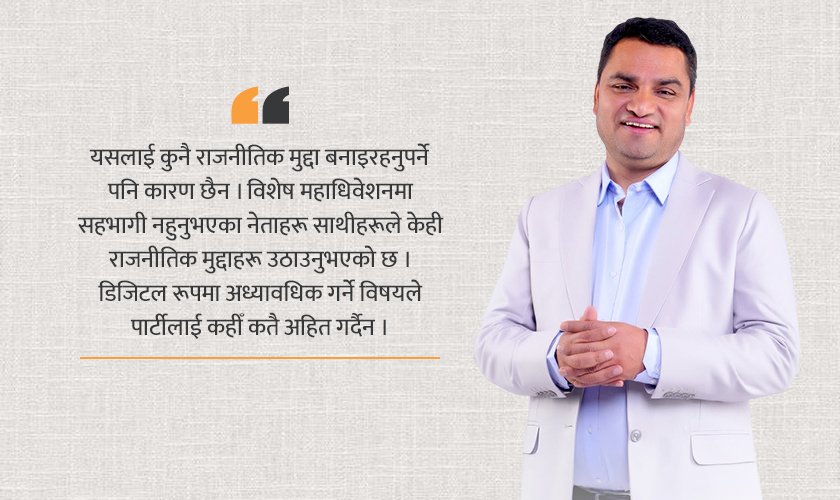
It is useless for us to speculate now whether Ravi and Balen will fight or not. When Ravi Lamichhane is supporting all the government's actions. If he has to split tomorrow, what excuse will he give? For that, shouldn't it have been necessary to be critical from now on?
This means that Ravi Lamichhane has 100 percent support for the Balen government so far. And it is not our concern whether their relationship is good or not.
We should not wish for any party to split or fight. But what will happen among their supporters and cadres due to the way they are running the government and the party, the power negotiations between the two leaders, is the main thing.
What will happen between Ravi and Balen is not my concern. Regarding the government, it was also heard that many of their MPs, cadres, and convention representatives, who could not manage a convention of four thousand people, how will they manage a country of 30 million?
It was also heard that if this is the kind of party it is, it is no different from the old ones, and this party will not last long. It was also understood that most of those who left without voting had disagreements and dissatisfaction with the convention process. These things are important. We have to see what these things will do to their party's grassroots support base.
Within 100 days of the convention, some of the government's actions, the people displaced from slum areas after bulldozing and not being able to manage them, are staying in holding centers in dire conditions. Amidst this, there is also the issue of price hikes.
There are also reports of Balen speaking irresponsibly in parliament, saying that Nepal has encroached on India's border. There is also pressure on the CIAA. Because of that, there is a possibility of shortages in the capital.
(Based on a conversation with analyst Dambar Khatiwada)
This specific news has been automatically translated by AI. As a result, there may be some inaccuracies or language errors.