Madan Bhandari's People's Multiparty Democracy: A Critical Analysis

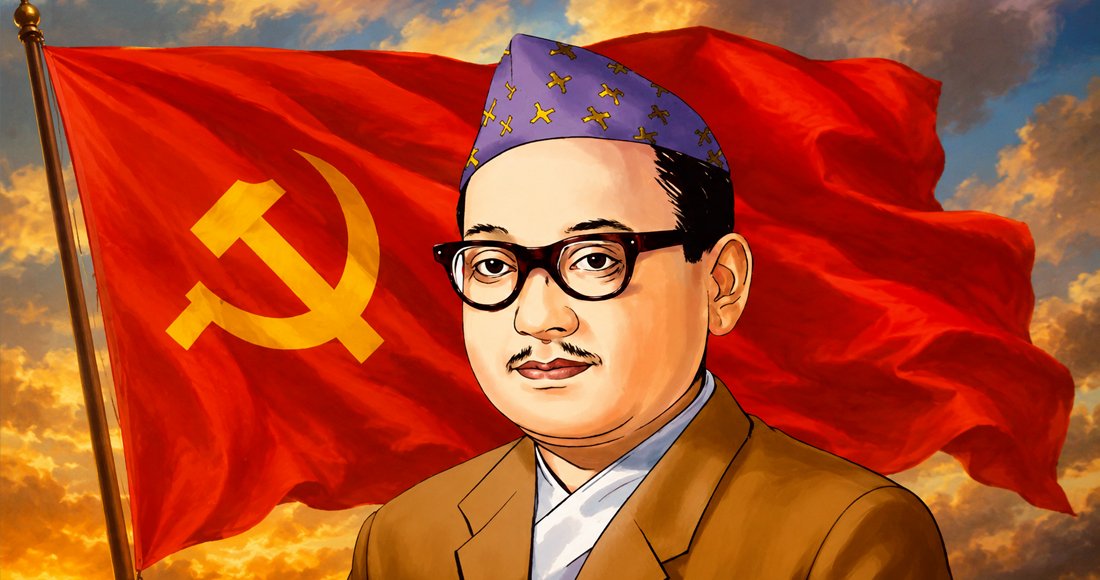
Just a few days ago, we celebrated the birthday of People's Leader Madan Bhandari in various ways. If he were alive today, he would be 75 years old. I first offer my heartfelt tribute to the great thinker, one of the most influential, inspiring, and popular leaders of the leftist movement in Nepal and contemporary politics, People's Leader Madan Bhandari, who embraced the life philosophy 'Theory is for life, life is not for theory'.
Madan Bhandari was not just a political leader. He was also an exemplary figure of the Nepali leftist movement. He played a very important role in orienting the Nepali leftist movement towards a democratic direction. Besides, while preserving the revolutionary, militant, and pro-people character of the leftist movement, he also skillfully fulfilled the historic role of establishing it as a permanent political force based on the people's mandate.
The basis of his popularity was not just his morality, integrity, and revolutionary personality. His dynamism as a leader capable of transforming his ideas and ideals into practice was equally exemplary. Every word of his carried its own weight, credibility, and deep meaning. People did not look for hidden meanings in his statements. There was no distance between his thoughts and his life's actions. He tried to live what he spoke. This is why the people had deep faith, trust, and respect for him.
Under Madan Bhandari's leadership, the Fifth General Convention of the then CPN (UML) passed People's Multiparty Democracy (PMD). PMD has been established as a historic political document in the history of the Nepali communist movement. If any political idea or program has been most debated, discussed, and analyzed in contemporary Nepali politics, not just within the leftist movement but in the entire political sphere, it is People's Multiparty Democracy. Those who speak in its favor have discussed its relevance, and critics have also extensively reviewed it. While the conclusions of the debate may differ, the fact that it has occupied the center of Nepali political discourse for a long time cannot be denied.
However, it would be wrong to limit the discussion or chanting of PMD's importance only to today. Even among the proponents of People's Multiparty Democracy, a tendency to use it as a means to gain or retain power, rather than creatively developing, ideologically refining, protecting, and promoting it, has become strong. It is high time to seriously review this matter. It is getting late to discuss the problem of focusing only on consuming its political capital instead of developing PMD as a living political program.
On the other hand, problems are also seen among its opponents. We can see this from two tendencies. One group fundamentally opposes the leftist movement itself. Another group, claiming to be leftist, tries to appear more revolutionary by declaring PMD as a thoroughly right-wing or capitalist program. In this way, those who attack from different angles have also failed to construct any practical alternative perspective in time. A tendency not to build anything new and not to accept the positive efforts of others is also seen there.
Both these extremist viewpoints cannot reveal the true essence of People's Multiparty Democracy. One side considers it an immutable document like a religious scripture, holding the view that no debate or revision is necessary. The other side completely devalues it and seeks to reject even the positive aspects within it. Both these viewpoints are obstacles to the creative development of PMD.
What we must remember when discussing PMD is that People's Leader Madan Bhandari himself presented People's Multiparty Democracy as a political program for that specific time. It was a political direction formulated based on the then national and international situation and the concrete realities of Nepal. He did not present it as a final, eternal, and immutable theory. Those who interpret PMD as an immutable and eternal theory seem to have missed this point.
Unfortunately, he did not get the opportunity to further interpret, refine, and develop PMD in accordance with the times after his untimely death in the mysterious Dasdhunga jeep accident in June 2050 BS. If he had been alive, how he would have modified it according to the changing national and international circumstances is only a matter of speculation today.
However, the original document he presented makes one thing clear—in the national and international context of that time, People's Multiparty Democracy was a unique political program to connect the Nepali leftist movement with the people, make it popular on a democratic basis, and address the aspirations of the people. He discussed its 14 characteristics and 3 stages of socialist transformation. Serious study, review, and timely development of these issues are now necessary.
Today, when we look at the behavior of the leadership that calls itself proponents of PMD, we are bewildered. In many places, their conduct does not align with the fundamental values of PMD. Furthermore, the expected seriousness in enriching PMD, reinterpreting its relevance for the new era, and preserving and advancing its historical contribution is lacking.
Today's need is not blind support or blind opposition to People's Multiparty Democracy. It is to creatively develop the leftist movement and socialist programs in accordance with the challenges of the changing times, while respecting its historical contribution and embracing its core essence. Only then will it be a true tribute to People's Leader Madan Bhandari. Rising above the ritual of remembering him every year on his birthday, following the positive aspects of his life and thought is the real respect towards him. In this time of great challenge in the communist movement, internalizing the culture of unity between thought and action that Madan Bhandari demonstrated in his own life will be a true tribute to him. And it can serve as a faint light in the darkness of today's crisis.
(The author is a Central Committee member and Dolakha District Coordinator of the Communist Party of Nepal (CPN).)
This specific news has been automatically translated by AI. As a result, there may be some inaccuracies or language errors.