Rastriya Swatantra Party's Potential China Visit and BRI Opportunities
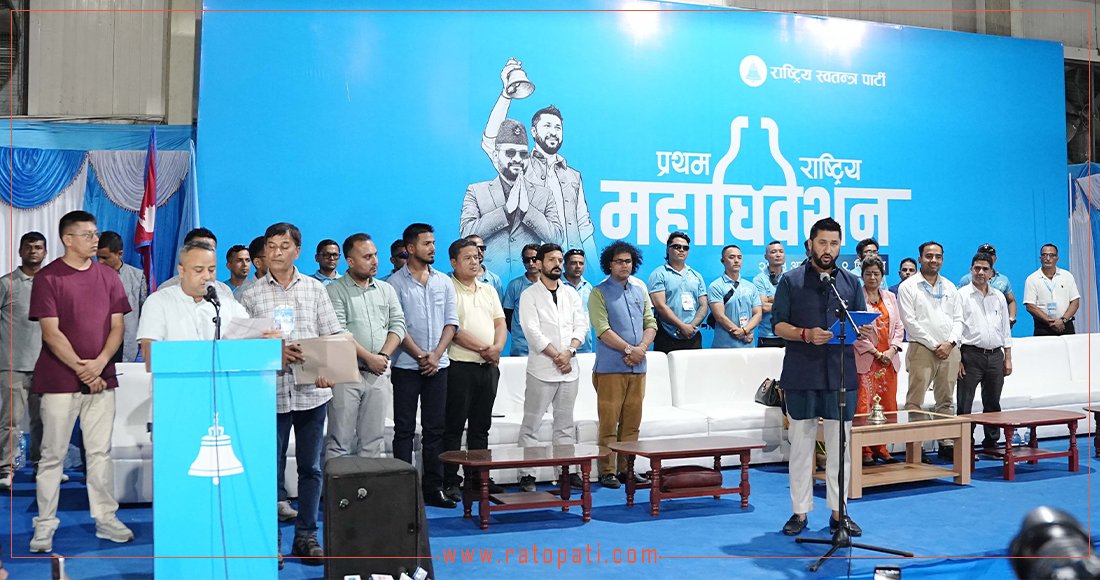
The Rastriya Swatantra Party (RSP) has completed nearly three months since forming a strong government with a two-thirds majority in the elections. During this period, RSP Chairman Rabi Lamichhane has returned after completing his visit to India. The visit is considered an important link in the tradition of maintaining cordial Nepal-India relations.
He was re-elected as the party leader from the convention held in Chitwan. After the convention, his next foreign visit may be to the neighboring friendly nation, China. China is the rising economic center of today's world. China's economic development holds a significant share in the global economy.
By skillfully turning various obstacles into opportunities, China has made great progress in energy, transportation, and information technology over the past seventy years in the field of infrastructure development. China ranks second in the world in energy production. It has also made great strides in the development of railways, waterways, and airways.
The practice of Chinese socialism, ambitious poverty alleviation plans, modern education, transportation, agricultural development, machinery and equipment manufacturing, and space technology development have truly made China an excellent nation. In this context, Rabi Lamichhane's potential visit becomes a noteworthy subject. RSP is a new political force in Nepal. It is imperative that RSP also takes China seriously.
- Infrastructure, Investment, and BRI
It appears that Nepal's political forces have not yet fully grasped the importance of the 'Belt and Road Initiative' or BRI. However, as a modern new political force, RSP must have understood something. In reality, China's BRI is uniting the world as a progressive path of development based on the concept of shared economic development and cooperation.
BRI is also a type of platform and network. It brings together local communities, governments, regional governments, central governments, the Chinese government, Chinese industries and businesses, and other investors under one umbrella. It also creates opportunities for creating equal income through joint planning and investment.
Similarly, China is opening paths of prosperity in Africa, Europe, and Asia. In the past, when Nepali Congress and CPN (UML) were in alliance, Nepal had already decided to join China's BRI infrastructure project.
In 2013, President Xi Jinping proposed BRI as a program for the development of international infrastructure and economic cooperation. The underlying goal of this proposal is to revive the historical legacy of the ancient Silk Road for trade purposes in a modern context.
Under BRI, efforts have been made to connect Asia, Europe, Africa, and other regions through roads, railways, ports, energy, and digital networks. This project, aimed at promoting trade, investment, regional connectivity, and economic development, has become an important medium for infrastructure development and inter-country cooperation in many countries around the world.
Undoubtedly, Nepal should also be able to benefit from this. As a new political force, RSP should recognize this opportunity and move forward confidently on the path of grand infrastructure development in Nepal.
- China and RSP
Immediately after the formation of the RSP-led government in Nepal, the Chinese Communist Party, through a message, expressed happiness over the growing relationship and cooperation with RSP and expressed confidence that the relationship between the two political forces would further strengthen in the coming days. It also reiterated the commitment to further deepen China-Nepal relations and build a 'community with a shared future' for the benefit of both countries and peoples.
The message also expressed China's confidence that RSP would make a significant contribution to elevating the traditional friendly relations between Nepal and China to new heights. On the other hand, RSP has also stated that it will always prioritize relations with neighboring countries while adhering to Nepal's independent foreign policy and the principles of Panchsheel.
With the displacement of old leaders who have been in power for the past few decades, the new government has an opportunity to conduct diplomatic relations from a new perspective. RSP has a public stance on the One-China policy. Therefore, there is no possibility of a major transformative policy change in terms of foreign policy.
Now, RSP's fundamental goal is to expand cooperative relations for Nepal's economic transformation. In its manifesto, it has stated that world-class infrastructure and state-directed goals and programs for socio-economic development will be determined through the mobilization of concessional finance from China. Therefore, the time has come to move forward with the construction of large-scale economic development and infrastructure projects with the help of BRI.
- Potential Infrastructure Development Projects
Nepal's geographical location is unique. While the geography connected to India is relatively easier, the route connecting China and Nepal is a bit difficult. However, to maintain vibrant people-to-people relations between Nepal and China, it is necessary to open all northern border crossings securely. Ten roads connecting the ten border crossings between Nepal and China to the Pushpalal Highway should be opened as international-standard highways.
Infrastructure 'connection' itself expands relations. Deep relations require infrastructure connection. In the coming days, Nepal and China should be connected through all routes including rail, road, tunnel, water, and air. Construction of Kerung-Kathmandu, Kathmandu-Pokhara-Lumbini/Butwal, East-West Electric, and seven-province-related railway lines should not be delayed any further.
Similarly, in the road sector, the Tinkar-Dadeldhura-Dashbanjha-Dhangadhi road, Hilsa-Simkot-Surkhet road, Karmarong-Gamgadhi-Sinja road, Korala-Muktinath-Palpa-Butwal road, Kerung-Rasuwa Gadhi-Chahare-Kathmandu road, Khasha-Kodari-Panchkhal-Dhulikhel road, Lamabagar-Tamakoshi-Bhiman road, Olangchunggola-Fungling-Ilam-Panchthar-Jhapa road, and Kimathanka-Fungling road need to be constructed to international standards.
Furthermore, the Pushpalal (Mid-Hill) Highway, Hulaaki, and Madan Bhandari Highway should be completed and upgraded to six-lane international-standard roads. In the future, priority should be given to constructing straight roads, not uphill-downhill, winding ones. Tunnels or bridges should be constructed where necessary. Modernization in the engineering sector has become indispensable.
It is well known that Nepal's Terai region becomes dry in winter and is inundated with water during the monsoon. To solve the problems of the Terai, which is considered the granary of Nepal, a flood-controlled east-west waterway should be constructed to irrigate the entire Terai. The conservation of the Terai is a very important task for Nepal.
The airports in Dhangadhi, Bhairahawa, Nijgadh, and Bhadrapur should be developed into modern international airports. In all seven provinces of Nepal, seven cities, i.e., 'Chinatowns', should be built as centers reflecting Chinese culture, Chinese products, and Chinese businesses.
Five-star hotels, hospitals, and technical training institutes reflecting Nepal-China friendship should be opened in all provinces. We Nepalis cannot even listen to such grand and magnificent plans; we lack self-confidence. The level of awareness about development is also very low. Certainly, creation begins with dreams. We should not hesitate to dream big. Currently, the public has placed great trust in RSP.
The Chinese government is also eager to assist Nepal. However, in a time when our ministries, planning commission, departments, and employees all seem to be asleep, the question arises: is RSP ready to bear the burden of all these dreams?
- Resource Management
All the aforementioned plans should be integrated and operated under the Prime Minister's Office as the 'Nepal Revival' program. The problem we face is a lack of willpower. If there is strong willpower, budget is a matter of management. If one repays loans honestly on time, it is not difficult to get credit.
The return and timeline of the concerned project should be determined at the time of planning itself. If there is efficient management, there will be no problem with returns. If one can reach Butwal from Kathmandu in one hour, no one will have a problem paying fifteen hundred to two thousand. Constructing services of this standard is now the main responsibility of the RSP government. There will be no problem with income; this is the era of business.
It would be good to formulate plans that will be completed within 5 to 10 years and issue international priority shares with a 10% dividend of continuous profit after 10 years. If an honest plan is made to request 10% from the Government of Nepal, 10% from the people of Nepal, 10% from Nepali business organizations, 10% from the World Bank, 10% from the Asian Development Bank, 10% from the Chinese government, 10% from Chinese businesses, 10% from the Chinese people, and the remaining from other organizations to purchase shares in the BRI model, then work worth trillions of dollars can be done.
This plan can be realized by having just 5 capable investment analysts conduct studies and research. The Chinese government is ready to provide economic and technical assistance through BRI. But the biggest question turns back to ourselves: 'Is Nepal ready for epoch-making change?'
This specific news has been automatically translated by AI. As a result, there may be some inaccuracies or language errors.