Buddha's Teaching on Beginning, Middle, and End Offers Insight into Nepal's Political Cycles
A Pali phrase appears repeatedly in the teachings of Gautama Buddha– “Adi kalyanam, majjhe kalyanam, pariyosana kalyanam” meaning good at the beginning, good in the middle, and good at the end. In Sanskrit, this sentiment echoes as “Adi kalyanam, madhya kalyanam, antya kalyanam.”
At first glance, this phrase might seem like a moral ideal or sermon– pleasant to hear, but detached from reality. In my youth, I too took it as an attractive abstract concept. I didn't think it was a subject that required such deep thought.
As I aged and observed Nepali politics closely for decades, I began to understand this teaching not just as an idealistic sermon, but as practical guidance. Now I understand that it provides a clear and serious perspective for leadership, governance, and our national future.
We often say experience is the greatest teacher. But learning is not gained from experience alone. Only through contemplation, evaluation, and self-reflection on experience does it become learning. Experience is merely raw material. Without contemplation, the wheel of history keeps turning, it does not move forward. Why do the exciting beginnings in Nepal's history end in disastrous conclusions? The answer to this becomes clear only when viewed in the light of Buddha's simple yet profound teaching.
- The Beauty of the Beginning
The first part: ‘Adi kalyanam’ encompasses the emotional power of the start. Every political change in Nepal has begun with a collective feeling of hope, enthusiasm, and possibility.
If we talk about events the author has witnessed in his lifetime, the People's Movement of 2046 BS ended the Panchayat system and restored multi-party democracy under the monarchy. It is still vivid– the streets were festive. The people believed that autocracy had ended, and a new era based on freedom, accountability, and dignity had dawned.
The Comprehensive Peace Accord of 2063 BS ended a decade-long armed conflict. The dream of a “New Nepal” sparked golden hope. The subsequent Constituent Assembly elections saw unprecedented public enthusiasm for inclusivity, justice, and transformation.
In 2065 BS, the monarchy was abolished and Nepal entered a republic– a long chapter of history closed, and another opened. In 2072 BS, a new constitution was promulgated, which many domestic and foreign scholars have evaluated as an excellent progressive and inclusive document.
One can imagine that before this, the end of the Rana regime and the beginning of democracy in 2007 BS must have also sparked similar new dreams. In all these moments, there was the unique beauty of the beginning. In Buddha's words, they were 'Adi kalyan' – exciting, inspiring, and full of potential.
- The Test of the Middle
Buddha's teaching does not end with the beginning. Every morning is beautiful, but the value of the day is determined not just by the sunrise, but by the events throughout the day. Was the intention transformed into action? Did the promise turn into results? Madhyam kalyanam – good in the middle. The real test lies here.
In the middle phase, ideals clash with reality. Here, slogans give way to governance. Institutions must transform. Leadership is judged not by pronouncements, but by tangible results. Nepal's history shows that the initial brightness begins to dim here.
The democratic practice after 2046 BS gradually became entangled in corruption and instability. Public trust weakened. The gap between expectations and reality widened. The aspirations of various classes and castes in society could not be fulfilled. The growing disillusionment among citizens fueled the rise of the armed conflict. Serious damage was inflicted across the country.
After the establishment of the republic and the constitution of 2072 BS, another wave of hope arose. In the crisis following the earthquake and blockade, the people were seeking stability and strong leadership. The rise of K.P. Oli and the dominance of the CPN (UML) seemed to offer that possibility.
However, over time, internal divisions, governance challenges, and political disputes again weakened public trust. The phase of achievement– the middle phase– proved fragile once more. The lesson is clear: the beginning provides enthusiasm, but it is the middle phase that sustains.
- The Rarity of a Beautiful End
The final part: Antya kalyanam – perhaps the rarest thing in the country's history.
A good end is not just about completing a term. It means departing with dignity. It means leaving institutions stronger and earning respect from the innermost hearts of citizens. A farewell that evokes not relief, but respect and gratitude.
Such endings are rarely seen worldwide, and especially in Nepal. The lust for power is subtle, and it requires a detached character to relinquish it easily. Abraham Lincoln famously said, “Nearly all men can stand adversity, but if you want to test a man's character, give him power.”
Nepal's political history shows a familiar pattern– an inspiring beginning, a problematic middle, and a tragic end. This cycle of hope and despair has become almost predictable.
- Another New Beginning
Today, the Nepali people stand at a new juncture of immense enthusiasm. The emergence of new political parties and personalities has excited citizens, especially the youth, to a state of euphoria.
This reflects their inherent desire for honest, capable, and accountable leadership. There is a new sense of possibility in online and direct public discourse. Many believe that change is not only necessary but also possible.
But hope itself is not transformation.
- The Need to Complete the Cycle
Just as Buddha spoke of the beginning, middle, and end, Hinduism has the concept of the Trimurti. The Trimurti are– Brahma, Vishnu, and Shiva. Brahma is the beginning or creator. Vishnu is the preserver, the sustainer of life. Shiva is the destroyer or transformer. Creation, preservation, and dissolution are not separate functions; they are parts of the same complete cycle.
The profound message of this is simple yet challenging. Brahma is not just the beginning, but the god of knowledge. A new beginning should be guided not by a flight of enthusiasm, but by Brahman (knowledge). Only when coordinated with knowledge and wisdom does the start of the journey become robust. Enthusiasm does not fall to Brahma's share; seriousness and maturity do. Enthusiasm belongs to Vishnu.
Vishnu is a skilled player of strategies that sustain life. Without planning, diplomacy, and tactics, the journey of life is not proper and happy. A capable leader is not enough just by appearing to be in a high position. To make the churning of the ocean possible, one must be ready to sit at the bottom of the sea as a Kurma.
And what to say of Shiva? While others scramble for nectar during the churning of the ocean, one must be ready to drink Halahal for the welfare of the world. Stories are not made in vain. Otherwise, how can the end be Shiva? The very thought of the end seems terrifying to us. But religion has made the end Shiva, meaning auspicious and benevolent. Brahma and Vishnu are names, but Shiva is the benevolent and auspicious one.
Nepal does not lack promising beginnings. What is needed is unwavering integrity throughout the middle journey and a dignified, achievement-oriented end.
- The Real Challenge
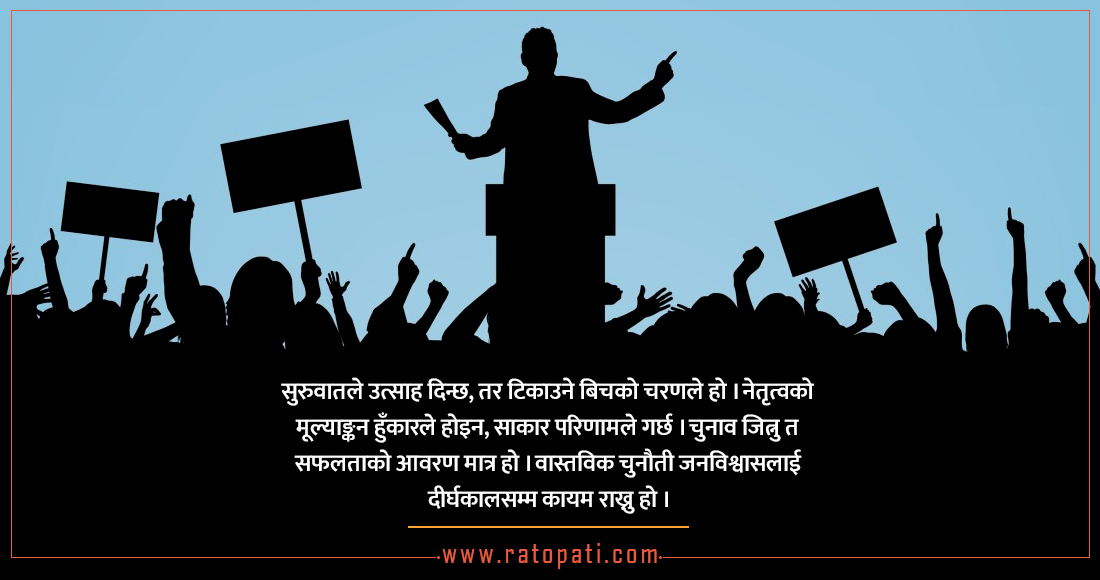
Winning elections is merely a facade of success. The real challenge is to maintain public trust in the long term. Past failures are not just objects of criticism; for those willing to learn, they are living lessons.
But learning requires humility, and humility is often what power resists the most.
If Nepal truly wants to move forward, it must break the cycle of beautiful beginnings, dispiriting middles, and painful endings. Because ultimately, a nation is evaluated not on how brightly its leaders emerged, but on how responsibly they governed and how gracefully they departed.
(The author is a scholar of Eastern philosophy.)
This specific news has been automatically translated by AI. As a result, there may be some inaccuracies or language errors.