Constitution Amendment Should Advance Rights, Not Curtail Them

The government has formed a 'Drafting Committee for Constitution Amendment Debate Paper' as part of its preparations to amend the constitution. We former Attorney Generals visited there after receiving a letter from this committee. We presented our views on the issues of constitutional amendment. The main concern was the rights of the people and democracy. While there is a need for constitutional amendment to clarify certain ambiguities for progressive solutions, we stated that amendments that curtail the achievements of this constitution are not acceptable.
Constitutions worldwide are amended in various ways. The world's first written constitution is American. The US Constitution has also been amended many times. India's constitution has also been amended. A constitution is subject to amendment, but for what purpose should it be amended? Its justification must be clear. The current government should have clarified the purpose and objective for which this constitution is being amended when forming the committee.
Secondly, delving into the constitution, the main issue raised is the form of governance. Amending the form of governance alone is not enough; there are many related contents. The main issue is the electoral system. When the form of governance is changed, the electoral system also changes automatically. In terms of form of governance, we have proposed a directly elected presidential system, which can be either a prime minister or a president.
My personal opinion is for a presidential system. However, a presidential system should not mean leaving the president unchecked. The parliament should review the president's decisions as needed and provide 'checks and balances'. For example, in America, the Senate controls the president. The Chief Justice administers the oath to the president. There is constitutional supremacy. The court is the interpreter of the constitution. Similarly, here, the parliament should check the president's actions.
Constitutional amendment should be for progressive solutions and to add to the rights of the people. Amendments that undermine democracy and curtail achievements just because there is a two-thirds majority are unacceptable.
Even now, the Supreme Court reviews the government's actions based on judicial review. Since the Balen government came into power, there have been several instances. Therefore, a directly elected presidential system should not be about the supremacy of the Head of State, but should be based on the balance of power.
Currently, there is a direct and proportional electoral system. Direct election has two types. One is the direct election of federal or provincial assembly members (MPs). Members of the federal parliament elect the prime minister. Secondly, in local governments, people directly elect the heads of municipalities and sub-municipalities, chairpersons and vice-chairpersons as heads of government. In local levels, we are already practicing something similar to a direct presidential system. Even though the electoral system is direct, at the local level, we directly elect all positions, from ward chairpersons to village/municipal chiefs. In the federal and provincial levels, we only directly elect members. This system needs to change. With a presidential system, the entire country would directly vote for the president. What would be the form of parliament? To whom would the president be accountable? Therefore, federal and provincial assembly members should move towards a fully proportional system. Under fully proportional representation, seats should be determined based on geography and population. Neither population nor geography should be ignored.
For example, in a fully proportional system, four to five candidates can contest for one seat, and the one with the most votes wins. Candidates from the same cluster should be nominated in a constituency. Whoever wins, it will be from that community. This will create a strong national unity by dividing clusters for Dalits, women, backward classes, backward regions, indigenous nationalities, Madhesis, etc. Such a composition strengthens national unity. Therefore, the proposal is to move towards a direct electoral system but fully proportional representation.
The form of governance should be changed to a 'Directly Elected Presidential System'. However, to prevent autocracy, the federal and provincial parliaments should be made fully proportional with provisions for parliamentary checks and balances.
Another argument is that federalism, provinces, and local levels are too expensive. In reality, they are not too expensive. When federalism was introduced, we brought it with the intention of decentralization, but the federal government has not devolved the rights of the provinces and lower levels. In true federalism worldwide, the federal government only handles three areas: foreign affairs, currency, and security. All other powers lie with the lower levels. Here, provinces have been deliberately weakened.
Similarly, the court structure from the Panchayat era still exists. Even multi-party democracy could not break it. Previously, there were four tiers of courts. Then we made it three tiers. The central government or the Supreme Court, the Judicial Council, controls and disciplines judges at all levels. The appointment, service conditions, and facilities of judges are all managed by the center, i.e., the Supreme Court.
Currently, the Supreme Court is burdened with cases. Honestly, even a dispute involving a mere 500 rupees can reach the Supreme Court. Municipal disputes also reach higher levels. This is not right. There is the issue of a constitutional court. Previously, during the constitution-making process, we considered the concept of a constitutional court. However, the Chief Justice of the constitutional court would have been at par with the Chief Justice of the Supreme Court. The question of who is superior, the Chief Justice of the Supreme Court or the Chief Justice of the constitutional court, might arise later, so the constitutional court was not established. Subsequently, a constitutional bench was arranged. Currently, the constitutional bench is in a state of limbo. The bench convenes twice a week. It is very slow and ineffective. Therefore, we propose establishing a constitutional court to interpret the constitution. Provinces should be empowered. Most cases should be settled at the provincial level.
The argument that federalism is expensive is wrong; provinces have been deliberately weakened. In true federalism, the center handles only foreign affairs, currency, and security, and all other powers should be devolved to the lower levels.
Regarding commissions, bodies like the Dalit Commission, Women's Commission, Indigenous Nationalities Commission, and Language Commission should be made executive. This is because the problems identified by these commissions can guide the government. However, they are currently like a hanging mask; they don't speak, they don't do anything, and the government seems to want them that way. Some colleagues suggest abolishing these commissions. My view is that they should not be abolished or reduced. Commissions should be policy-making bodies that provide guidelines to the government through study and research. Rather, they should be made somewhat executive, and their decisions should be prioritized by the government through constitutional provisions.
As for the Judicial Council, parliamentary hearings should not be included. The Chief Justice should not be on the Judicial Council. Including senior judges would lead to power sharing. Currently, there is a controversy in the appointment of the Chief Justice. This needs to be reformed. The judiciary needs restructuring. Family law and minor disputes should be settled at the local court level. Their appeals could go up to the district court. Otherwise, they might go up to the high court. Disputes related to borders, natural resources, international relations, and large projects should be resolved quickly. All these matters should be handled based on 'law and development'. Currently, in Nepal, it is only 'law is law'. It is not linked to development. How can the country develop if law is not linked to development? The judiciary needs restructuring with its unique characteristics.
Another core issue is constitutional amendment. The current government formed a committee for constitutional amendment. What is the utility of that committee? What is its objective? Was the committee formed for genuine constitutional amendment or not? The government calls it a task force to prepare a debate paper; what is it debating? Therefore, this is purely a matter related to a political document. A constitution is not just the 'fundamental law of the land'; it is also a political document that handles all state bodies on a day-to-day basis. Therefore, even with a two-thirds majority, the sovereignty and integrity of the country cannot be amended.
The judicial structure from the Panchayat era could not be broken by multi-party democracy or the republic. The Chief Justice should not be on the Judicial Council, parliamentary hearings should be abolished, and a powerful 'Constitutional Court' should be established instead of the ineffective constitutional bench.
Constitutional amendments should be made to establish the rights of the people, but amendments that cause people to lose or curtail their already acquired rights and push them backward are unacceptable. A constitution that allows for the re-establishment of feudalism, any form of monopoly, or autocratic rule will not be formed in Nepal now, nor should it be. It is time for the government to clarify that no action can be taken that adversely affects our political journey, democratic journey, and the people's constitution so far.
Constitutional amendment is something that will happen at every step over time. Any constitution in the world has provisions for amendment. In a country without a written constitution like Britain, the values that establish the rights of the people are its constitution. The rule of law, constitutional supremacy, and independent judiciary are the basic tenets of democracy.
Constitutional amendment alone is not enough. The direction can be east, west, north, or south. Therefore, the objectives determine the direction. That is not clear even in the 100-point agenda. Democracy will be established in accordance with Nepal's diversity, its variations, its characteristics, and its unique identity. My belief is that constitutional amendment can be achieved through discussions among all political parties and through their positive thinking, ensuring the establishment of rights for the Nepali people.
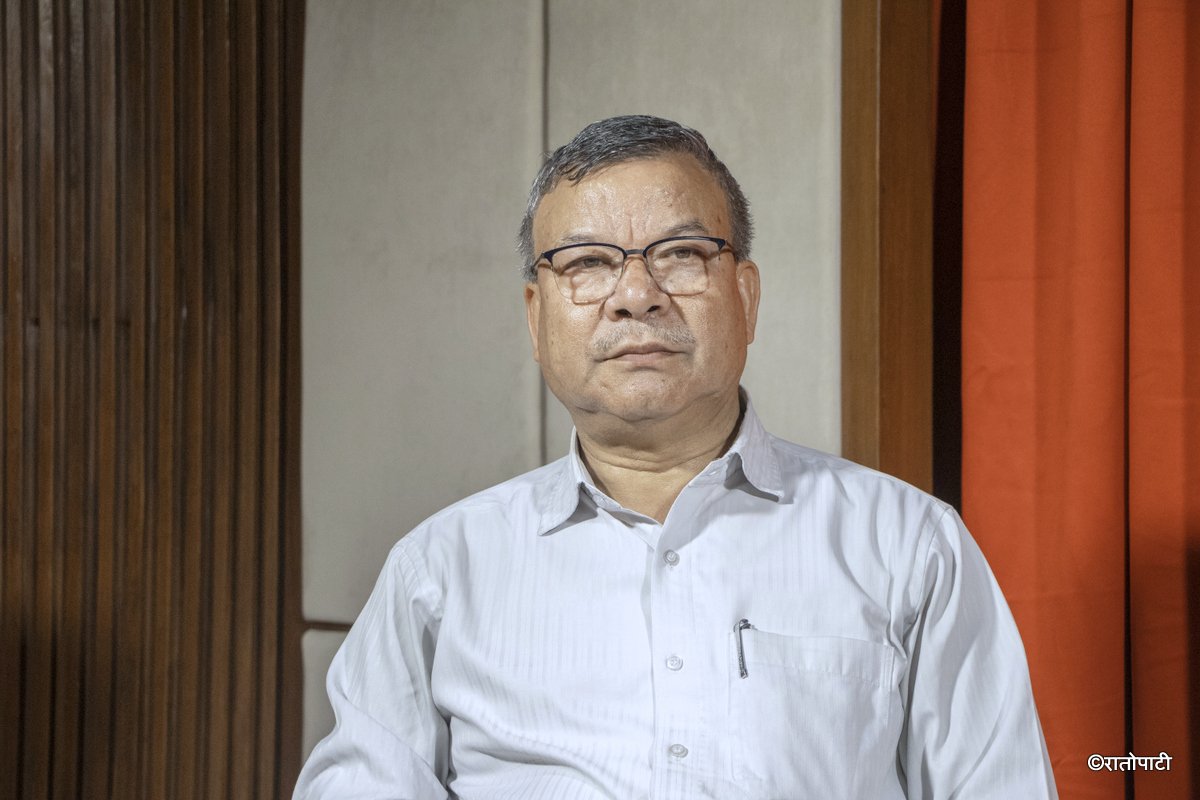
(Based on an interview conducted by RatoPati correspondent Ganesh Pandey with former Attorney General and senior advocate Mukti Narayan Pradhan.)
This specific news has been automatically translated by AI. As a result, there may be some inaccuracies or language errors.