Nepal's Foreign Employment Sector Faces Policy and Practical Challenges

Kathmandu. The foreign employment sector is the backbone of Nepal's economy and it is also the state's responsibility to manage it. However, this sector is going through various policy and practical challenges.
Effective implementation of laws and regulations made to make foreign employment safe, organized and dignified is necessary. Policy reform according to the changing global environment is also a need of the hour. The government is making efforts to remove anomalies in this sector and ensure the rights and interests of workers within the framework of the Foreign Employment Act.
Any act or law, although complete in itself, is largely determined by the intention of its implementation. Sometimes, laws brought with different objectives create problems when they are understood or interpreted differently during implementation.
- Policy Reform Preparation
The main objective of the Foreign Employment Act and Regulations is to ensure the safety of workers and transparent regulation of businesses. Although the extent of reforms in the past has not been precisely measured, the current priority is the honest implementation of the prevailing Foreign Employment Act, Regulations, and the standards set by the government.
In a state of law, compliance with the law is mandatory. If there is any weakness in the law, it can be amended or reviewed. But as long as the law remains, it is everyone's responsibility to implement it.
Free Visa Free Ticket Policy and its Practical Aspect: The government has adopted the policy of free visa free ticket for 7 Gulf countries since 2072 BS. Although this policy is in the interest of the workers, the entrepreneurs have been continuously expressing dissatisfaction regarding its implementation.
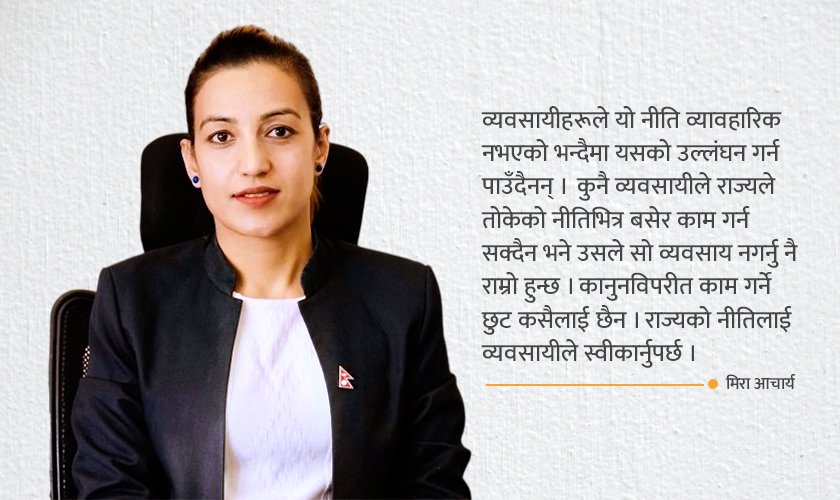
However, entrepreneurs cannot violate this policy just because they find it impractical. The argument of entrepreneurs is that it is not possible to send workers at zero cost. But if any entrepreneur cannot work within the policy set by the state, it is better for him not to do that business. No one has the right to act against the law.
Entrepreneurs must accept the state's policy. Working in an area not permitted by law is illegal and criminal activity. Recently, the ministry has also formed a committee to review this policy.
The committee is working to make necessary reforms in the policy by analyzing international practices and current costs. However, as this policy is currently in effect, the department has been moving forward with monitoring and action processes to ensure its strict compliance.
- New Destinations and Demand Verification
Regarding the problem of new destinations and demand verification, in addition to the old destinations for foreign employment (Gulf and Malaysia), new and attractive destinations like Europe and Turkey have also been added.
However, there are still some difficulties in sending workers to these countries institutionally (through manpower). The main problem appears to be the lack of a body for demand verification. Due to the absence of Nepali embassies in many European countries or the lack of a clear procedure for demand verification, workers are forced to go with personal labor approval.
This increases their risk of being cheated. The department is making policy initiatives to bring these new destinations under the institutional framework and to facilitate the demand verification process.
Responsibility and Accountability of Licensed Institutions: The Foreign Employment Act defines manpower companies not only as a medium for sending workers but also as an entity responsible for their well-being as long as the workers are abroad.
The Act provides that it is the legal responsibility of manpower companies to keep regular records of the workers' conditions abroad, their health, and whether they are receiving the services and facilities specified.
Based on the directive received from the Office of the Prime Minister and Council of Ministers, the department has prepared an action plan for entrepreneurs. Now, each manpower company will have to submit a report to the department every three months about the condition of the workers they have sent.
This is expected to prevent workers from being stranded abroad and facilitate immediate rescue in case of problems.
- Digitalization Service Delivery
The work of making the Department of Foreign Employment technology-friendly has been given top priority and accelerated. The department has made many improvements to the previous Foreign Employment Information Management System.
Now, workers are no longer forced to visit the office for re-issuance of labor permits. They can obtain labor permits by filling out their details online from anywhere in the world. Since the department is connected with the data of the National Identity Card and Passport Department, workers are spared the hassle of uploading many documents.
Similarly, previously, if a worker forgot the password for their online profile, they had to come to the office, but now it has been made possible for the worker to reset it themselves.
Modernization of Case and Investigation System: There are thousands of fraud and complaint cases in the department.
Managing files from 2057 BS physically caused many problems for the employees. Keeping this in mind, the department is developing a case and investigation software. This software, which will be fully implemented from the upcoming August, will provide some benefits.
Service recipients will be able to see the status of their case online and when their turn will come. It will maintain a digital record of how many complaints are against which manpower company, how quickly who has resolved cases, and which companies are engaging in misconduct. This will help distinguish between good and bad entrepreneurs.
The risk of losing case files or tampering with details will be reduced.
Employee Management and Workload: Currently, about 110 employees are working in the department. This limited manpower has to handle the work related to foreign employment of about 9 million Nepali citizens.
5 to 6 million workers are abroad, and millions more are preparing to go. Digitalization has been emphasized precisely because managing such a large number is not possible with the traditional file system.
Although the anomalies in the foreign employment sector may not be eradicated overnight, the reformative steps taken by the government have shown positive signs. Through the effective implementation of policies like Free Visa Free Ticket, action plans to make manpower companies responsible, and the high use of technology, the department is trying to make this sector dignified.
Foreign employment entrepreneurs are not just a means of earning profit but also responsible bodies providing services to citizens on behalf of the state. Therefore, entrepreneurs must maintain professional integrity and comply with the prevailing laws and regulations.
Acharya is the Director General of the Department of Foreign Employment.
This specific news has been automatically translated by AI. As a result, there may be some inaccuracies or language errors.