Exam Paper Leakage: Challenges and Solutions in Maintaining Confidentiality

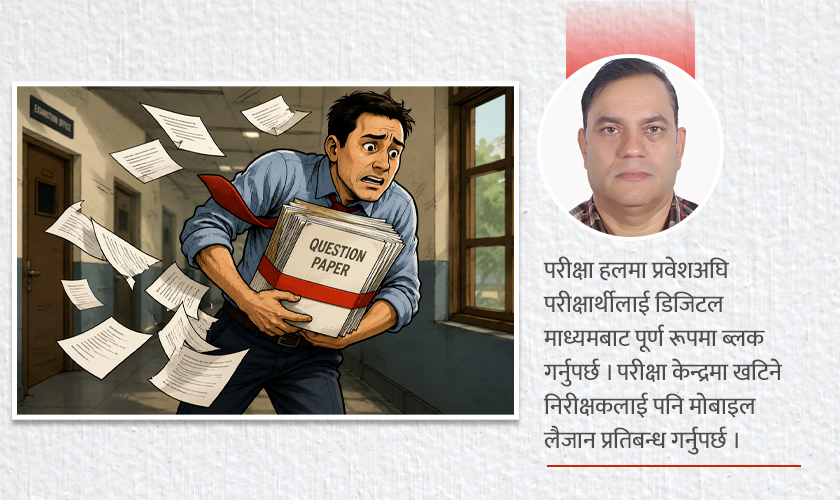
Maintaining the confidentiality of question papers during any examination is crucial. Question paper leaks are an unbecoming issue. However, such incidents are coming to light from time to time.
The process of creating question papers is long and secure. The Examination Control Office has a highly confidential section. Most universities have a highly confidential section and a confidential section.
The highly confidential section is where the work of creating question papers takes place. A roster of subject matter experts is prepared. Individuals with long experience and degrees in the relevant subject are selected as experts. From that roster, subject matter experts are called to the highly confidential section to prepare questions.
After the questions are prepared, they are put into envelopes and sealed. Experts provide the question papers to our office. The board verifies whether the question papers are correct or incorrect, whether they are repeated, and whether they align with the curriculum. Then, the envelope of the question paper is opened. Experts in the relevant subject prepare three to five sets of question papers for a subject.
The authority to open the seals of the question papers received for the subject lies with the chairperson of the subject committee and one member who accompanies them, who moderate, scrutinize, or review them. From the five sets available in the highly confidential section of the Examination Control Office, one set is randomly selected. A set of question papers is drawn. The printing of question papers takes place in the highly confidential section itself. Unnecessary people are not allowed entry into that section. Even office employees are not allowed to go there unnecessarily. Carrying mobile phones is prohibited in that section.
After printing the question papers, they are sealed in the confidential section and sent to the examination center. From a security perspective, the question papers are sent to the nearest police station. The question papers are transported to the examination center in the presence of the center chief and the police chief. Then, in the presence of the police chief or their designated representative, the center chief, and the assistant center chief, the seals are broken and the question papers are opened.
In recent times, after the question papers are distributed to the center, it appears that the guards deployed at the center have sent them via WhatsApp using their mobile phones secretly and deceitfully, in coordination with supervisors and students. The investigation committee will reveal that.
The question papers are opened only half an hour before the examination begins. However, these questions reach the invigilator in the examination hall only five minutes before and students receive the question papers only after the examination time or bell rings. This leaves no room to question the confidentiality of the questions up to this point.
From the creation to the distribution of question papers, the work is done in a very confidential manner. Leakage of questions and undesirable activities can only occur after the question papers are opened. To prevent this, mobile phones and digital devices like cameras should be prohibited from being carried by students, invigilators, examination section staff, or the examination conducting committee into the examination hall.
In recent times, after the question papers are distributed to the center, it appears that the guards deployed at the center have sent them via WhatsApp using their mobile phones secretly and deceitfully, in coordination with supervisors and students. The investigation committee will reveal that. Therefore, students must be completely blocked from digital means before entering the examination hall. Invigilators deployed at the examination center should also be prohibited from carrying mobile phones, which can prevent such potential incidents.
Examinations are being conducted online in universities around the world. In those universities, multiple-choice questions are asked. There is a practice of arranging CCTV cameras at the examination center. The sets of question papers are also largely different. This reduces the possibility of question paper leaks.
The process of creating question papers in universities and higher education is carried out through a highly academic, scientific, and disciplined procedure. When preparing question papers, the curriculum and its credit hours are given special attention first.
If a unit has many credit hours, it means it has been taught with more time and importance, so the question paper should also include long and important questions accordingly. Asking questions worth many marks from a section with few credit hours and few marks from a section with many credit hours is contrary to the spirit of the curriculum. The question paper should be a multidimensional representation of the student's knowledge, skills, and practical abilities. For this, all questions should not be of the same type but should be such that they demand analysis, discussion, and critical thinking.
To prevent questions asked in previous years from being repeated verbatim, the expert preparing the questions considers many factors and prepares 3 to 4 sets of questions. These sets, prepared by mixing from a question bank containing old questions, are finalized by another expert or group through moderation.
Such incidents also occur by evading the eyes of the invigilator or center chief, or sometimes due to undesirable collusion between lower-level staff, teachers, and students.
The moderating team has the authority to modify or change up to 30 to 40 percent of the questions. Since questions are changed in many stages and question sets are selected randomly from the question bank, even the experts or committees preparing the questions do not know in advance which questions will appear in the examination.
Strict time limits are enforced to maintain the sanctity of the examination and prevent question paper leakage. Examinees arriving half an hour after the start of the examination are not allowed to enter the examination hall under any circumstances, so that there is no possibility of them entering after looking at the question paper outside or making chits. Students who have entered the examination hall are also not allowed to go to the toilet or submit their answer sheets and leave within the first hour. This prevents undesirable activities such as leaving, preparing answers outside, and re-entering.
Scientific and international standards like these are adopted to try and maintain the impartiality and sanctity of the examination. Despite adopting so many security measures, challenges of question paper leakage and irregularities in examinations have increased due to the misuse of modern technology.
Currently, due to the accessibility of mobile phones, cameras, and digital technology, undesirable activities such as taking photos of question papers from inside the examination hall and immediately sending them out, searching for answers via email, WhatsApp, or online, and using AI to get answers in 5 minutes and resending them into the hall are occurring.
Such incidents also occur by evading the eyes of the invigilator or center chief, or sometimes due to undesirable collusion between lower-level staff, teachers, and students. To completely prevent this, strict security arrangements similar to the 'metal-free' checking done before international flights should be implemented.
The District Administration Office, Police Administration, and the Examination Center must jointly take responsibility to ensure that students do not have mobile phones, cameras, pieces of paper, or any digital devices before entering the examination hall. Furthermore, only by keeping invigilators and supervisors under strict discipline and rules can such serious errors be completely prevented.
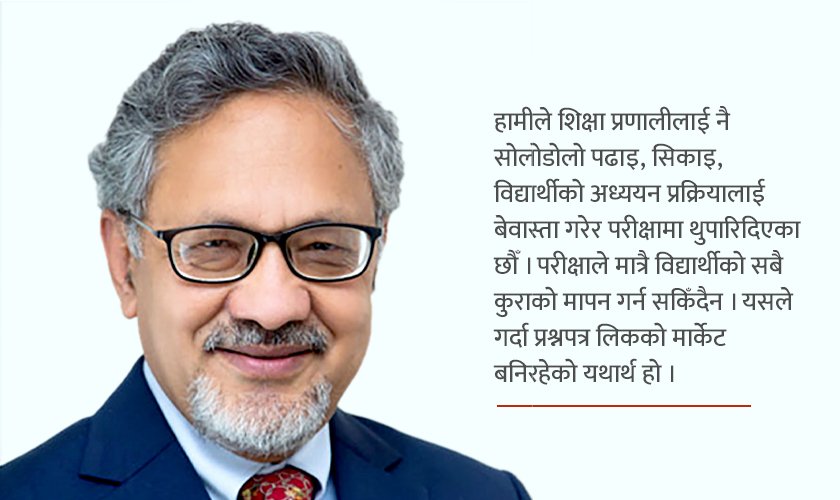
(Based on an interview with Dr. Kabiraj Poudyal, Joint Examination Controller at Tribhuvan University Examination Control Office.)
This specific news has been automatically translated by AI. As a result, there may be some inaccuracies or language errors.