Rastriya Swatantra Party Unveils 'Salo Path' Philosophy for Nepal's Transformation

Introduction and Historical Political Background
The general election of 2079 BS (2022 AD) in Nepal's modern political history is not just a regular periodic election but is considered a significant starting point for a deep psychological transformation of Nepali society. In this election, the Rastriya Swatantra Party (RSP), seeking an alternative to traditional political forces, emerged in the federal parliament with 21 seats.
This mandate was not merely a fleeting attraction to a new party but a manifestation of deep public disillusionment with decades of misgovernance, policy corruption, impunity, and political instability. However, instead of internalizing this serious message from the public mandate, the then coalition government adopted a malicious strategy of political revenge against the chairman of the RSP, Rabi Lamichhane.
This act of revenge, carried out through the abuse of state power, further accelerated the chain of ideological and moral decline of traditional parties, causing public frustration to move beyond mere dissatisfaction towards a direction of organized ballot rebellion. The entry of alternative politics at the local level was a clear public wave against the old parties, giving a glimpse of the door of transformation being knocked from the grassroots and lower levels.
Thus, the series of events in 2082 and 2083 BS in Nepal's political, social, and economic history were not just ordinary technical exercises of government change or power transfer. Rather, they were stark and clear declarations of the structural, ideological, and generational transformation of Nepali society. In this report, I present a detailed, in-depth, and nuanced analysis of the philosophical basis of social democracy ('Salo Path') advocated by the RSP, the overall restructuring of the state it envisions, economic policies based on indigenous social practices, and democratic practices in the digital age of the twenty-first century.
The 'Gen-Z' Rebellion of 2025: Digital Rights and the Fall of State Power
Structural transformation of any society often begins with the extreme conflict between an illiberal state apparatus and the boundless aspirations of the emerging generation. In September 2025, a similar historical situation arose in Nepal. The then government, under the guise of 'regulation', took an extremely restrictive and illiberal step of simultaneously banning 26 social media platforms. For the youth generation that grew up in the digital age of the twenty-first century, this was not just a technical ban but a direct assault on their fundamental human rights, freedom of expression, right to information, and digital rights. An unprecedented 'Gen-Z' rebellion erupted across the country against this move.
Behind this popular rebellion, the ban on social media was merely a spark. Underlying it was the deep-seated economic inequality, institutional corruption, impunity, and public outrage against the state apparatus that had taken root in Nepali society for years, leading to an unprecedented explosion. This historic digital movement forced both the state and society to pay a very heavy price. During the movement, 76 unarmed citizens lost their lives and more than two thousand citizens were seriously injured in defense of digital rights and freedom of expression. Furthermore, the country's economy suffered an unimaginable and irreparable economic loss of approximately 586 million US dollars.
Extreme public dissatisfaction, the heat of street protests, and the loss of state control made the downfall of the then government inevitable. Unable to withstand the heat of the popular rebellion, on September 13, 2025, then-President Ram Chandra Paudel dissolved the parliament of the then Prime Minister and announced new general elections, forming an interim government. In this challenging situation and institutional vacuum, the RSP, breaking the complete loss of trust in traditional political parties, emerged on the national stage by building a strong, decisive, and reliable alternative force.
The Historic Rise of RSP and Election Results
In a situation where the bridge of trust between the state and citizens had completely broken, the RSP completely replaced traditional campaign methods like pamphlets, flyers, and wall writings. Instead, the party conducted a concentrated and planned 'digital campaign', which successfully connected the youth, 'Gen-Z', and tech-savvy voters directly with the leadership.
Further energizing this campaign, the then popular Mayor of Kathmandu Metropolitan City, Balendra Shah (Balen), formally joined the RSP on December 28, 2025. To materialize public expectations, he resigned from his mayoral post on January 18, 2026, and dedicated himself to the leading role of the general election. The root of this was to build internal strength, provide a political exit for the country, and work towards building the country as expected by the general public.
The results of the general election held on March 5, 2026, completely shattered the arithmetic and power balance of traditional Nepali politics, creating a new history. In this election, the RSP secured a massive and historic two-thirds majority with 182 seats in the 275-member House of Representatives. This was an unparalleled public mandate in Nepali democratic history, marginalizing the existence of old parties.
Consequently, on March 27, 2026, 36-year-old Balendra Shah took the oath of office as the youngest Prime Minister in Nepal's history, turning the long-standing debate about generational change into reality. However, technically taking over power through elections and operating a long-ailing state apparatus with a new ideological roadmap are entirely different and complex matters. The new leadership deeply realized that mathematical strength of a two-thirds majority alone does not bring about societal transformation; a clear and era-appropriate philosophical basis to guide the entire state, economy, and society is essential.
Chitwan General Convention and the Philosophical Departure of 'Salo Path'
Since its inception, the RSP has been continuously criticized by the intellectual class and opposition parties for 'lacking ideological clarity'. Initially, the party debated 'Constitutional Socialism' as its guiding principle. However, with the historical responsibility of state governance on its shoulders, the RSP held its first historic national convention in Chitwan from June 21 to 26, 2083 BS (2083 BS), grandly resolving this ideological ambiguity.
In the closed session of this convention, the 'Political Report' presented by party chairman Rabi Lamichhane and the 'Economic-Political Proposal' presented by Vice-Chairman and Finance Minister Dr. Swarnim Wagle completely replaced the old guise of 'Constitutional Socialism' and laid a new ideological foundation. As per the demands of time and circumstances, based on factual conclusions, the party officially and fundamentally approved 'Social Democracy', i.e., 'Salo Path', as its political-economic philosophy.
The Rise of Salo Path
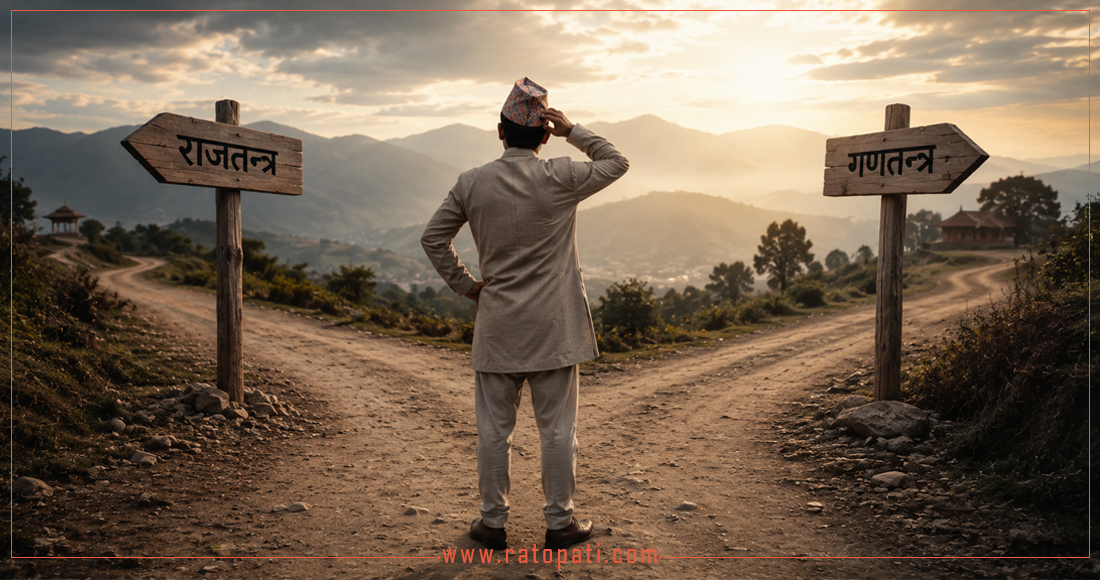
The main reason behind the rise of Salo Path is the extreme failure of the traditional left-right polarization in Nepal. Traditional communist ideology only led society towards the dogmatic debates of proletarian dictatorship, state-controlled economy, and armed class struggle, which severely stifled democratic freedom and innovation, allowing the practice of middlemen to dominate society. On the other hand, to transform the communist movement in Nepal, leader Madan Bhandari, through 'People's Multiparty Democracy' (JBM), proposed 14 characteristics and advocated for peaceful transition, but in reality, it became a mere copy of the British 'Westminster' model. JBM, under the guise of communism, institutionalized the distortions of the capitalist parliamentary system, especially the buying and selling of MPs and unstable governments.
When this political ideology deviated and entered the practice of neo-capitalism, JBM's stance drifted towards neoliberalism, offering no guidance. As a result, JBM remained limited to speeches. Similarly, the Maoist path, which emerged from a decade of armed people's war, transformed through the parliamentary front into a majority government, which then turned into neoliberalism. With the method of a single leader being unanimously accepted throughout their life, neither socialism nor the Prachanda Path remained. Leftist ideas and principles remained on paper, and leaders gave socialism as a gift to the cadres while they themselves moved towards neoliberalism. As leftist leaders became deeply immersed in chronic capitalism and neoliberalism while practicing parliamentary politics, the state's delivery system began to falter, eroding public trust and leading to a change in votes due to public disillusionment.
Similarly, the so-called democratic party in the other pole, driven by extreme capitalism and neoliberalism, considered the market omnipotent and self-regulating, thereby shrinking the welfare role of the state. This led to extreme economic inequality in society and the exploitation of marginalized classes. To be free from the ideological rigidity and practical failures of extremism in both these views, Salo Path has emerged as a progressive, balanced, and era-appropriate best guide.
Chairman Lamichhane's profound metaphor used in his political report,
This specific news has been automatically translated by AI. As a result, there may be some inaccuracies or language errors.