Congress Debates Republic vs. Monarchy
A group within the Nepali Congress seeking to re-establish constitutional monarchy as its political foundation has become active recently. This can naturally be part of the debate that occurs within a democratic party. Ideas emerge, debates happen, disagreements arise, and sometimes old questions resurface in new contexts within any living party.
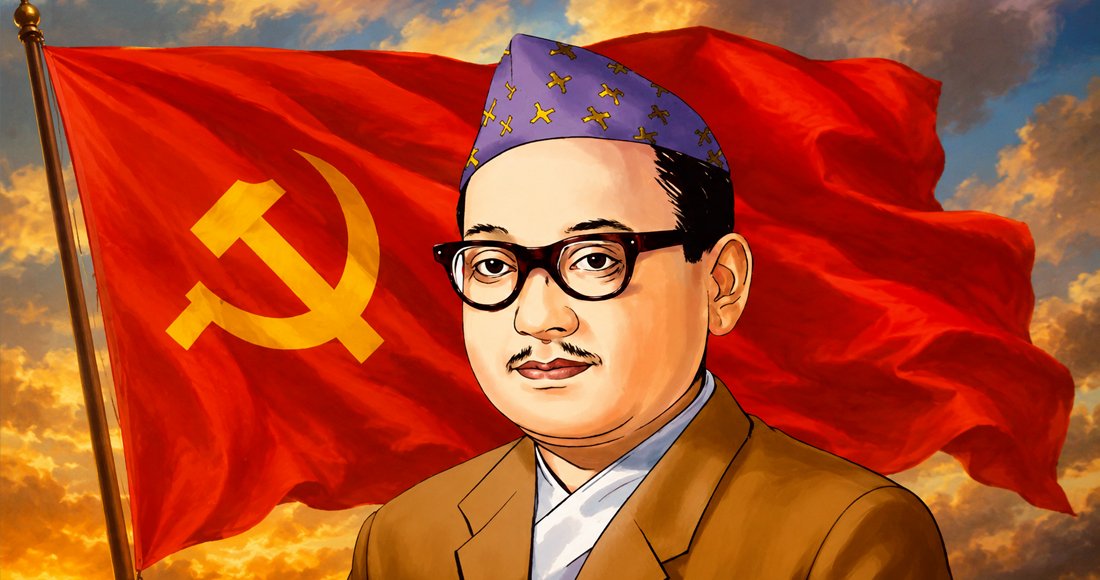
However, the issue becomes serious when history begins to be rewritten according to current political agendas, when BP Koirala is sought to be made evidence for one's present political conclusions, when transitional historical ideas are presented as permanent ideological scriptures, then the problem starts to become more complex.
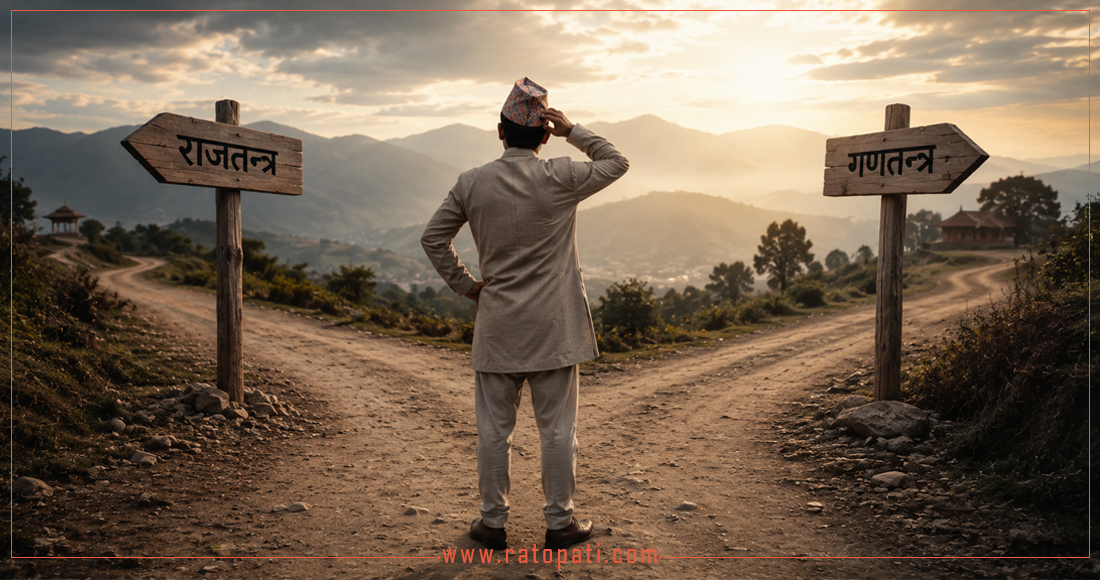
The fascination with constitutional monarchy seen in a section of the Nepali Congress today must be understood in this context. This is not just a debate about monarchy or republic. This is a question of the Congress's self-identity.
This is a question – Where did the Nepali Congress come from? Which path has it taken in Nepal's political history? And, towards which direction is it trying to turn today?
This question is even more important for the Congress. Because the Nepali Congress did not accept the republic due to any external pressure, momentary popularity, or political bargaining. The Nepali Congress arrived at the republic as an inevitable conclusion of Nepal's long-term political struggle, people's movements, democratic consciousness, and history.
Because, the republic is the fundamental voice of the Nepali people and the Nepali Congress. Accepting it was not a surrender for the Congress. Rather, it was the Congress's historical commitment to the sovereign will of the Nepali people. Let's not make BP a proof for today's agenda. Today, proponents of constitutional monarchy are quoting BP Koirala.
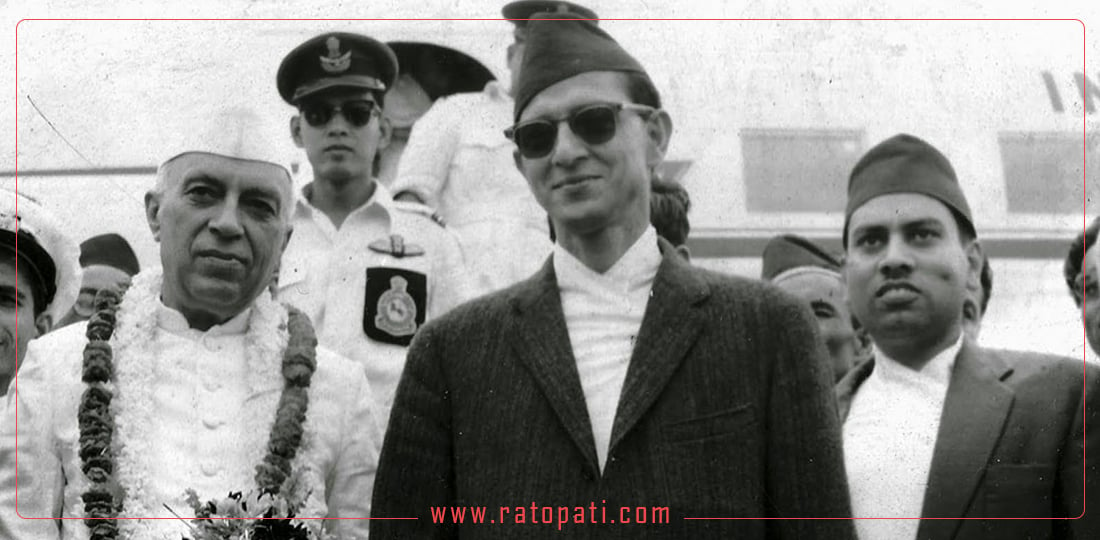
BP cooperated with the monarchy, dialogued with the king, expressed thoughts on the political utility of the monarchy, all these are historical facts. However, history cannot be confined to a single sentence.
BP Koirala was not a person of rigid ideas and thinking. He understood history as a dynamic process. He viewed political principles in conjunction with a living society. Who else would have understood better than him that strategy and institutional thinking need to change with a concrete analysis of changes in the situation?
Those who are trying to give legitimacy to today's agenda for monarchy by quoting BP are forgetting BP's greatest characteristic – his political dynamism.
Confining BP's political philosophy to the preservation of the monarchy is diminishing his vast personality.
BP was not a worshipper of constitutional structures. He was a proponent of democracy. His concern was much greater than whether the head of state wore a crown or not. His fundamental question was – Where is the freedom of the people? Where is the dignity of the citizen? Is the state accountable to the people or not? Is there economic and social justice in society or not?
Confining BP's political philosophy to the preservation of the monarchy is diminishing his vast personality. It is easy to make historical figures into posters for one's current political agenda. But, an honest study of history is difficult. Quoting BP is easy, understanding him is difficult.
The monarchy was not BP's final destination. BP cooperated with the monarchy. However, concluding that 'BP considered the monarchy as the ultimate ideal of democracy' is an injustice to history, it is a lie.
BP's relationship with the monarchy was a complex chapter of political struggle. That relationship involved strategy, compulsion, situational understanding, and its own kind of political experimentation. However, BP's entire political life cannot be confined to that single relationship.
The relationship between the monarchy and democracy in Nepal is itself a big question of history. Democracy arrived after 2007 BS, but the monarchy did not fully accept democracy. In 2017 BS, the elected government was overthrown. Parliament was dissolved. Political parties were banned. Democratic rights were snatched away. After that, the Nepali Congress struggled for democracy for decades.
BP certainly had dialogue with the monarchy, but he had a deep struggle with the autocracy imposed by the monarchy.
If Nepal's monarchy was the protector of democracy, why would the Nepali Congress have spent so much of its life struggling against the autocracy imposed by the monarchy? One cannot escape the 'yaksha question' of history, friends! And, it is not permissible to distort the history of the Nepali Congress itself.
BP certainly had dialogue with the monarchy, but he had a deep struggle with the autocracy imposed by the monarchy. If one is to understand BP, both these aspects must be understood together. Holding onto one aspect while hiding the other is not respecting BP, it is utilitarianism.
- Why did the Congress come to the republic?
The Nepali Congress's journey to the republic was not an accidental turn. Nepal's monarchy could not transform itself democratically. The monarchy ultimately could not place the sovereign rights of the people above its own existence.
After the 2062/63 people's movement, Nepal reached a decisive turning point. The Nepali people did not just agitate to remove the king. They raised the question of state ownership.
Whose is the state? The people's or a dynasty's? Does power come from the people or from birth? Is the sovereignty of the nation vested in the citizen or in some family? The republic gave clear answers to these questions. The meaning of Nepal's republic was not just to replace the king with a president. Its fundamental meaning was – power is not hereditary and sovereignty is vested in the citizen, not in any individual.
The republic means – Nepal is not the private property of any family. All citizens of the state are equal. No individual is the natural owner of the nation by birth. The Nepali Congress accepted this historical change.
This acceptance is not a weakness of the Nepali Congress. It is the democratic maturity of the Nepali Congress. The republic is the basis of Nepali unity.
The republic has for the first time given the possibility of restructuring the Nepali state on the principle that all citizens are one.
Proponents of the monarchy often make the same argument – the monarchy is a symbol of national unity. However, this argument attempts to establish the legacy and importance of a single family by distorting Nepal's real social psychology and history in an extremely simplified manner.
Nepal was never a country built from a single ethnicity, language, culture, or nation. Nepal is a country of unity in diversity. It is a country that embodies the coexistence of the mountains, hills, and plains. Nepal is a shared geography of multiple languages, ethnicities, religions, cultures, and memories. If there is any force that keeps Nepal united, it is not in a single dynasty, but in shared coexistence and self-respect.
The republic has for the first time given the possibility of restructuring the Nepali state on the principle that all citizens are one. The republic says – the citizen, not any dynasty, is at the center of the state. Citizens of the Madhesh have the same rights as citizens of Kathmandu. Dalit citizens have the same dignity as upper-caste citizens. Indigenous peoples, women, marginalized communities, minorities are all equal owners of the state.
For this very reason, the republic can become the basis of Nepali unity. The unity of the monarchy was often imposed from above. The unity of the republic is a unity built from below. The monarchy says – 'I am the nation.' The republic says – 'The people are the nation.' The difference between these two sentences is the difference in Nepal's modern political history.
Therefore, the Congress should not forget its roots. The greatest strength of the Nepali Congress is its history. However, history is transformed into strength only when it is implemented honestly. If history is used according to one's current convenience, it becomes a burden, not strength.
The Congress must also remember that the people did not elect it merely to honor history.
The Congress must be able to see the struggle it waged for democracy in its history. It must see the struggle against the Rana regime, the autocratic Panchayat system, and the direct rule of the king. It must see the journey towards inclusivity, federalism, and the republic. Only then can it realize the importance of the republic.
The Congress must also remember that the people did not elect it merely to honor history. The people elected it to build the future. The re-emergence of the idea of constitutional monarchy within the Congress is not just an alternative political proposal. If it is sought to be established as the party's core ideological foundation, it will uproot the Congress from its historical roots and make it an irrelevant and weak force.
Political parties survive on ideas. But, ideas do not mean going backward. Ideas are the ability to dialogue with time. The question for the Congress is not whether BP dialogued with the monarchy at some point. The question is, in today's Nepal, is the fundamental element of the people's sovereign will the republic or the monarchy? The answer is clear – the republic.
The republic has weaknesses, but their solution lies not in a monarchical system, but in the refinement of the republic. The solution to bad democracy is improved democracy. The solution to corrupt republic is a responsible republic. The solution to incompetent leadership is capable leadership, not the monarchy as an alternative to the republic.
The Congress should not spend its energy on the return of the monarchy. It must connect the republic with the lives of the people.
Today, the Nepali people are dissatisfied. There is disillusionment with political parties. There is distrust towards the state. However, it is wrong to interpret the people's dissatisfaction as a mandate for the monarchy. The people want to reform political parties. They want to make the state accountable. They want to strengthen democracy. To push the people's disillusionment back into the mire of a monarchical system is an insult to the people's mandate, feelings, and spirit.
The future of the Congress lies not in walking backward, but in moving forward. Therefore, the Nepali Congress must ask itself today – does it want to confine its future to a backward-looking debate, or does it want to engage in building a forward-looking horizon?
The republic has been established in Nepal. However, the institutional culture of the republic is still under construction. The social base of democracy is still weak. There is economic inequality. The distribution of resources is unequal. Federalism is incomplete. The question of citizens' rights is alive. Inequality between the Madhesh, hills, and mountains has not yet ended.
These are the real questions for the Congress. The Congress should not spend its energy on the return of the monarchy. It must connect the republic with the lives of the people. It must take the republic to schools. It must take the republic to the villages. It must take the republic to the farmers' fields. It must take the republic into the lives of the workers.
The Congress needs to return to its roots, but those roots are not in the monarchy. The Congress's roots are in the people's democratic aspirations. And, the clearest political name for those aspirations of the Nepali people is – the republic.
This specific news has been automatically translated by AI. As a result, there may be some inaccuracies or language errors.