BP Koirala's 44th Memorial Day Marked by Internal Division within Nepali Congress
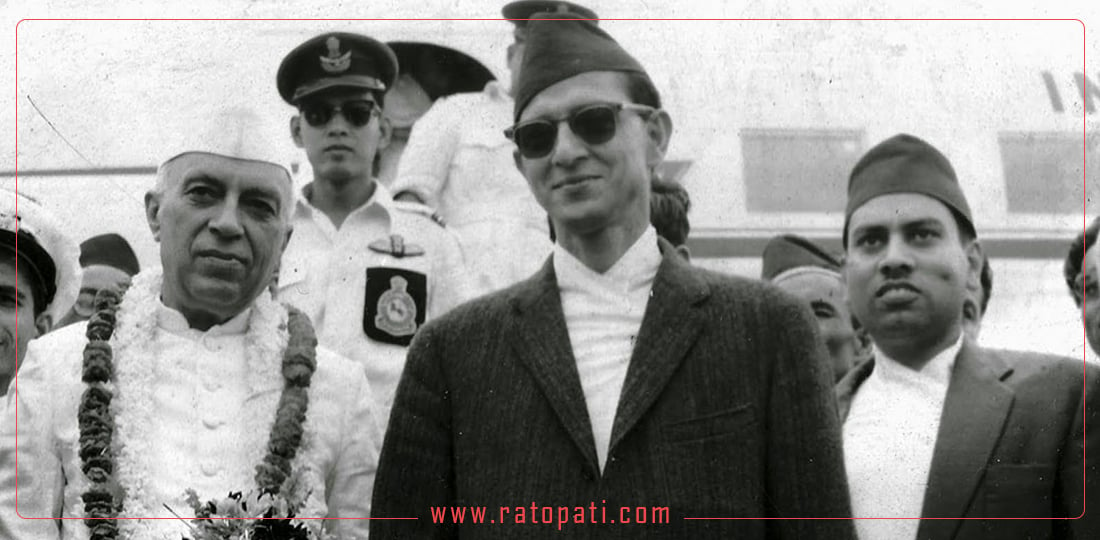
Today, Saun 6, marks the 44th death anniversary of the epochal leader Jananayak Bisheshwor Prasad Koirala. On this day, the political sphere, and especially the Nepali Congress party founded by BP himself, organizes various programs from local to central committee levels to pay homage to him.
However, this year, the internal conflict between the new and old establishment factions of the Nepali Congress has divided BP himself into two. Both sides are organizing separate programs. Viewed in the current context, this year's memorial day appears more like a deviation and mockery of BP's ideological legacy than a celebration of it.
Looking at the outline of programs organized by his own followers for the leader who laid the foundation of democratic socialism in Nepali politics and drew a visionary roadmap for national reconciliation, it seems that today's Congress is more interested in selling his name as a 'brand' in the modern market than in his ideology.
The new establishment faction, which emerged after the special general convention, is vying to become a celebrity among the youth by organizing a five-kilometer 'Green Run' marathon from UN Park to Jawalakhel in Lalitpur today.
Running on the asphalt road with BP's picture on the front of the T-shirts distributed to the participants and the 'Green Run' logo on the back, and then discarding that T-shirt in a corner the next day, is a reflection of today's superficial politics.
_6EG6wNp7Mq.jpg)
The fashionable 'round table talk' on climate change to be held at the Falcha in Jawalakhel immediately after the run, and the show of strength to be held the next day in the grand hall of the Pragya Pratishthan, will bring how much peace to BP's soul is a matter of debate.
On the other hand, the other faction is not far behind. They too are busy performing ritualistic traditions by applying vermilion and garlands to BP's picture inside the grand hall of the Pragya Pratishthan and bargaining for their own existence. The party has recently suffered a severe organizational setback, losing over 10 lakh of its traditional votes in the elections. At such a time, the inability of the two top factions of the Congress to sit on the same stage even on BP's memorial day, and their creation of separate platforms due to factional ego, can be said to be a tearing apart of BP's 'national reconciliation' policy.
It is not difficult to understand that only urban fit youths can participate in a five-kilometer marathon. But the leadership has forgotten that a political party is not, and should not be, just a club for a certain age group.
To understand the development of BP's thought, one must delve into his childhood and struggle, vividly depicted in his autobiographical works 'Aafno Katha', 'Jail Journal', and 'Aatmabrittanta'.
This is a common platform that encompasses every age, class, and stratum of society. History bears witness that the sweat of the elderly waiting at the booth, the middle-aged farmers tilling the land, and the women managing the kitchen has flowed equally in the construction of Congress and the struggle for democracy.
When today's leadership confines BP's ideology to the smooth roads of Lalitpur and the fashion of the urban middle class, the organic connection with the common people is completely severed. BP Koirala's ideological consciousness and his nature of fighting against injustice were not born out of intellectual indulgence in an air-conditioned room or a symbolic street run.
To understand the development of BP's thought, one must delve into his childhood and struggle, vividly depicted in his autobiographical works 'Aafno Katha', 'Jail Journal', and 'Aatmabrittanta'.
The exile of the Koirala family, which began when father Krishna Prasad Koirala sent a parcel of a poor farmer's torn shirt to the Rana rulers, was BP's first political school.
While spending his childhood in Banaras, India, BP learned the first lessons of fighting against injustice from the mud of poverty, deprivation, and expatriate life. That stay in Banaras was not just a refugee life; it was a place for churning the ideological currents rising around the world.
The fervor and heat of the Indian independence movement, the Satyagraha of Mahatma Gandhi, and the proximity to the socialist thoughts of Jayaprakash Narayan, Ram Manohar Lohia, and Jawaharlal Nehru built in him a profound faith in democracy.
From his proximity and journey with those great individuals, and from the cycle of the then circumstances, BP understood that freedom is a natural right of man. And, one should not be afraid to confront any power for it.
Whether it was the establishment of the Nepali National Congress to end the autocratic Rana regime in Nepal or taking command of the 2007 BS revolution, the rebellious and democratic consciousness within him always remained at its peak.
BP, who stood at the forefront of the historic labor movement in Biratnagar demanding respect for labor, climbed every organizational ladder up to becoming Nepal's first elected Prime Minister on the foundation of the sweat and trust of the people.
His thinking was not limited to politics; in literature, he appears even more visionary and progressive.
The steps like abolishing Birta (land grants) and land reform that he sought to implement after winning a two-thirds majority in the 2015 general elections were indeed practical socialist policies centered around the common people. It carried the dream of making marginalized farmers, oppressed for centuries, owners of the land.
However, the harsh chapter that began in BP's life after the royal 'coup' of 2017 BS made his thoughts on democratic socialism and nationalism even more mature and irrefutable. His daily accounts recorded in 'Jail Journal' and 'Feri Sundarijal: Jail Diary' are not just the memoirs of a prisoner; they are documents of his unwavering stance, even while fighting against the cruelty of the state and a disease like cancer, without compromising an iota on his principles.
His thinking was not limited to politics; in literature, he appears even more visionary and progressive. The foundation of 'inclusivity' and 'women's empowerment' that today's politics strongly advocates was laid by BP decades ago in his literary works.

The dialogue between Aryan and Kirat cultures in BP's novel 'Sumina' is actually the earliest form of the inclusive philosophy that accepts Nepal's multicultural and multi-ethnic identity. Similarly, through Indramaya in 'Teen Ghumti', he presented a rebellion against a woman's right over her own body, her freedom to make decisions, and patriarchal bondage, which serves as a guide even for modern society today.
Ironically, the party that carries the legacy of such a philosopher, who sought freedom of the human mind in literature and fought for socio-economic justice of citizens in politics, has now become completely directionless. Looking at the current political landscape of Nepal, the country is ready to embark on a path towards serious anarchy and 'hybrid populism'.
This populist government, standing on the foundation of the inaction of traditional parties, has sold cheap and sentimental slogans, but it is shaking the fundamental institutions of democracy from their roots.
Even as schemes to abolish trade unions, considered pillars of democracy, and processes to abolish student organizations are initiated, the Nepali Congress, the oldest democratic party in the country, remains a silent spectator, abandoning strong ideological protest.
Today, our democratic institutions, whether it be the parliament, the judiciary, or the bureaucracy, are all falling victim to political maneuvering and anarchy, losing their dignity. Parliament has become a ground for insults and power struggles instead of a forum for policy-making. The shadow of the executive and unseen forces is clearly visible over the judiciary.
Because of this, the common people's faith in justice is wavering. The bureaucracy is forced to work in an environment of extreme fear, instability, and political vendetta, rather than being professional and impartial. Security agencies, including the army, have been reduced to mere tools of the government.
What is even more ironic is that even as schemes to abolish trade unions, considered pillars of democracy, and processes to abolish student organizations are initiated, the Nepali Congress, the oldest democratic party in the country, remains a silent spectator, abandoning strong ideological protest.
At this critical juncture when citizens are forced to self-immolate on the streets due to extreme economic despair, inflation, unemployment, and cooperative fraud, the Congress should have stood firm on the ground in favor of the general public, both on the streets and in parliament. However, the leadership is engrossed in warming up the streets of Lalitpur with marathons and round table discussions in a corporate style, forgetting the extreme suffering and anger of the people.
Will running in T-shirts from UN Park to Jawalakhel reduce the suffering of farmers unable to plant paddy due to lack of fertilizer, peasants not receiving payment for sugarcane, debtors burdened by usury, laborers cheated by cooperatives, and consumers whose backs are broken by inflation? Will their voices be heard? Certainly not.
The main reason for the Congress losing its traditional vote is that the party has now distanced itself from the common people and become a club for the 'urban elite', where there is no democratic means left to hear the voices of long-term party members, intellectuals, principled individuals, and grassroots workers, or to incorporate their ideas.
On the memorial day, leaders should not be in halls or marathon tracksuits, but should connect with the farmers sowing seeds, the laborers in their huts, and small business owners in their shops, resolving to stand firmly with them to solve their problems.
To cut through this superficial wind of populism, the Congress needs to hold onto the foundation of BP's true socialism, which believed in results, not propaganda.
If the Congress is to truly remember BP and revive the party, it must abandon both the fashion of celebrity politics and the ritualistic rigidity of the old generation. The party should have conducted open dialogues and hearing programs in every ward and locality for the protection of labor, consumer rights, and democratic institutions.
On the memorial day, leaders should not be in halls or marathon tracksuits, but should connect with the farmers sowing seeds, the laborers in their huts, and small business owners in their shops, resolving to stand firmly with them to solve their problems.
At this critical juncture in history, both the young and experienced leadership of the Congress need to understand that BP is an organized ideology, not a seasonal fashion or an election slogan. Unless the Congress moves out of the closed rooms of the Pragya Pratishthan and the marathon tracks of Jawalakhel and reconnects with the people in the huts of the 'farmer tilling the land' and the 'village mother', neither will BP's soul find peace, nor will it be possible to protect democracy in crisis and achieve the historic resurgence of Congress.
(Dr. Kushwaha, who holds a doctorate from Jawaharlal Nehru University, India, is the Research Director of the Good Governance School.)
This specific news has been automatically translated by AI. As a result, there may be some inaccuracies or language errors.