Energy Minister Stresses Legal Regulation for Water Resource Conservation

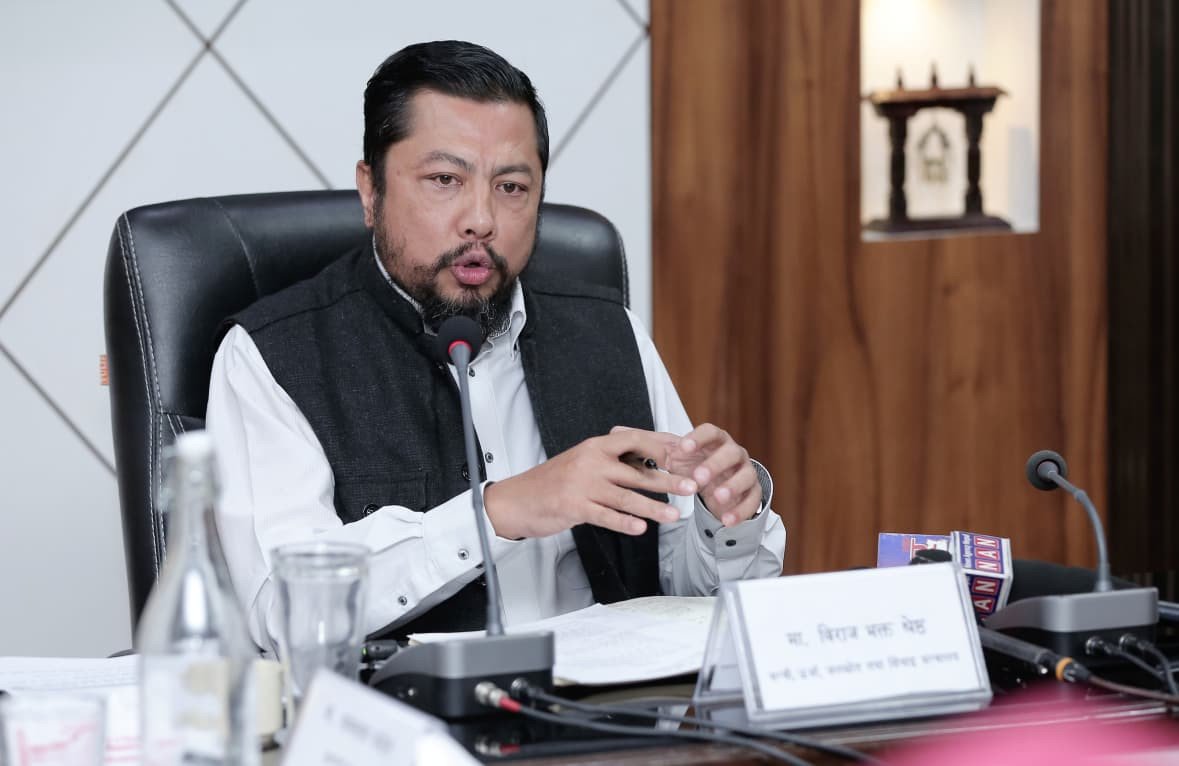
Kathmandu. Energy, Water Resources and Irrigation Minister Biraj Bhakta Shrestha has stated that water resources need to be legally regulated for water conservation.
Minister Shrestha said this while speaking at a discussion with chief ministers from seven provinces on the Water Resources Bill and the Renewable Energy and Energy Efficiency Bill at Singha Durbar on Tuesday.
He informed that the Water Resources Bill includes provisions for regulation as water resources are being destroyed due to increasing pollution. He stated that along with enacting laws for water conservation, it is also necessary to enhance public awareness in parallel. He mentioned that water conservation has become even more challenging as industries and locals dump all types of waste produced into rivers and streams.
Minister Shrestha pointed out that the pollution of the Sirsiya River in Madhesh Province has led to the death of cattle raised by locals and has also negatively impacted agricultural production. He informed that the bill also proposes a system of rewards to encourage increased community participation in water conservation.
Speaking at the meeting, Minister Shrestha said, ‘It is time to regulate water issues. Because we have polluted our rivers and streams. And we are also saying that there is no water.’
Giving the example of the Sirsiya River, he added, ‘Looking at the condition of the Sirsiya River in Madhesh, industries have polluted it, causing the death of cattle raised by the citizens there and damaging agricultural farming. We have also included in this how to address that.’
Clarifying about law and public awareness, he said, ‘What we feel is that while formulating policies, it is necessary to enhance public awareness in parallel. If that cannot be done, water conservation cannot be achieved by government laws, policies, and budgets alone.’ Therefore, he highlighted the need to talk about water conservation, even if it means implementing a reward system.
Regarding the plan to produce energy from waste, he said, ‘To solve this very problem, we are working on how energy can be produced from waste as a pilot project this time. If this project is successful at the center, we are preparing to take it to the provincial and local levels.’
Recalling his past experience, Minister Shrestha added, ‘As I myself have come from being a provincial assembly member, I am aware of what kind of policy problems exist. That is why we are trying to address the issues that make it difficult for provincial governments to work through the bill.’ He stated that although the chief ministers' suggestions are yet to be included in the bill, the problems of local and provincial governments have not been overlooked.
Minister Shrestha clarified that there is no alternative to cooperation, coexistence, and coordination among the three tiers of government for water conservation. He stated that the government is working on the basis of increasing citizens' access to sustainable energy by promoting, developing, and expanding renewable energy and energy efficiency.
This specific news has been automatically translated by AI. As a result, there may be some inaccuracies or language errors.