Writer Dadhi Sapkota Shares Experiences of Writing 'Tyo Nepal'

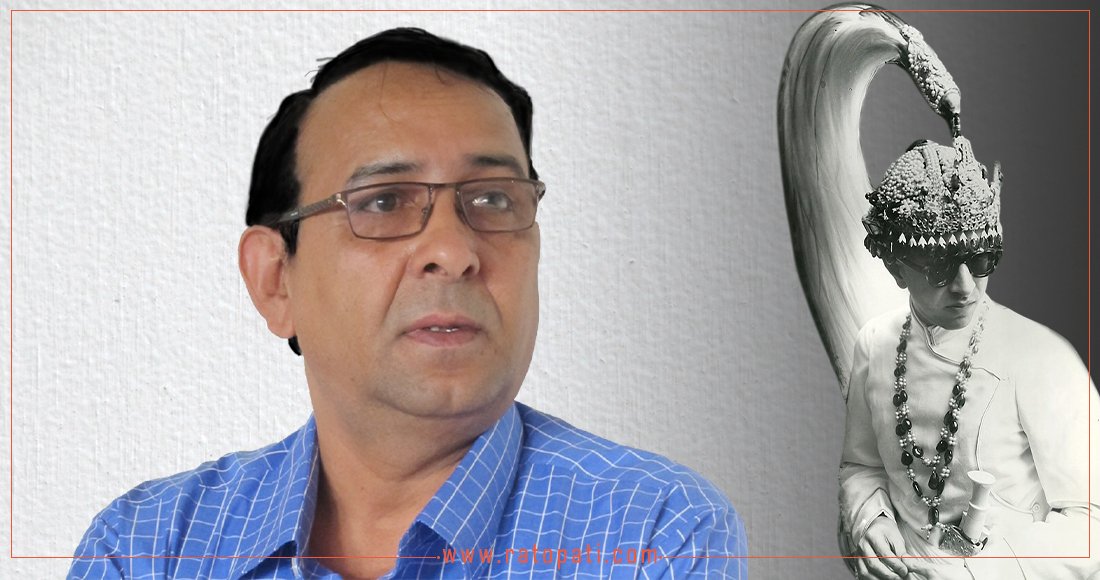
Wandering writer Dadhi Sapkota appears in the alleys of Kathmandu at once, and within a few days, he is already in Paris. Having made France his workplace for over two decades, he is constantly traveling through European countries. Whenever he meets a foreigner with some connection to Nepal, he pursues them and weaves a story. Sapkota, who used to write for newspapers and online platforms in the past, has created books like 'Dukheko Europe' and 'Tyo Nepal' while living abroad. He has written 'Tyo Nepal', which was recently translated into French. Sapkota, who has a keen interest in wildlife and birds, has published books such as 'Jeevagatha', 'Gyani', 'Pashupanchi Jagat', and 'Van Ko Vaibhav'. This is a conversation Narendra Raula had with Dadhi Sapkota during his visit to Nepal:
I received the book 'Tyo Nepal' around 2011/12. It has recently been translated into French. This book contains the stories of 29 French individuals, with fascinating narratives. How did this book come into being?
After moving to France in 2002, I was invited to a Nepali program at the embassy. They knew I was a journalist. Others there also knew. During our conversation about journalism, they said, 'Oh! You are a writer. Maurice Herzog and Eric Vallee are also here. There's also the master who taught the King, do you know about him?' They told me about some individuals. That struck me. It would be great if I could write a book. If not, I thought it would be interesting to write about these people's stories in some magazine or newspaper. After that, I started searching for people. While searching, I began writing the book.
'Tyo Nepal' features interesting characters, including Maurice Herzog. Maurice and Louis Lachenal made the first successful ascent of the 8,091-meter-high Annapurna mountain, after which France celebrated a three-day national festival. How did you meet this historic figure who had met Indian Prime Minister Jawaharlal Nehru and Nepal's last Rana Prime Minister Mohan Shamsher? Let's hear that experience.
The day it was announced at a program in Paris that Maurice Herzog, the first person to climb Annapurna, was there, I started searching. But it was difficult to find him. However, after searching thoroughly on Google, I found out that he lived in a place called Neuilly-sur-Seine near Paris. After finding his address, I wrote him a letter by hand. I sent a letter stating, 'I am this kind of person, I want to meet you, I am a Nepali.'
He asked his secretary to call me. She informed me, 'Your email has been received by Mr. Maurice Herzog. He will meet you at a convenient time.' I was very happy. I didn't expect to meet him like that. He invited me to his home. My wife Anuradha and I both went. When we reached his house, he showed great interest, asking, 'Who are you, how did you come?' We said, 'We want to talk to you, we want to meet you. We want to write about your experience in a book.'
After I expressed my desire to write about him in my book, he gave me time. We went again. He gave a detailed interview about the history of the Annapurna expedition, his life, and what he is doing now.
A few days after I interviewed him, he wrote a book called 'Monнні Annapurna'. It means 'I got a second life after climbing Annapurna'. He gave me that book with his signature. While reading that book, I stopped at one point. He wrote, 'I wanted to die in Lette in the Annapurna Conservation Area.' That book should also be published by Nepalis. But no effort has been made so far. Perhaps no one knows about it. But I have that book. It's in French.
- Maurice Herzog's book 'Annapurna' is said to be the best-selling book, more than the Bible. Did he say that himself?
Yes. Who doesn't know about that book related to mountains and Nepal? It's a highly recommended book of his. It's also available in many languages. In that context, he mentioned that the book written after climbing Annapurna was sold more than the Bible for six months in America. He also expressed some disappointment that Nepalis were not showing interest in that book. After that, I told Niraj that this book must be published in Nepali. He said, 'I have to do the work of a bridge.' With that, the book by Maurice Herzog was also published with permission. But, sadly, it came out only after his death. I had told him that we would try to publish his Annapurna book.
- 'Tyo Nepal' also includes many other interesting characters. It features stories of people who taught French to King Birendra and taught him to fly a helicopter. Not only that, but there are also anecdotes of Birendra learning something in French agricultural farms while he was the crown prince, and plucking chickens. How did you meet those characters?
In some countries, ordinary people also build relationships. They act as bridges. King Mahendra or members of the royal family used to travel to Europe. They used to go to a very famous saree shop in France called Fensiken. There was a person named 'Mr. Arigou' at that shop in Paris.
When they went to buy that saree, the royal family met this person 'Arigou' at the shop. There was a situation where foreigners did not come to Nepal, and visas were not even given to foreigners. Even for someone invited by King Mahendra, the practice was to issue a visa by hand, saying, 'You can only go from Kathmandu to Muglin, you can go to Pokhara.' It was that strict at that time. I also have photos of those visas.
Through the process of buying sarees, I learned that 'Arigou' knew President Charles de Gaulle. Their relationship was very good. 'Arigou' introduced King Mahendra to President Charles de Gaulle.
He was just an ordinary saree merchant, nothing significant. King Mahendra had a knack for recognizing people, and he quickly figured out whom to approach and what to say, especially to foreigners. He established a relationship with the President.
King Mahendra and the French President became friends. King Mahendra observed and visited French agricultural farms, irrigation systems, and tourism development. During that time, he also visited Luxembourg. I also found out where King Mahendra stayed when he visited Luxembourg. Among all the countries he visited, he was most impressed by France.
He told the President, 'Charles de Gaulle, so many tourists come to your country, and you earn so much income. What should be done for Nepal too? Please help us a little.'
After King Mahendra said that to Charles de Gaulle, he was a busy man. At that time, a person named Georges La Vrecque was in the 'Paris Tourism Department'. He was a capable person. De Gaulle assigned Georges La Vrecque, saying, 'Go to Nepal and outline how Nepal's tourism can be developed, give suggestions, and do what needs to be done.' After that, King Mahendra established a relationship with Georges La Vrecque. Then he came to Nepal.
Upon arriving in Nepal, he created a tourism policy. Based on his suggestions, such as opening hotels in Nagarkot, Dhulikhel, Chitwan, and Karnali, hotels were opened in Pokhara and various other places. At that time, the government itself opened hotels.
The development of tourism in Nepal is concentrated in the areas where these Frenchmen provided suggestions. This is how the foundation for the tourism development of Nepal and France was laid. The relationship that started with a saree merchant achieved so much! It becomes clear how much Mahendra did for the country, even though he was the king.
- King Birendra's story should also be included here.
Yes, I forgot to tell you. Mahendra observed agriculture, tourism, etc., in France. The king himself couldn't do everything. So, Mahendra asked the person who came to outline tourism, 'My son needs to learn and be taught about agriculture and animal husbandry here, show him, teach him.'
Georges La Vrecque arranged for Birendra to stay at an agricultural farm in Normandy, at the home of his relatives in France. Birendra was very diligent, according to what the French told me; he would even pluck chickens! But he did it without anyone knowing he was a prince.
After learning at the agricultural farm in France, Birendra introduced many policies. It was inspired by that experience. Helen La Vrecque reportedly said, 'King Birendra wants to develop agriculture in our country too, like in your country. What needs to be done? I want to learn, teach me.' He had such simplicity. Even as the crown prince, he learned by going to agricultural farms.
After Birendra's death, those French people felt pain, and he was stressed for a long time.
- One anecdote about Maurice Herzog is missing. After he climbed Annapurna, the French President made him the Minister of Youth and Sports for 8 years. Later, he also became a Member of Parliament and Mayor. The President gave him so much importance!
The world didn't really believe that 8,000-meter-high mountains could be climbed. Because there was no Google back then. There was no internet system; how could one know? One would only know by reading newspapers and magazines. Perhaps even those who attempted to climb didn't believe it.
I have interviewed Denis, who secretly went to the third or fourth base camp of Everest and returned before Maurice climbed Annapurna. He told me, 'Even back then, people would try to climb, but not many believed it was possible.' Those who went with the intention of climbing might have believed it, but the world wasn't convinced at that time.
When the news of Maurice Herzog climbing an 8,000-meter-high mountain spread at such a time, it caused a stir worldwide. The news spread all over the world at once. If there was the internet, it would have spread in a minute. There was a discussion worldwide, 'How is this possible?' The name of France spread all over the world at once. Back then, there weren't technical equipment like today for climbing 3,000-4,000 meter high mountains and falling to death. Such development hadn't happened. It was even more difficult then.
The bravery of the French was established. France's reputation and respect grew worldwide. France took it as a great achievement, and still does. France promoted the slogan, 'We have conquered the roof of the world, an 8,000-meter-high mountain.' France's prestige soared.
After that, France developed helicopters for high mountain expeditions. Maurice's connection is not just with climbing mountains. He developed technologies for climbing high mountains, and made climbing boots, clothes, hats, and oxygen cylinders.
French people were praised all over the world. After achieving so much, President Charles de Gaulle called Maurice Herzog and said, 'You should become the Minister of Sports and go around telling French youth about this saga of bravery, teach them about climbing Everest, tell them, share it.'
The Makalu mountain was also first climbed by the French. Therefore, Maurice has built two large buildings in France, Annapurna and Makalu, in a place called Samuni, where he later became the mayor. He built two large buildings there. They look like two eyes facing each other. They house various offices.
- After Maurice Herzog climbed Annapurna, Nepal's last Rana Prime Minister Mohan Shamsher honored him and awarded him a medal. Did you narrate that incident too?
Mohan Shamsher honored him, saying, 'You have upheld the honor of our country and ours.' The Ranas probably knew that this publicity would also make them somewhat famous in the world. They might have thought it would help develop relations between the two countries.
He said that the Rana Prime Minister called him, saying he had upheld the honor of our country. He was the first person to receive the Gorkha Cross. He said perhaps no one else had received it.
- At the end of the book 'Tyo Nepal', in the chapter 'Extreme Love for the Nepali Language', there is the story of Marie Christine Kabat. It describes her efforts to learn the Nepali language. How did you meet her?
There is a university in France, which was previously called Dauphine University. It had a section for teaching the Nepali language. It still exists. It is now called INALCO. She was its head. She was a student before.
Her teacher, from whom Christine Kabat learned, said, 'You have worked so hard. You have learned Nepali so well. Now I am leaving from here. You carry on.' She learned the Nepali language for a long time. She has also written a French-Nepali dictionary. Her books on folklore are also published. She has also written many other books related to Nepal. She is in France.
- The book 'Tyo Nepal' includes many interesting and historical characters who loved the Nepali language, Nepal's mountains, its tourism, and culture. How can Nepal honor their contributions?
Especially rulers and administrators should read this book. There are characters in it that Nepal must recognize. Let's not even talk about how difficult it was to meet them. I met many more than just 29 people. I still have interviews with about 17 people recorded.
- Among the 29 people, how many of the characters included in this book are still alive? How many have passed away?
I don't know the exact number. Maurice Herzog and Forsi de Noel, who climbed Annapurna, are both no longer with us. Mire Helfer followed the footsteps of singer Jhalakman Gandharva and walked from Kathmandu to Palpa, Dang, and Pokhara. He recorded Jhalakman Gandharva's songs in Batulechaur. He is also no longer with us.
- What do you do in France now? Do you only write and read, or do you have another profession?
I do writing and reading. Now I am interested in videos. I am more interested in animals and birds.
This specific news has been automatically translated by AI. As a result, there may be some inaccuracies or language errors.