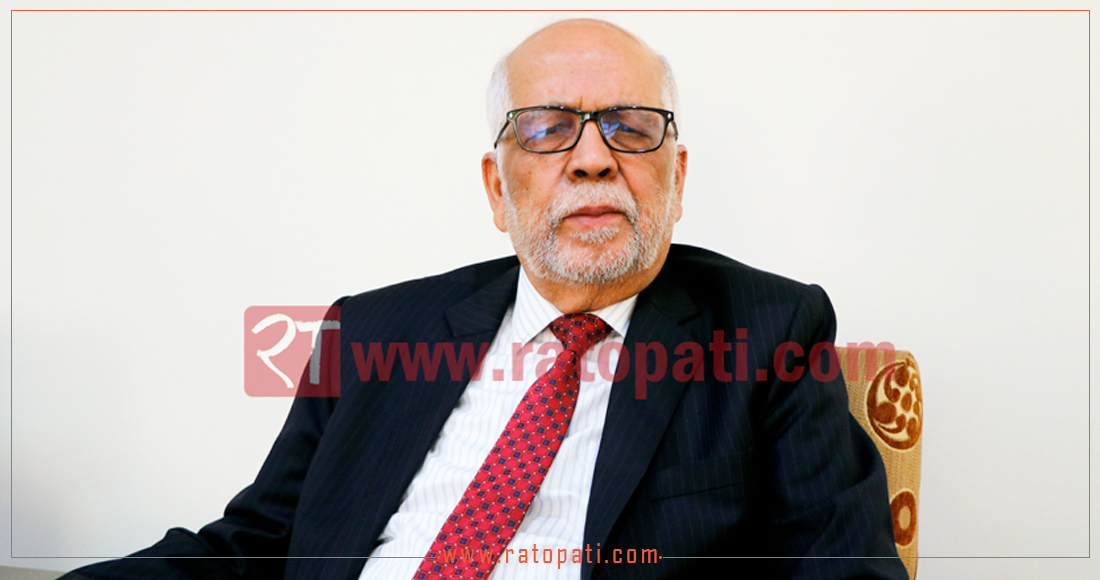
Former Ambassador Nilambar Acharya Discusses Nepal's Foreign Policy and Geopolitics

The government led by Balendra Shah has completed one hundred days. During this period, the most discussed area of this government has been international affairs. Whether it is a group meeting with heads of diplomatic missions, the issue of Lipulekh, the advertisement for the recall and appointment of ambassadors. Or even the birthday of the Dalai Lama. Geopolitical discussions have been frequent during this period, leading to doubts about foreign policy.
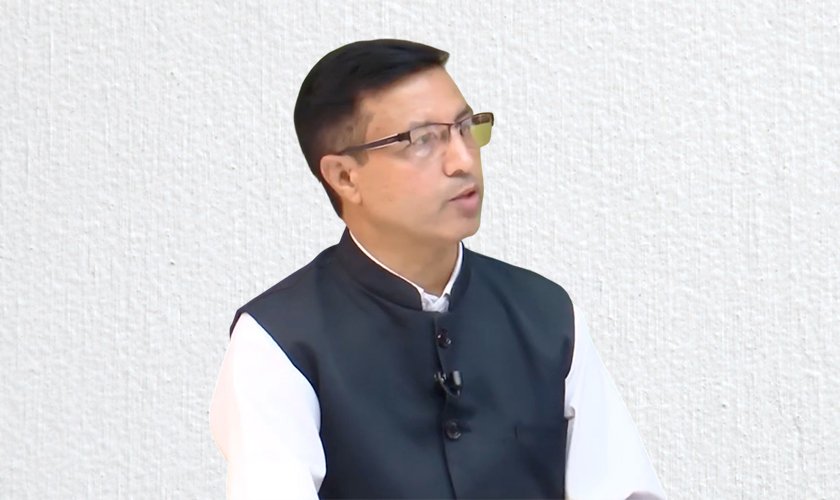
What is the government trying to do, reset or revise its foreign policy? Former Ambassador Nilambar Acharya discusses issues such as where the country is heading and how much foreign policy needs improvement in an interview with Ratopati.
- The government has completed one hundred days, how do you understand the field of foreign affairs?
–There is continuity in our foreign policy. The constitution itself defines the basic principles of our foreign policy. It cannot be abandoned or deviated from. However, there can be some differences in its operation, practice, and style. That difference has been observed recently. There are concerns that our foreign policy and thoughts about relations are somewhat influenced or leaning towards Western countries. Our foreign policy is not to maintain relations with other countries at the cost of neighboring countries or at the cost of relations with them.
Furthermore, we cannot maintain relations with one country in a way that harms our relationship with another. This is the fundamental fact of our policy of non-alignment. There is a concern among people that there has been some deviation from it.
- You mentioned deviation, will this affect our geopolitics, alienate neighboring nations, or will we be unable to maintain balance with neighboring nations?
–If this deviation is not stopped or if the constitutional recognition is disregarded, it will definitely affect national interests. But I don't think it will go that far. Some steps taken by the Ministry of Foreign Affairs have been good, and the practices have been good. I don't think the policies implemented and the foreign minister's visits will lead to the continuation of that deviation.
- Instead of one or two, what are those deviations?
–Let's take the relationship with India first. We have a long-standing and extensive relationship with India. As soon as Balen won the election, Indian Prime Minister Narendra Modi called and congratulated him. After that, many expected the relationship to develop further, Balen to visit India, and Modi to visit Nepal. But no progress was seen.
Because the beginning that was made did not continue.
Another thing is, we should meet according to our needs. Have we gone from one extreme to another? If we reach a point where we don't meet at all, that won't be good either. Visits should happen, and meetings should be according to our needs. If excessive engagement was not right yesterday, a different kind of excessive engagement is seen today. That also needs to be corrected. Foreign relations need to be deepened and strengthened for our development, our national interest, the strengthening of our independence, and our sovereignty.
- Regarding the issue of relations with India and the Prime Minister's meetings, based on what you said, is our country slowly getting caught in a geopolitical vortex?
–We should not jump to that conclusion. But we need to be vigilant and cautious. Because if the first step is taken towards a pitfall, one must be cautious. It's not that we are going to fall into a pit and will definitely fall, but there are grounds for suspicion that it might go in that direction.
- After the movement on Bhadra 23 and 24, there have been some different informal sentiments and ideas from China regarding Nepal's geopolitics?
–As I said earlier, we are in a very sensitive geographical area. There is competition between China and America. Therefore, we need to tread very carefully. We are between two rapidly developing neighbors. India is developing, and China is developing. We must prioritize relations with these two neighbors. Along with that, we must also promote relations with countries around the world.
There is a suspicion in some quarters that we are neglecting China.
The government's relations began with the Dalai Lama's office's greetings and the activities of Tibetan support groups. Therefore, it is very necessary to dispel this suspicion. The government must do this work, and responsible leaders of the government must do this work. If some suspicions arise, they should not be given a basis if they are likely to harm our national interest.
- Perhaps for this reason, when Foreign Minister Shishir Khanal visited China, their Foreign Minister Wang Yi said, 'A close friend is better than a distant relative, remember that.' Was this a big message implying that you are neglecting us and should look at those nearby, not those far away?
–A close neighbor is more useful in times of trouble than a distant friend. Our lives have also shown this. We should not try to please distant friends by antagonizing our neighbors. But whether we have done anything to antagonize our neighbors is a decision we must make. Because if we act against the real interests of our neighbors by antagonizing them, we will be the ones to suffer. Therefore, it is our job to evaluate that. It is not necessary to do exactly as the neighbor says. We must also maintain our independence and our autonomy to make our own decisions.
- Is this 'distant friend' a hint towards America?
–Everyone should understand that. I don't need to explain what China said; it's understandable. Neighbors are our neighbors; China and India are the ones who are useful. This shows that we should not consider anyone else as close by considering our two neighbors as not close. Perhaps his hint was that we are not leaning in that direction. Therefore, we must think about this seriously and evaluate whether our actions have been correct.
- After the government was formed, was it trying to change or reset foreign policy? Upon arrival, mission representatives were dismissed, ambassadors recalled, and open advertisements were issued for appointments. The Prime Minister met the heads of missions in groups. Has this also raised suspicions?
–I don't think the government itself has started doing that. However, some actions from the Prime Minister's Office have indeed caused a jolt. Because the way the Prime Minister spoke in parliament was extremely objectionable. And the Ministry of Foreign Affairs also tried to downplay it by not accepting it. The meaning is that even if the Prime Minister's statement is not directly accepted as objectionable, it can be understood from the Ministry of Foreign Affairs' attempt to correct it, to cover it up.
And it is still recorded in the parliamentary records. And the Prime Minister has not yet clarified his statement in the parliament, saying, 'This is what I meant, there was confusion due to brevity, and I am sorry for that confusion,' or whatever the word is. Also, we need to meet with everyone as needed. It's not possible to say 'I won't meet anyone.' We have to meet as needed. Our country is small, and the country runs on various forms of aid. We must meet; we should not refuse to meet.
The chairman of the ruling party, who had not visited any other country, traveled to India. The Foreign Minister visited both China and India, which was good. Similarly, interactions should be held with everyone according to their needs, the depth of the relationship, and the problems that arise.
Trade is being obstructed, should we not speak? Some of our products are facing problems entering the Indian market, we have to speak up there, we have to speak! Similarly, we have some problems that need to be resolved, we have to speak there! Is it okay to not speak? We cannot afford to be like a powerful country that can survive without interacting with anyone.
- Recently, there was widespread protest claiming that the Dalai Lama's birthday was celebrated in Nepal against the 'One China Policy,' with former ambassadors, former prime ministers, and others issuing statements. This means they must have known something, right?
–I don't think we have altered China's integrity or the One China policy. That incident is also a distortion; it would have been better if it hadn't happened. We must be careful about that too. However, in a democratic country, isolated incidents sometimes occur; it's not new. We need to be careful so that such incidents do not continue. Therefore, let's take it as an incident that calls for caution. Let's ensure such incidents are not repeated and do not disrupt relations by affecting our policies.
- In this changing political situation, do you see any need for improvement in foreign policy?
–It is time to review foreign relations and policy. But while reviewing, we must not forget our basic principles. As I said, the values and principles of foreign affairs are mentioned in the constitution, and the review must be based on them. These basic principles cannot be tampered with. We must advance relations with neighbors and countries around the world keeping our national interest in mind. While advancing relations with national interest in mind, we must also conduct meetings and exchanges as needed. Therefore, the style of conducting our foreign relations needs to be reconsidered. The previous style was not right, and the current style also does not seem right. Both need to be corrected.
- If it needs to be corrected, what should be corrected? Tell us in one line.
–Work must be done by prioritizing national interest. National interest includes our economic development, self-respect, independence, and a respectful relationship with neighbors. We must maintain relations with all neighbors, both immediate neighbors, and even those in the sky.
- Does this mean that neighbors should be prioritized in foreign policy?
–I wouldn't say that. Neighbors are neighbors; we should have neighborly relations with them. We should have friendly relations with other nations. Therefore, if we need to import goods from other countries, the transit facility will be through the neighbors, won't it? Transit cannot be sought from other countries.
Therefore, relations with each country have their own characteristics. We must advance relations with each country accordingly. However, while doing so, we must consider national interest, self-respect, and respectful relations. We must ensure that unequal relations and treaties and agreements do not occur.
This specific news has been automatically translated by AI. As a result, there may be some inaccuracies or language errors.

_Eqo5W0NMVM.jpg)