Political Analysts Discuss Nepal's 'Word Diplomacy' and Development Models at 'Bodhi Dialogue'

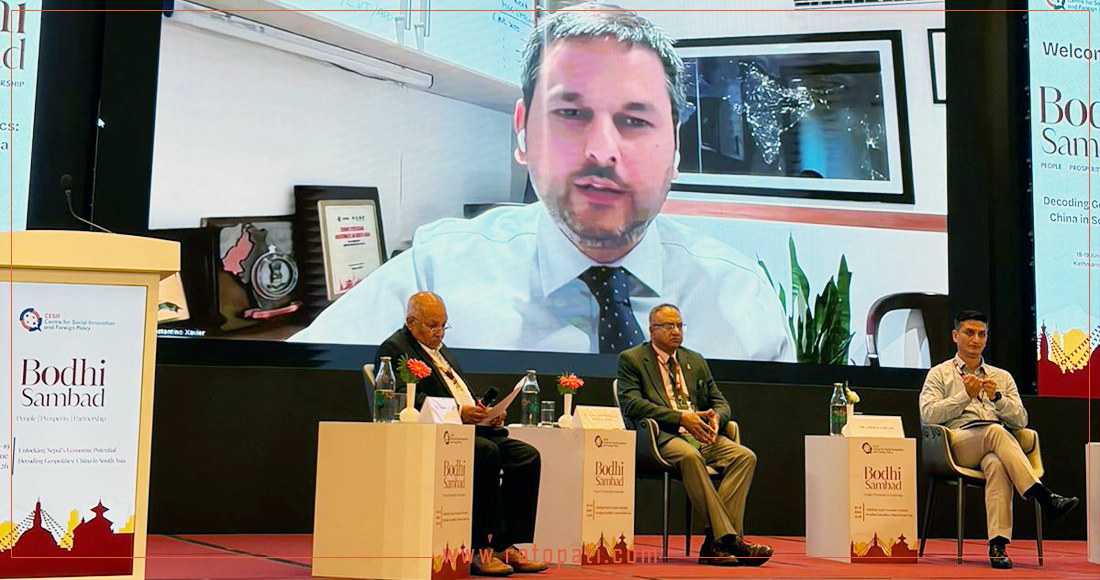
Kathmandu. Political analyst Chandradev Bhatt has commented that Nepal is trapped in 'word diplomacy' in the four-day 'Bodhi Dialogue' program organized by the Center for Social Innovation and Foreign Policy (CESIFP) in Kathmandu. He stated that such diplomacy does not contribute much to the enhancement of state capacity and clarified that the development model adopted by Nepal has made us dependent on the outside world and other donors. Bhatt said that the time has come to reconsider the development models to help increase the state's capacity. While presenting his views on 'Comparative Governance: State Capacity and Development Models', Henrietta Levin, a Senior Fellow at the Freeman Chair in China Studies under the Center for Strategic and International Studies (CSIS) in the US, urged small and medium power nations to unite. She said that small countries would benefit more by uniting and moving forward, and this could remove the dependence on countries with huge economic sectors like America, China, or India. She commented that small countries tend to wait for countries like America and China for new proposals, new alliances, or new initiatives, but this situation of waiting for America or China will end once small countries integrate among themselves. Levin said, 'We can see many initiatives from countries in this region, keeping in mind common challenges and opportunities.' Dr. Pradip Taneja, a senior associate professor of Asian Politics and International Relations at the University of Melbourne, Australia, expressed the view that it would not be beneficial for India to adopt a reactive approach in South Asia by following China. He emphasized that India should find its own way to work with South Asian countries, stating, 'India can provide excellent cooperation to its neighbors by presenting its strong aspect as a multi-ethnic and multi-religious democracy, as many neighbors have similar situations. In this regard, India is in a much better position than China.' Commenting on China's BRI, he linked it to the sluggishness of the Chinese economy. He said, 'China had developed immense capacity in the construction sector. When the Chinese economy started to slow down, they wanted to use this excess capacity in other parts of the world to get good returns.' Dr. Constantino Xavier, a Senior Fellow at the Center for Social and Economic Progress (CSEP) India, had said that India should bring balance to its Nepal policy in view of the growing Chinese influence in Nepal. He emphasized that India's future policy should be balanced between denial and delivery. He said, 'India's Nepal policy should be focused 20 percent on denial and 80 percent on delivery.' He stated that although China is not a resident player in this subcontinent today, it has the resources and capacity to participate in every major decision of South Asian countries, including Nepal. Nepali author and analyst Amish Raj Mulmi mentioned that both China and India are accelerating infrastructure construction in the Himalayan region, and Nepal is trying to develop itself as a transit corridor. He claimed that China is building houses in the border areas, and although the main objective is security, other interests are also involved. Mulmi claims that China is currently resettling people on the Himalayan border. Clarifying India's strategy, he said that India is also building new infrastructure in the region. He said that it has started the Vibrant Villages program to retain people in the hills. He also said that Nepal is also envisioning itself as a transit corridor between India and China by using these Himalayan road networks. Geopolitics and security analyst and former Additional Inspector General Santosh Ballabh Poudyal said that China has excess capacity in infrastructure construction and claims to have the world's best technology in cyber and digital technology. He said, 'China has not adopted the same uniform model everywhere in terms of security management and the use of digital capabilities in border areas.' He said that other countries should deal with these Chinese capabilities in their own specific ways.
This specific news has been automatically translated by AI. As a result, there may be some inaccuracies or language errors.

_CiyNEtuLZ6.jpg)