Himalayan Regions Facing Changing Natural Disasters Due to Climate Change

In the last few years, nature has begun to change its form in the Himalayan regions of Nepal. Until yesterday, we looked at the Himalayas only as a symbol of beauty, but today those Himalayas are becoming a source of various natural disasters.
From the Melamchi flood of 2078 BS to 2082 BS, we have experienced many small and large avalanches, blizzards, and glacial lake outburst floods. These incidents are not just natural coincidences, but a terrifying reality caused by climate change.
As an expert who has been studying glaciers and glacial lakes for a long time, the nature of disasters seen in the Himalayas has changed compared to before.
Changing Nature of Disasters: Stable Outside, Explosive Inside
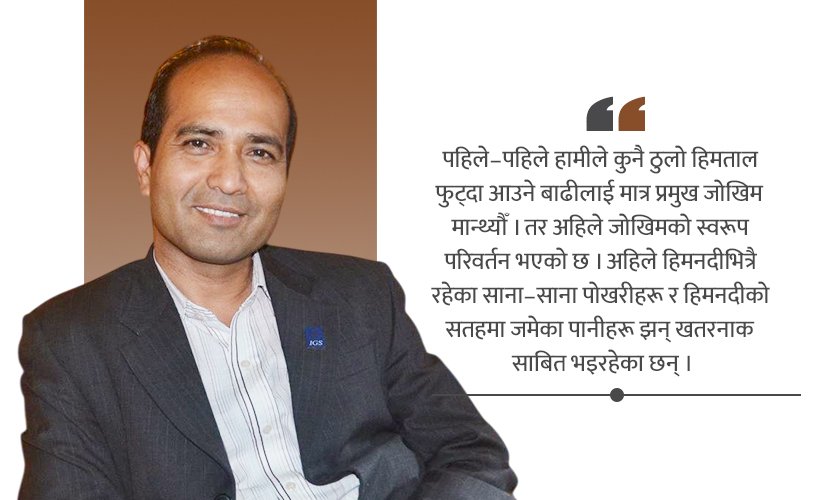
In the past, we only considered the flood caused by the bursting of a large glacial lake as the main risk. But now the nature of the risk has changed. Currently, small ponds within glaciers and water accumulated on the surface of glaciers are proving to be more dangerous.
The flood in Thame, Solukhumbu, is a prime example of this. No large lake burst there; rather, small ponds on the surface of the glacier joined together, and the large volume of water formed by melting snow exploded at once. We call this a 'supra-glacial' outburst. 'In-glacial channels' (natural pipe-like structures within glaciers) heat up due to temperature increase and send a lot of water down at once, causing destruction in the downstream areas.
Similarly, the flood incidents seen in Rasuwa and Mustang are also of a different nature. The flood in Rasuwa came from the Tibetan plateau of China. Due to temperature increase and continuous rainfall, the amount of water in the glaciers and glacial lakes in Tibet increased, and its direct impact was seen in the rivers of Nepal. Places that used to receive only snow are now experiencing torrential rainfall, which is helping to melt dry hills and snow quickly.
Why are the Himalayas Melting?
The main and only reason for the Himalayas melting is the increasing temperature of the Earth. The temperature in the Himalayan region is increasing at a rate about three times higher than the global average temperature increase. The temperature of snow and ice in glaciers is usually around 0 to -5 degrees Celsius. When the temperature increases even slightly, that ice begins to melt quickly. Pipe-like holes within glaciers become larger due to hot water, and the accumulated water inside is released at once.
Future Preparation: Not Just Relief, But Early Warning
There is a snow range in the northern part of Nepal from east to far west. It is difficult to assess when and where accidents will occur in such a long geography.
The tradition of going with helicopters and distributing relief after a disaster is no longer enough. We must be able to predict disasters using technology. My suggestion and emphasis have always been on two things.
- 24-hour satellite monitoring: Many of our glacial lakes and glaciers are in such remote places that it is almost impossible for humans to reach them. Therefore, regular study of satellite images should be done. Information about which glacier is adding ponds, which lake is growing to an abnormal size, should be updated every week or every day. This should be intensified especially during the monsoon season and from April to September when the temperature rises.
- Early warning system: If there is any disturbance in the upper riparian area or if there are signs of an impending flood, there should be a mechanism to immediately inform the settlements in the lower riparian areas. If information can reach places like the dry port of Rasuwa or hydropower projects along the river banks just minutes or hours before the flood, much loss of life and property can be reduced.
Budget Should Not Be Ignored Either
Nepal is facing this crisis not because of its own actions, but because of global carbon emissions. Therefore, it is important for us to raise our voice in international forums. Fortunately, Nepal has received a large project of about 49.9 million US dollars through the 'Green Climate Fund'. Under this, work is underway to reduce the water level of four highly risky glacial lakes in Nepal and to install an early warning system. We have already succeeded in similar experiments in Imja and Chho Rolpa.
The government should not ignore the Himalayas when allocating the budget. The melting of the Himalayas is not just the disappearance of snow; it also means the drying up of our rivers, a decrease in agricultural production, and destruction in the lower riparian areas. We cannot stop the temperature rise alone, but we can certainly reduce the potential damage. For that, it is high time for the government to seriously consider following the advice of experts, investing in technology, and relocating settlements in risk-prone areas. The alarm bell is ringing in the Himalayas; we no longer have the luxury of closing our eyes.
This specific news has been automatically translated by AI. As a result, there may be some inaccuracies or language errors.