Remembering Pushpa Lal Shrestha: A Visionary Leader of Nepal's Communist Movement
- Background
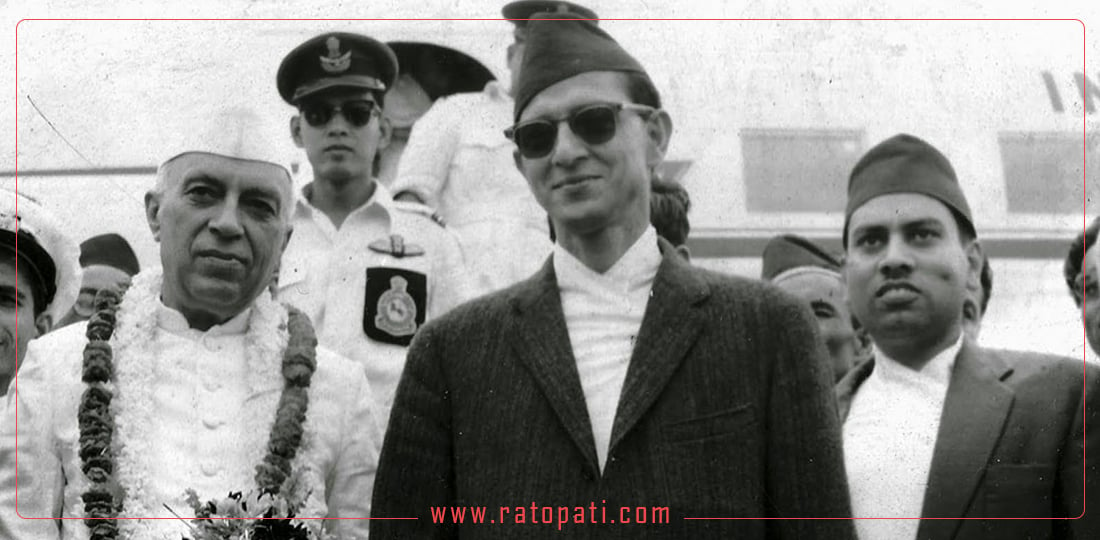
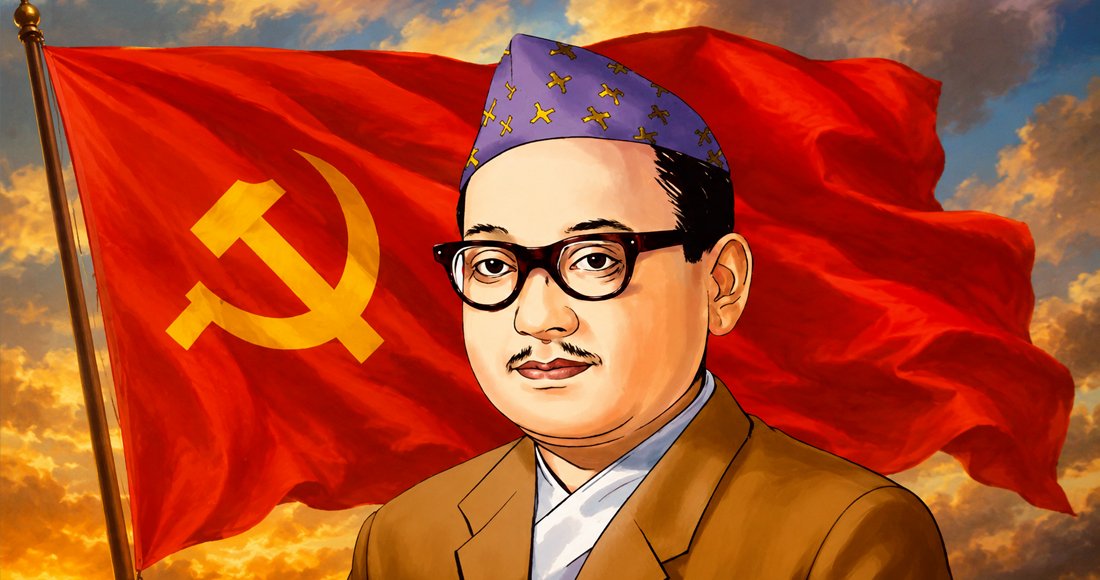
Pushpa Lal Shrestha is an evergreen ideological personality of the Nepali communist movement. He did not just lead a political party, but determined the ideological direction of the Nepali revolution. As the founding General Secretary of the Communist Party of Nepal, the first scientific Marxist analyst of Nepali society, the theorist of revolution, and a visionary thinker of democratic republic, he is a common ideological asset of the entire Nepali communist and democratic movement.
While celebrating his 48th death anniversary and 102nd birth anniversary, mere formal tributes are not enough. A true respect for him lies in re-examining his thoughts, documents, and political vision in conjunction with today's reality. Honoring history is not just remembering the past, but also seeking lessons for the present and the right direction for the future.
Today, the Nepali communist movement is grappling with challenges of division, individualism, opportunism, ideological deviation, and power-centric politics. In such a situation, the natural question arises—if Pushpa Lal were alive today, how would he evaluate this situation and in which ideological and political direction would he advance the reorganization of the movement? Finding answers to these questions is not just an intellectual exercise, but a historical necessity linked to the future of the Nepali communist movement.
- Pushpa Lal: The First Original Interpreter of Nepali Marxism
Pushpa Lal Shrestha was born on Asar 15, 1981 BS in Bhangera, Ramechhap, and passed away on Shrawan 7, 2035 BS. Amidst the autocratic rule of the Rana regime, social discrimination, feudal exploitation, and national subjugation, he initiated a new era in Nepal's political history by providing a scientific ideological basis for change.
His specialty was not just dreaming of revolution, but constructing a working agenda by connecting it with scientific theory, historical analysis, and Nepali reality. He did not mechanically imitate Marxism; instead, he uniquely analyzed Nepal's history, social structure, economic relations, class conditions, and issues of national independence using the Marxist method.
He interpreted Nepali society as having a semi-feudal and semi-colonial character and presented the agenda of a new democratic revolution. Its immediate goal was national independence, democratic rights, and the end of feudalism, with the long-term goal being the journey towards socialism and communism. This original analysis grounded the Nepali communist movement in its own soil and established Pushpa Lal as the first original interpreter of Nepali Marxism.
- Establishment of CPN in 2006 BS and Manifesto
The Communist Party of Nepal was established on Baisakh 10, 2006 BS. This was not just the birth of another political party, but the formal entry of scientific socialism into Nepal's political history. The party's manifesto published along with it became the fundamental ideological document of the Nepali communist movement.
The manifesto scientifically analyzed Nepal's class character, economic structure, political situation, and international influence, presenting a clear agenda for building a new state based on national independence, the end of feudalism, the democratic rights of the people, the leadership of peasants and workers, and social justice. Even when the monarchy was powerful, it centered people's sovereignty, laying the ideological foundation for a democratic republic.
As early as 2005 BS, Pushpa Lal had already introduced Nepali readers to the international communist movement by translating the world-famous Communist Manifesto into Nepali. The establishment of the CPN a year later with a manifesto tailored to Nepali reality was a testament to his extraordinary ideological foresight. While his ideas were approved until the first and second conventions, he could not reach leadership due to opportunist and careerist tendencies. Ultimately, he was outvoted at the third convention in 2019 BS.
- Third National Conference of CPN and 'The Main Path'
Amidst the ideological disputes after 2019 BS, the 'Main Path' presented by Pushpa Lal Shrestha was formally recognized as the political guiding document of the Nepali revolution by the Third National Conference of the Communist Party of Nepal, held under his leadership in 2025 BS.
The conference reaffirmed the new democratic revolution as the agenda for Nepal's revolution and Marxism-Leninism as the party's guiding principle. Furthermore, it adopted a policy of a united front against feudalism, autocratic monarchy, and imperialism with democratic, patriotic, leftist forces, including the Nepali Congress, based on a minimum common program. It laid the foundation for communist unity based on principles, collective leadership, organizational discipline, and people-based movements.
Thus, 'The Main Path' was established as the manifesto for the ideological reorganization of the Nepali communist movement. Its vision, which prioritized policy, principles, and public interest over individuals, provided clear guidance for building a principled movement against opportunism, factionalism, and personality cults. This is why 'The Main Path' is still honored today as Pushpa Lal's most original, mature, and relevant ideological contribution.
- People's Movement: A Visionary Agenda Proven by History
The most significant contribution of Pushpa Lal Shrestha's political foresight is the concept of a united people's movement against the autocratic system. This was not just a tactical political strategy of the time, but a strategic agenda developed from a scientific analysis of the objective reality of Nepali society. Based on the conclusion that democratic change in a multi-class and multi-ethnic society like Nepal is not possible by any single party, he emphasized the need for political unity among democratic, progressive, and patriotic forces based on minimum common objectives.
After the regression of 2017 BS, while many communist factions were leaning towards single struggle or armed rebellion, Pushpa Lal put forward the policy of a broad united people's movement. Although some called it revisionism, for him, it was not an abandonment of class struggle, but a realistic strategy based on the correct identification of the main contradiction of the time. History also proved his vision correct. The People's Movement of 2046 BS ended the Panchayat system, while the joint movement of 2062/063 established a federal democratic republic by ending the monarchy. Thus, the concept of a united people's movement became a visionary political agenda proven by Nepali history.
- From Pushpa Lal to Madan Bhandari: An Ideological Evolution
Pushpa Lal Shrestha, Manmohan Adhikari, and Madan Bhandari are three complementary ideological peaks of the Nepali communist movement. Pushpa Lal laid the ideological foundation of the movement, the agenda of the new democratic revolution, united struggle, and the path of national independence. Manmohan Adhikari established it in practice through people-based governance, democratic practice, and public trust. In the changing national and international context, Madan Bhandari, by formulating People's Multiparty Democracy (Jabaj), evolved the ideology to be contemporary by linking socialism with multiparty competition, civil liberties, national independence, and public participation.
Today, when the leftist movement is struggling with ideological ambiguity, organizational inertia, individualism, factionalism, and a crisis of public trust, Pushpa Lal's core principle—
This specific news has been automatically translated by AI. As a result, there may be some inaccuracies or language errors.