Analysis of Rastriya Swatantra Party's Internal Dynamics and Political Landscape

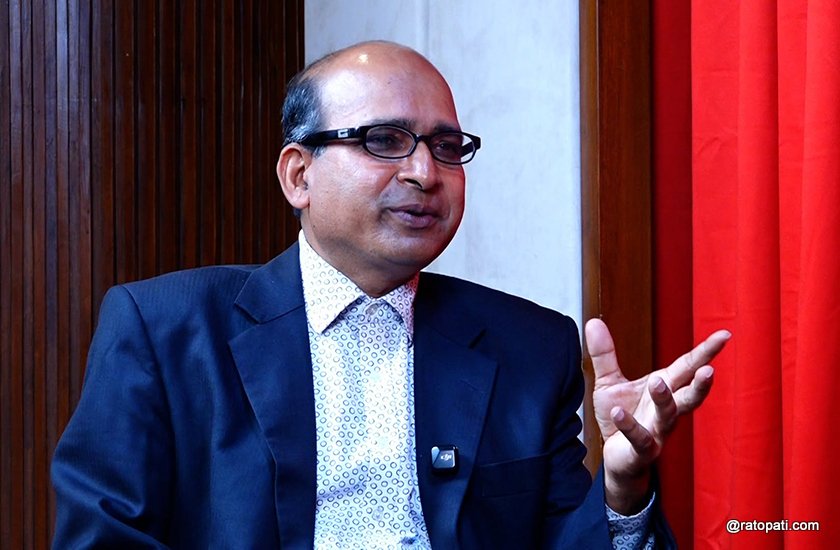
The current Nepali politics is in a fluid state. Especially, the rise of the Rastriya Swatantra Party (RSP) and the various suspicious circumstances created after this party reached the government require deep analysis. The current discord within the RSP and in the government, and the dissatisfaction with each other, have raised many questions. Many are also suspecting whether there is any understanding between Rabi Lamichhane and Balen Shah. But to understand this entire situation and the rise of the RSP, one must look at its internal structure.
In my view, the Rastriya Swatantra Party is not a political party at all. It can be understood as a 'train station', where a train arrived and passengers with different destinations boarded together saying 'let's go'. Among those boarding, there are people with nearby destinations and people with far-reaching destinations. This is not a force driven by any specific political ideology, any concrete program, any political philosophy, or economic philosophy. Although this party has been formed and is also participating in the government, its internal structure is quite complex.
Here, there is a mixture of people with 'far leftist' ideologies like Maoists and 'far rightist' ideologies like Swarnim Wagle. Initially, when the flood was murky, everyone mixed together, but after reaching power, when the situation started to clear up, it became evident who was where and with what interests. The Nepali political history has always been influenced by external powers. Especially, the northern neighbor China, the southern neighbor India, and (air neighbor) America have their own interests. Now that American interests are starting to dominate in Nepal, it is natural for both northern and southern neighbors to object. Looking at Rabi Lamichhane's personal background, he is not in a position to lean too much towards the West. The reason for this is his personal problem. If the situation becomes adverse tomorrow and he has to leave the country, he is not in a position to survive in America. Because he has problems with his Green Card, Debit Card, Credit Card, and bank accounts in America. There are discussions about some old records related to fraud in five 'A' class banks in America, due to which he returned to Nepal, unable to stay there. Therefore, to remain in power, he sees it in his own interest to bring the northern and southern neighbors together rather than the Americans. Lamichhane seems to be trying to improve relations with the North through his own Foreign Minister, while the Prime Minister's team is considered close to American interests.
Looking at Nepal's political history, no government has lasted long after 2007 BS. The longest-lasting government was Surya Bahadur Thapa's 52-month government, which worked closely with India. After that, Girija Prasad Koirala's government of 2048 BS and Marichman Singh's government spent some time despite disagreements with India. KP Sharma Oli's government comes in fourth place. What does this show? India never wants political stability in Nepal. Since Nepal is like India's 'backyard', it always tries to run a controlled government here. The Indian side is startled by the understanding that figures like Balen Shah currently have Western support. If such figures bring stability, India will feel that it has failed in this place. This is a historical and serious geopolitical factor. It is due to these external and internal reasons that discord has arisen within the RSP.
Another trend is dominating current politics, which is called 'whisper sniper' in English. This means inexperienced. This is a style of trying to run the government with excessive confidence by new people. Since this style is dominating within the RSP, it has not been able to grasp the proper way of governance. This is why dissatisfaction has increased within the party itself.
Even RSP leader Manish Jha has said that governance (government) will not run this way, and Amresh Singh had commented on this earlier. The events of Bhadra 24 and the accusations they have raised are now starting to turn back towards them. The 'algorithm' based on which they gained popularity yesterday is now starting to turn against them. Those who used to enjoy trolling others on social media are now being trolled themselves. This situation seems to be proving 'counterproductive' for them.
The country's economic condition is extremely critical right now. Some events created after Bhadra 24 have ruined the economy. New investment is not coming, and government development expenditure is also very low. Business is stalled as there is no demand in the market. People lack confidence. The livelihood of the people has become more critical as the government arrests traders but does not create an environment for new investment. As a result, people have started self-immolating due to despair in recent times, which has caused even those who had hopes in the RSP yesterday to become negative. For this reason, the RSP itself has been pushed into a defensive position. They understand that it is easy to criticize others, but managing a country is very difficult.
Rabi Lamichhane himself, having become a minister, is trying to show some maturity, but in Balen's group, there are some people with 'immature' tendencies. Apart from this, the public disclosure of issues like the passport scandal and the 2 billion scam is not difficult to understand as a sign that it has increased the distance between them.
On the other hand, Indian media and intellectual circles are also closely observing the American presence in Nepal. Earlier, their understanding was that this presence was targeted against China, but the rise of Balen and recent activities have startled them. If this situation continues, in my estimation, the party called RSP is unlikely to last more than the next three and a half years. The structure and leadership of this party cannot solve the fundamental problems of Nepal's economy. The problem is not solved by just changing people.
In Nepali society, job creation has not happened, and the economic progress that has occurred is also limited to a small affluent class. After Covid, the wealth of the rich increased threefold, but the income of 80 percent of the poor decreased. Until this unequal distribution of income is resolved, nothing will happen no matter how many times politics changes. After the property details of RSP ministers were made public, the general public realized that this party only represents the most affluent class of society, which has shocked many.
The government's policies, programs, and budget include big things like 'digital transformation'. But only 30 percent of people in Nepal are digitally literate, and the technical manpower to benefit from it is even less. It is important to see which class benefits from state investment. Speaking of the agricultural sector, subsidies are given to big investors, but small farmers do not even get fertilizer. Farmers going to India to get fertilizer are facing arrest. With such a state of industry and agriculture, economic problems will inevitably explode. We have the understanding that a majority in a single party brings stability, but that is a failed experiment from before.
During the time of the CPN, even with a nearly two-thirds majority government, the parliament was dissolved. Therefore, stability cannot come within this system just by vandalism and arson.
Looking at the current global situation, we are also in a major transition period. The global economy is currently in a time of 'energy transition'. Just as there was great upheaval during World War I when moving from steam engines to diesel-petrol, similar problems are arising now in the transition from fossil fuels to green energy. This global economic problem directly affects a country with an open economy like Nepal. Nepal's economy is even more open than America's, which causes even small fluctuations in the global market to increase inflation and transportation fares here. In such a situation, whoever says 'I will perform miracles' is merely giving false assurances. The main need now is to manage the existing situation, establish peace, and educate citizens. But there is a class in society that always wants instability. During times of crisis, some people become unnaturally rich, which is called 'K-shaped recovery' in economics. This trend of one group's wealth skyrocketing and another group falling to the bottom ensures that elements seeking instability always remain active.
Due to these various reasons, no scenario of political stability is visible in Nepal for the next twenty years. This is not just about one party or person; it is the result of overall structural and geopolitical complexity. Therefore, this current confusion and misunderstanding does not seem likely to be resolved anytime soon.
(Based on a conversation with Bhurtel, who holds a postgraduate degree in Anthropology, Political Science, and Economics from Tribhuvan University)
This specific news has been automatically translated by AI. As a result, there may be some inaccuracies or language errors.