Rastriya Swatantra Party's Bipin Acharya Discusses Campaign Strategy and Voter Expectations in Dang-2


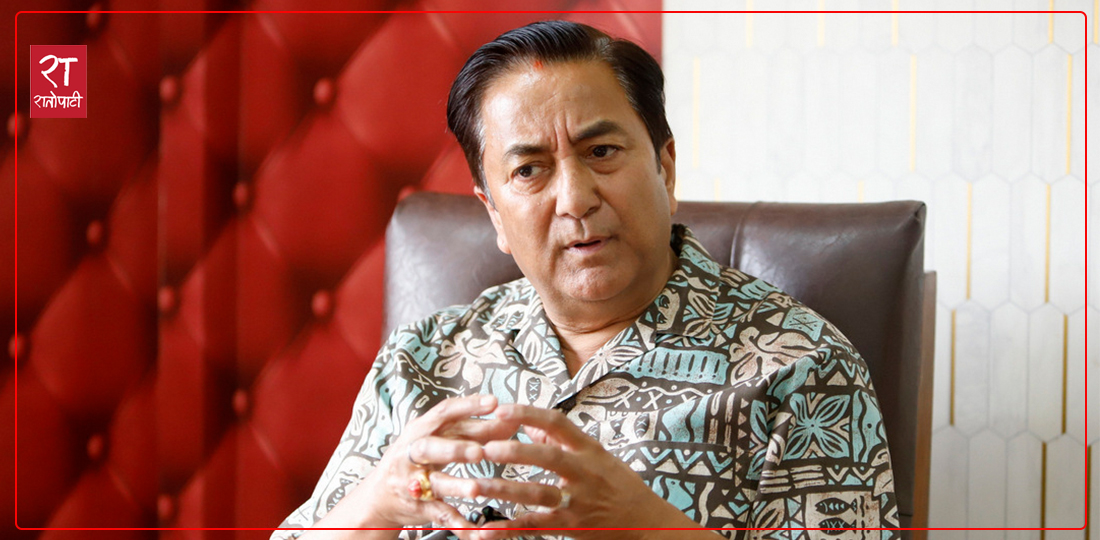
Rastriya Swatantra Party's (RSP) Co-General Secretary Bipin Kumar Acharya, who withdrew his name from the proportional representation closed list to contest as a direct candidate for the House of Representatives from his home district Dang-2, is competing against candidates including CPN-UML General Secretary Shankar Pokhrel, Nepali Congress's Kiran Kishore Ghimire, and CPN (Maoist Centre)'s Nirmal Acharya.
As the election campaign enters its final phase, Acharya spoke with Ganesh Pandey for Ratopati. Below is the edited excerpt of the conversation.
- Why should the voters of Dang-2 trust you and cast their votes for you?
I believe there are three major reasons why the common citizens should trust Bipin Acharya. Firstly, it is the trust in the role I played as an architect in building the party, a founder of the RSP, and the role played by the party's lawmakers in Parliament in terms of representation.
Secondly, while Balen Shah was the Mayor of Kathmandu Metropolitan City, citizens across the country understood how much positive change an honest, visionary mayor can bring to society. The role demonstrated by our top party figures in their respective areas is also a factor.
Thirdly, personally, my contribution to building the party's foundation as a founder, along with my background—perhaps my background in Bio-Technology Engineering, my MBA background, or the fact that I myself was born and raised in Dang-2—and the citizens' perception of me as a person who represents societal change and works more on vision than on mere speeches, makes me confident.
- Dang-2 has historically seen wins by Congress or the Communists; you are just beginning to expand your connection with the public. Is your basis for winning the momentum seen for RSP, or do you have specific agendas?
On February 4th, I presented a pledge by creating a video of about 21-22 minutes detailing what I would do or what I am focusing on as the House of Representatives candidate for Dang-2. Through that pledge, I focused heavily on three things.
While visiting the common citizens of Dang-2 during door-to-door campaigning or submitting the pledge, they had two expectations from me. Voters have told me that I should end the trend where candidates come to the citizens during elections, win, and then never return to meet them. Based on this, I feel that the citizens here are looking for a leader who will stand by them in their joys and sorrows not just before the election, but also afterward, which I have clearly presented in my pledge.
Secondly, the most important thing they mentioned was: 'We understand the limitations of this country's resources; please establish proper norms and only make promises you can fulfill.' Voters mentioned that they have seen people make promises over the last 36 years, use them as vote banks, and then be dishonest about those promises. Accordingly, I have included in my pledge what I can achieve within the scope of a House of Representatives member.
The problems in Dang are 90% the problems of the entire country. I have clearly presented in the pledge what the bases for change could be and what issues I will vigorously advocate for, impacting not just Dang-2 but the entire nation.
Thirdly, I have clearly explained how Dang-3 and Dang-1, not just Dang-2, can be moved forward correctly, based on detailed study. What can a House of Representatives member do? What specific actions will I take as a member? I have clearly explained what those things are regarding changing overall national political indicators to enrich Dang-2.
During my door-to-door campaign, I stated, 'I have not come to be the leader of only Dang-2, nor only of Dang. I have not come to be the leader of Lumbini either; I have come to be the leader of the entire state, the entire nation.' I have articulated in the pledge, in language that voters understand, that I can lead a prosperous Nepal. In the current context, if things are not explained clearly in a style understood by citizens, they hold little meaning.
Since this pledge was created based on the experiences, expectations, and suggestions gathered from reaching every hamlet in all 27 wards under this constituency for about a month, these are not just my agendas but the agendas of the entire residents of Dang-2. I am moving forward carrying their agendas.
- After every revolution, common citizens have high expectations for change. However, history shows major setbacks when leadership fails to address those expectations. How will you address the demands raised by the Gen-Z movement in Bhadra against corruption and malpractice once you are in government?
I generally tell citizens two things. First—I try to make everyone understand everywhere that this country is so broken that everything will not be fixed in the first six months we are in government. I have stated that in the first 6-8 months, we will make people feel that change is possible in this country if there is right leadership. Based on that feeling, I have asked you to give us time. Because it is impossible to normalize a situation this dilapidated in six months, but in six months, we must be able to signal to the public that things are getting better, and I am very conscious of that.
When making any commitment, it is a very important aspect whether we have a plan to implement it or not. I am conscious of that aspect.
Rather than discussing abstract things, we have made a critical component of our pledge something that the public can tangibly feel. The unfortunate aspect of Nepali politics so far is that most political leaders gained knowledge on how to conduct a movement or how to win an election, but they never gained knowledge, nor had a plan, on how to deliver once they won the election and reached the stage of state governance.
They became burdened by the weight of learning on the job, or by failing to learn. Therefore, we are working by learning lessons from those accidents, as we are focusing more on preparation for what to do after winning the election, not just winning it. You might need to give us a few months after the government is formed to see how much we deliver. As media personnel, you must keep us alert by showing past examples.
- During your month-long visits to every nook, corner, street, and voter's home in Dang-2, what were the main problems of the voters?
I found the problems in Dang-2 not significantly different from the problems in other regions. Because when I visited a farmer's house, the farmer told me, 'I will pay my own money, but give me fertilizer on time.' Someone else says, 'I will spend my own money, just ensure irrigation is available when needed.' A trader says, 'I will happily pay taxes, but create an environment for me to do business.' Someone else says, 'When my children are sick, let there be an accessible hospital where I can get treatment without worry.'
Overall, I found that the issues raised were the basic livelihood problems people face from morning till night. There are demands for roads to be paved, drainage systems, gutters, fertilizer, and markets for the goods they produce.
Secondly, the most difficult aspect I encountered was the request to 'create an environment where our children can return to the country.' Many complained that their children have not been able to live at home for years, and they have nothing to tell their children to encourage them to return to this country. I received many expectations asking to establish a basis for those abroad to stay in this country.
- In election rallies, RSP candidates are saying that the job of a representative is to make laws, and development will follow automatically. Is the lack of development due to a lack of laws, or the non-implementation of existing laws?
I am very conscious of this. The ultimate goal of all the laws we make and all policy formulation is to bring development to the country, establish good governance, and enable a citizen to lead their life with dignity.
It doesn't seem like anyone says they won't take responsibility for development. So far, development in Nepali society has been allocated based on how close you are to your leader, how intimate you are with them, and how much power the leader has, rather than based on a scientific method.
Let me give an example: As I was going to a certain locality, there were two roads branching off from one junction. One road served about 20 households, and the other served 200 households. The road serving 200 households was graveled, while the road serving 20 households was paved. When I asked the citizens there about this, they said the paved road leads to the Member of Parliament's house. So far, whatever little development has occurred in Nepal seems to be based on access. This development has a major problem with sustainability. RSP aims to establish a method and norm where the system handles everything.
Let me give you another example: Ward No. 19 of Ghorahi Sub-Metropolitan City is remote, like Karnali. In such a ward where roads, electricity, and internet access are lacking, the Sub-Metropolitan City still collects taxes from the citizens. If we fix these small flaws in the procedures and establish a practice of strict regulation of those procedures, the development issues mentioned earlier will happen in an automated mode.
This country is full of possibilities; the problem is that possibilities have become problems by failing to become reality. Recognizing this requires intervention at the policy level. If the policy is right, the norms will be right; if the norms are right, everything will be right, I say.
- In a parliamentary system where representatives themselves become ministers and prime ministers, can representatives evade the problems of common citizens and the agenda of development?
If we, as a party, receive the responsibility to run this country and formulate policies, we must work on the root cause of all the problems created in the country. My and our team's simple objective is that the system I created should work even if I am not a leader. Because I might be a leader today, but I might not be tomorrow, the system must be for all citizens, not for any specific party.
Secondly, some problems arise due to the dilution of system elements or 'roles and responsibilities.' It is also a tendency to beat around the bush because individuals in positions of responsibility lack vision and ability. Therefore, we need to 'dissect' these issues meticulously to determine what can be done immediately and what requires policy-level intervention. The Rastriya Swatantra Party is conscious of these matters. This time, RSP is more focused on long-term fixes rather than quick fixes. You will see the results of that soon.
- The gap seen between the government and citizens, and leaders and cadres, is leading to increased anger. If you win, will the same happen to you?
A leader is always built on the foundation of the love and trust of the citizens. A leader must find a scientific path that ensures the relationship with citizens never breaks. Take Dang-2, for instance; there are about 140,000 voters here. It is practically impossible to remain in phone contact with all these voters every day after the election, nor do citizens expect that. If their problems are resolved correctly, citizens do not need to be close to the leader.
In many places, when I ask parents and citizens why they need to be close to a leader, their understanding is, 'We need to use connections with the leader; otherwise, how will our work get done?' When I ask them if they would still need a leader if their expectations were met, they replied, 'Then we only need a leader at the time of voting.'
Therefore, first, if the compulsion to show connection to the leader and the need to be close to the leader can be removed, these issues will gradually decrease.
Secondly, the gap in the relationship between citizens and leaders, and the media and leaders, should never be too wide, and the RSP is very conscious of how to correct that aspect. I am personally clear that a leader should be even more humble after the election than they were before it.
- How confident are you about winning the election?
I am personally a super-confident person. If I were someone who lacked confidence in my abilities, I would have contested for the MP post from the place where I was born and raised, by taking the number one spot on the proportional representation closed list. I have immense faith in my capabilities.
A leader's stature is not decided by how many years they have been in politics. I believe a citizen's stature is decided by how many impactful things they have done for that society or that country. Sometimes we overlook the consciousness of our citizens. I have found the level of consciousness of the citizens of Dang-2 to be so excellent that I am confident they will make the right decision. The final verdict in the election will come from the ballot box.
I consider myself a strong competitor, someone who understands the soil, has felt the soil, and has the vision not just to lead Dang-2 but the entire country. I believe the citizens of Dang-2 understand me as such. As they show me affection, I am confident that they are getting not just an MP for Dang-2, but an excellent person who can drive the entire country. Based on that confidence, I move forward with the belief that everything will be fine.
- Are voters more influenced by your personality or by the nationwide rhythm associated with the bell symbol?
Firstly, wherever the rhythm of the bell is strong, I see myself somewhere in it. Perhaps as a founding member, or because of the party's name and election symbol, I see myself in the bell wherever it rings, as I had a significant role in all of them. So, as the rhythm of that bell gets stronger, I feel I have at least a small contribution there. I see that as a starting point.
Today's citizen, alongside that rhythm, analyzes which person they want to vote for: What is that person's background? Does that person have the capability to solve citizens' problems? Is that person someone who works on vision or someone who works on speeches? Therefore, in a democracy, a party is supreme. The national trend of that party, the citizens' expectations of that party, and the fusion of Bipin Kumar Acharya's background, his vision, and the impact he can have on the future path of not just Dang-2 but the entire state, based on those expectations—I see it as a fusion of these factors.
This specific news has been automatically translated by AI. As a result, there may be some inaccuracies or language errors.