Namkha Rural Municipality Faces Increased Risk of Avalanches and Glacial Lake Outbursts


Namkha, located in the northern region of Humla, is a rural municipality with a very large area. Due to the high Himalayan terrain, the border connected with Tibet, and adverse weather conditions, the risk of avalanches and glacial lake outbursts is increasing every year.< /p>
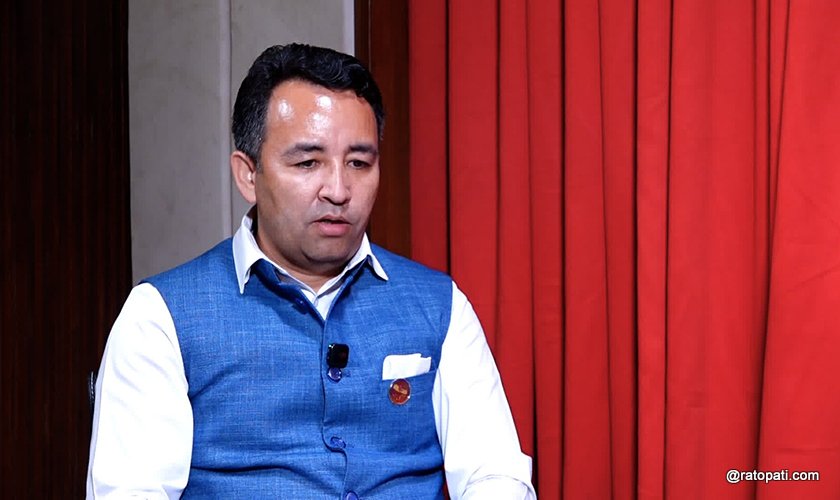
In this context, Ratopati has interviewed Takdir Lama, the Vice-Chairman of Namkha Rural Municipality. Here is the edited excerpt of the conversation with Vice-Chairman Lama:< /p>
- What is the current situation of disasters caused by glacial lake outbursts, avalanches, and glaciers in Namkha Rural Municipality? How is it affecting people's lives?
Namkha Rural Municipality is geographically very remote and falls in a high Himalayan region. The main problem here is natural disasters. Especially after the incident of glacial lake outburst in Til village of Limi last year, we have become even more alarmed.< /p>
In winter, it is covered with snow, and in the rainy season, the water level in the glaciers rises, so the settlements in the coastal areas are always at risk. During the rainy season, the rivers become large and erosion of land is a problem, and on top of that, due to rising temperatures, snow melts, creating new lakes and increasing the risk of old lakes bursting.< /p>
This has put our fields, roads, and human settlements in crisis. There is a kind of fear among people because we do not have prior information about when a lake will burst and when a flood will occur.< /p>
- The incident of glacial lake outburst in Til village of Limi last year was widely discussed. Please provide details and the current situation.
That incident in Til village of Limi valley was very devastating. The glacial lake in a place called Sungjung burst, causing a large flood and landslide. What was interesting and frightening was that the lake did not just burst from the top; the water entered from beneath the ground and washed away the entire mountain when it came out. This caused significant damage to the lower part of Til village. When we went to the site ourselves at that time, we saw that the condition of the lake was very weak.< /p>
Even now, that area is not completely safe. There are still many small and large lakes in the Limi region, the condition of which we are regularly monitoring. Due to the effects of climate change, water is starting to accumulate in places where it did not before, which can cause further crises in the future.< /p>
- During such disaster events, how does the rural municipality work for immediate rescue and relief? What is the coordination with the provincial and federal governments?
In times of disaster, the local government is the first to respond. We have arranged for a disaster management fund in the rural municipality's budget every year. When the incident in Til village occurred, we immediately provided relief materials. For the displaced people, we arranged for tents, food, and medicine. In this, the provincial government, the federal government, and our neighboring friendly country China also provided good support. The assistance from the Chinese government made relief distribution much easier.< /p>
So far, the public has no complaints about the relief and rescue work we have provided. All state bodies are cooperating by understanding our pain, but due to the geographical remoteness, transporting materials is very expensive and slow.< /p>
- It is heard that the residents of Til village have been displaced. What plans does the rural municipality have for their permanent resettlement?
Yes, Til village is currently at high risk. There were about 35 households there before, but now most people have moved to safer places in Kathmandu, Hilsa, or Simkot. Now only 18 households remain in the village. They are also very scared. We have planned to move these remaining households to another safe location. Discussions are ongoing about whether to take them back to the old place where they used to live, from where they left due to water problems. Our priority now is to manage the water source and move them to a safe place. We will relocate the settlement only after coordinating with them and fulfilling their basic needs.< /p>
- What is the level of awareness among the residents of the Himalayan region regarding climate change and the risks it poses?
We have a saying, don't we – 'One learns more from experience than from reading.' Earlier, people used to take climate change or melting snow lightly, but only after the lake burst in their own village last year and they saw the devastation did people start to understand its seriousness.< /p>
Now, the villagers of Limi, Til, and surrounding areas are alert even to small changes in the Himalayas. They have started understanding the melting of excessive snow or the change in the color of the river as a sign of danger. The rural municipality has also formed community-based disaster management committees to make people aware.< /p>
- It is said that many more lakes in Namkha are at risk. What arrangements are in place for the monitoring of these lakes and technical studies for risk reduction?
There are many lakes in Namkha, and not all of them are in the same condition. The watershed area of Shekhang Lungba river above Til village is also at equal risk. To understand the condition of the lakes, the state has also sent a team of experts to conduct research, but due to the high Himalayan region and difficult terrain, it is difficult to reach all the lakes and measure their depth or potential for bursting.< /p>
We have created an information system at the local level so that any disturbance is reported downwards immediately. In the long term, it is necessary to think about technologies to reduce the water in those lakes, but this is not possible with the rural municipality's budget alone.< /p>
- What is your suggestion to the federal and provincial governments for disaster management in the Himalayan region?
My main request is that disasters in the Himalayan region be given special priority. Like floods in the Terai and landslides in the hills, avalanches and glacial lake outbursts in the Himalayas are even more fatal. Therefore, a separate and effective policy is needed for the security of Himalayan settlements. Support is needed in terms of budget and infrastructure to relocate settlements at risk to safe places.< /p>
Furthermore, modern technology should be used for regular monitoring of environmental changes in the Himalayan region. We, the local governments, are here, but the upper government must also understand our remoteness and problems and support us in finding long-term solutions.< /p>
This specific news has been automatically translated by AI. As a result, there may be some inaccuracies or language errors.