Speaker DP Aryal Addresses President Ram Chandra Paudel as 'Prime Minister' in Parliament


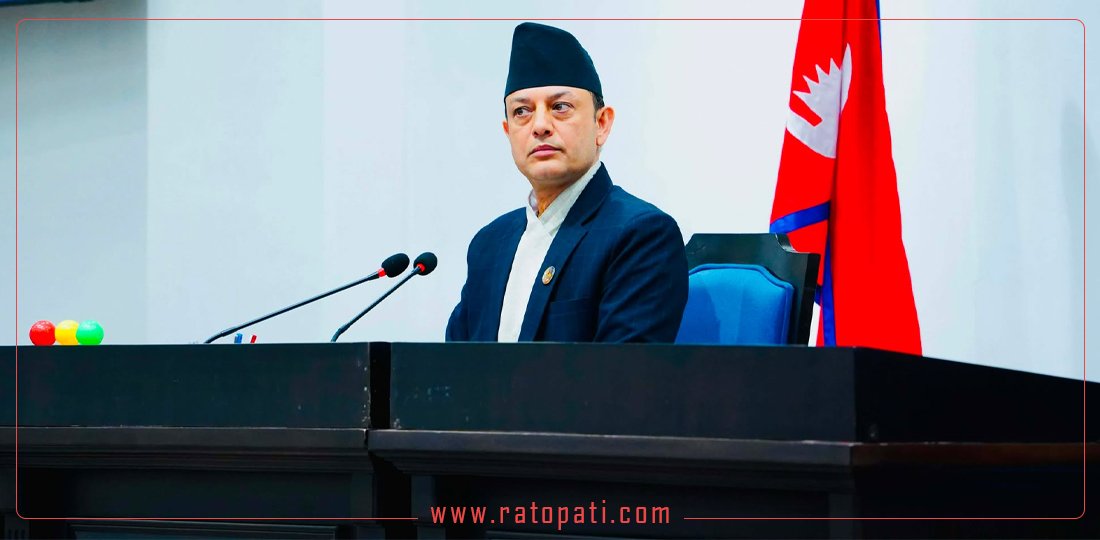
During the House of Representatives meeting on Wednesday, Speaker DP Aryal's video addressing President Ram Chandra Paudel as 'Prime Minister' while reading a letter from the Office of the President has gone viral on social media.
A human error occurred on the part of the Speaker while reading the letter sent by President Ram Chandra Paudel regarding the formation of the Council of Ministers and the division of work. In the house, instead of saying 'Honorable President', Aryal pronounced 'Honorable Prime Minister'.
While MPs can raise objections to the speech of the Prime Minister and ministers in the parliament, there is no such provision for the Speaker. In such a situation, how can the error made by the Speaker be corrected? Or will it not be corrected? Ratopati's conversation with former National Assembly Secretary Rajendra Phuyal regarding the procedure to be adopted in such a situation:
- During the House of Representatives meeting on Wednesday, while reading a letter from the Office of the President, the Speaker addressed the President as 'Prime Minister' instead of 'President'. What kind of error is this?
Such an error should not happen in the parliament. However, humanly, such errors can occur sometimes. Even if such an error occurs, it should be corrected. For that work, parliament secretariat staff, especially senior officials, sit on either side of the Speaker or Chairperson.
- But, the error that occurred yesterday was not corrected; it seemed as if the staff or the Speaker did not even realize it?
The very purpose of sitting next to the Speaker is to resolve any errors or problems that may arise in the process or speech. Because in such a situation, they should show promptness. It is also the duty of the staff to provide written information to the Speaker to identify the problem and correct the error. Therefore, the error should have been corrected at that time.
- What is the correction process, and can the Speaker's speech also be removed from the record?
There is no practice in our parliamentary system of demanding the removal of the Speaker's speech from the record. Except in discussions on proposals regarding the Speaker's conduct not being appropriate, no action taken by the Speaker is criticized in the house. Yesterday's incident was an error due to a slip of the tongue rather than intent. Such an error should not remain in the house's record. Therefore, if the secretariat staff had written or given any indication or signal at that time saying, 'This happened here,' it could have been corrected then.
- It seems the Speaker and the staff did not pay attention to it; what is the way to correct it now?
The way forward is for the Speaker himself to correct the statement in the next meeting, rather than someone else demanding it.
Such mistakes have happened in the National Assembly before as well. In the discussion on the Electronic Transaction Bill, that mistake was not pointed out immediately. At that time, the staff sitting next to the Chairperson should have assisted the Chair by saying, 'This is not the topic today; another agenda is being introduced where there should be a specific agenda.' Of course, the Chair himself should also be mindful of such matters. Then, the speakers or members should also pay attention. If any of them make a mistake or weakness, the colleagues sitting as 'watchdogs' should play a role, but why they did not do so is something they themselves will have to explain.
- Are the letters read by the Speaker prepared by the parliamentary secretariat staff, or are the letters received from the President's office read verbatim?
Letters received from the President's office are read as they are. The practice is to copy the received letter and read it. However, 'working styles' can vary. Sometimes errors occur while reading such letters; it's not that they don't. Such errors should be viewed from a human perspective. When doing a live cast, we might pronounce one word instead of another that is written in the paper. In informal settings, this might not be a big issue, but in a formal forum like parliament, such an error should not happen, and if it does, it should be corrected immediately. If it was not corrected, it should be corrected now. The method of correction is that the Speaker himself should order the record to be corrected, stating, 'In the meeting of [date], while reading the letter of [subject], the President's name was mentioned incorrectly, and it is hereby corrected.'
- Do you recall any such incidents happening before?
I recall one incident. In the National Assembly, while using the designation before a minister's name, the concerned minister was not a doctor, but 'Dr.' was mistakenly pronounced. However, it was corrected immediately.
This specific news has been automatically translated by AI. As a result, there may be some inaccuracies or language errors.

_Eqo5W0NMVM.jpg)