Government Extends 50% Discount on International Airport Handling Fees, Airlines Remain Uninterested

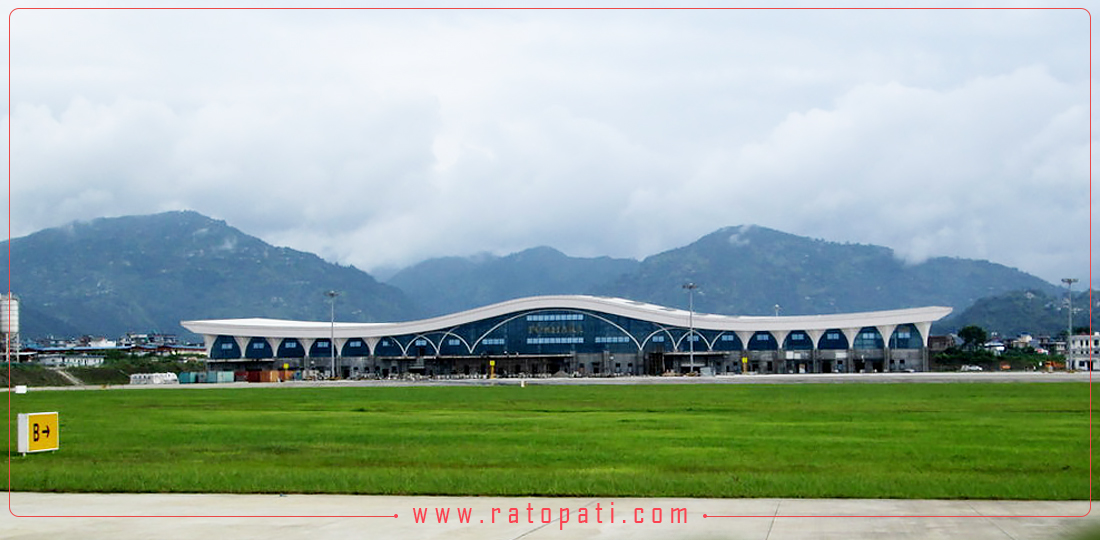
Kathmandu. On Wednesday, the government decided to provide a 50 percent discount on ground handling and airport fees for two international airports in Bhairahawa and Pokhara. The cabinet meeting made this decision to continue the discount that was in place after the airports began operations.
Currently, for narrow-body aircraft, the fee for a single flight at the airports is nearly one thousand US dollars. Jagannath Niroula, chief of Pokhara International Airport, states that wide-body aircraft have to pay up to fifteen to sixteen hundred dollars based on weight. This 50 percent discount has been continued. In the new system, which will be implemented from October, chartered flights will not be eligible for the facility.
Although the government has attracted international flights by offering airport discounts, international airlines are currently not interested in providing services from Bhairahawa and Pokhara airports. Currently, there are no regular flights at Pokhara and Bhairahawa airports. The aircraft that were sent to Bhairahawa due to the upgrade of Tribhuvan Airport have also returned to Kathmandu.
Why don't aircraft want to go to Pokhara and Bhairahawa?
According to Rajkumar Chhetri, former Director General of the Civil Aviation Authority of Nepal, no international airline chooses an airport based solely on landing fee discounts. He states that operational costs and commercial sustainability are more important for them. He mentions that there are five main reasons why Pokhara and Bhairahawa airports have not been commercially operational.
The most significant reason is the difficulty with air entry routes. The biggest technical complexity for Bhairahawa and Pokhara airports is the air route. Currently, aircraft wishing to land at both these airports have to use the airspace of Simara. Aircraft coming from the west, even after reaching above Bhairahawa, have to go to Simara before turning back for landing.
This adds at least 15 to 20 minutes of flight time for each aircraft. The increase in flight time results in a significant amount of fuel consumption. According to former Director General Chhetri, as long as India does not provide a new entry route from Mahendranagar or Nepalgunj, it is a losing business for airlines to come here.
The second reason is the obstruction with the Instrument Landing System (ILS). The modern landing system installed at Bhairahawa's Gautam Buddha International Airport has not been fully operational due to a lack of agreement from the Indian side.
This prevents aircraft from landing during bad weather or low visibility conditions. Airlines seek certainty in their flights, which is not available at these airports due to technical obstructions.
The monopoly and high cost in ground handling is another reason, he says. Although the government claims to have provided a 50 percent discount on ground handling, Nepal's ground handling charges are among the most expensive in the world. Due to the monopoly of Nepal Airlines Corporation, airlines are not able to get services at competitive prices.

According to Chhetri, even after a 50 percent discount, Nepal's charges may still be higher compared to airports in neighboring countries. To attract airlines, the private sector should also be allowed to compete in ground handling.
Another reason is the Kathmandu-centric system for workers. Although a large portion of youth going for foreign employment are from these regions, they are compelled to travel to Kathmandu for labor permits, medical examinations, and manpower-related work.
As long as these services, which are concentrated in Kathmandu, are not decentralized, passengers will prefer to fly from Kathmandu. He states that it will be difficult to operate the airports without a sustainable solution to this.
In the case of Pokhara Airport, the geographical structure of the place is also a contributing factor. Due to the geographical structure, aircraft coming here cannot carry passengers at full capacity. This increases the cost per passenger for airlines, which cannot be compensated by a simple fee discount.
No Government Initiative for Improvement
It has been about 4 months since the new government, with a fresh mandate, took office. However, the government has not yet taken any initiative to commercially operate two national pride projects of the country.
There has been no progress so far in resolving the issue of air routes, primarily with India. Instead, there have been discussions about strained relations with India since the new government came into power. India has shown little interest in flights from Pokhara Airport, citing that it was built with Chinese loans and is part of the BRI project.
However, the government does not seem serious about resolving this issue. Even when Rastriya Swatantra Party Chairman Rabi Lamichhane and then-ministers visited India some time ago, no concrete agreement or agenda regarding air routes was reported. The operation of these airports does not seem to be a priority for the Foreign Minister and the Tourism Minister.
Former Director General Chhetri believes that the government seems to be trying to evade responsibility by continuing the discount through the cabinet, saying, 'We provided the concession, but the airlines did not come.' However, there is a complete lack of proactive diplomacy and business planning needed to solve the real problems.
Authority Says: We are Bringing a Detailed Action Plan
Mukesh Dangol, Director General of the Civil Aviation Authority of Nepal, says that they are in the process of formulating an action plan for airport operations and will bring a detailed framework for it. He states that preparations are underway for this and that the detailed information will be made public.
Although the primary responsibility lies with the authority, he also mentioned that the support and cooperation of all parties are necessary for this. However, this is not a new issue. The authority has been talking about such action plans since the past.
Pokhara International Airport was built with a Chinese loan of approximately 22 billion rupees, while Gautam Buddha International Airport in Bhairahawa incurred an expense of about 35 billion rupees. As the time for interest and principal repayment of the loans for both these projects approaches, the income from the airports is currently almost zero.
The concession currently provided by the government is merely a continuation of the past. It is unlikely to add any new enthusiasm. Rather, the decision not to provide concessions on chartered flights from October is likely to impact special flights that occasionally operate in Pokhara.
This specific news has been automatically translated by AI. As a result, there may be some inaccuracies or language errors.
_acbIbW97AK.jpg)