Political Shifts Expected in Seven Provinces, Gandaki Remains Stable


Pokhara. Changes in the power equations of all seven provinces have begun. Ruling parties have recalled their ministers in some provinces, while ministers have been dismissed in others. The decision by the Nepali Congress and CPN-UML to break the central ruling coalition has particularly impacted the provinces.
The effect of the central decision has created a situation for the formation of new governments in all seven provinces.
Its impact is certain to be seen in Gandaki as well. If the government of the Congress-UML coalition, which has more than two-thirds of the votes, falls, parties will be under pressure to carefully gather the necessary numbers to form a new government. In the Gandaki Provincial Assembly, the Nepali Congress is the largest party with 27 seats. 30 seats are required to form a government here. If the 22 MPs of the UML withdraw their support to the government, Congress will need an additional 3 seats.
However, the government led by Congress leader Surendraraj Pandey has maintained the support of MPs from the Rastriya Prajatantra Party (RPP) and the then Nepal Socialist Party (now PRLOPA). RPP has 2 seats and PRLOPA has 1 seat in Gandaki. Adding this number brings the government's majority (30 seats). Nevertheless, as there has been no directive from the central leadership, there has been no movement in the Gandaki government so far.
Both ruling parties are unanimous that the central dispute should not be brought into Gandaki. However, they are not in a position to delay central directives. 'No decision or directive has come from the center. The Gandaki government has no problem,' says Chief Minister Surendraraj Pandey, 'If a decision comes from above, it's a different matter, otherwise, we will not make any changes now.'
Unlike in other provinces, here the Chief Minister has not dismissed UML ministers, nor has UML recalled its ministers. The UML Parliamentary Party meeting had assigned the responsibility to party leader Khagraj Adhikari to report to the center while maintaining the cooperation with Congress. Although some MPs suggested that the government should be formed under UML's leadership and some suggested being in opposition, the majority of MPs seem to be in favor of maintaining the current coalition.
UML Chief Whip Devaka Pahari says they are in a 'wait and see' situation. 'The situation in Gandaki is stable. Congress is also calm and we have not made any decisions,' she says, 'Something will become clear after meeting with Prachanda at the center. Until instructions come from above, no different decision will be made here.' Currently, both Congress and UML are awaiting decisions from the higher levels.
'There is no problem in the case of Gandaki Province. Due to the internal problems of Sudurpashchim, movements have been created in other provinces as well,' say leaders of both parties, 'At such a time, provinces should be given the right to make their own autonomous decisions.' In Gandaki, if Congress remains in opposition, all other parties must unite to form a government. A coalition of only UML and CPN (Maoist Centre) cannot form a government here. CPN (Maoist Centre) has 7 seats including the Speaker, but only 6 people can vote during government formation.
The government has passed the policy and program and budget through consensus. CPN (Maoist Centre), however, has claimed that if a new government is formed, it should get the Chief Minister post. The party's leader Haribahadur Chauhan says, 'We have given the leadership of the government to Congress and UML in turns. Now a new government should be formed under the leadership of CPN (Maoist Centre) and other parties should also support it.'
Looking at the current party-wise seat numbers in the Provincial Assembly, his argument is that it will be easier to form a government if a coalition of Congress and CPN (Maoist Centre) is formed. However, for now, all parties seem to be in agreement that the current coalition government should continue. RPP has also drawn attention, stating that changing the government when the current government is working effectively will not send a good message to the citizens.
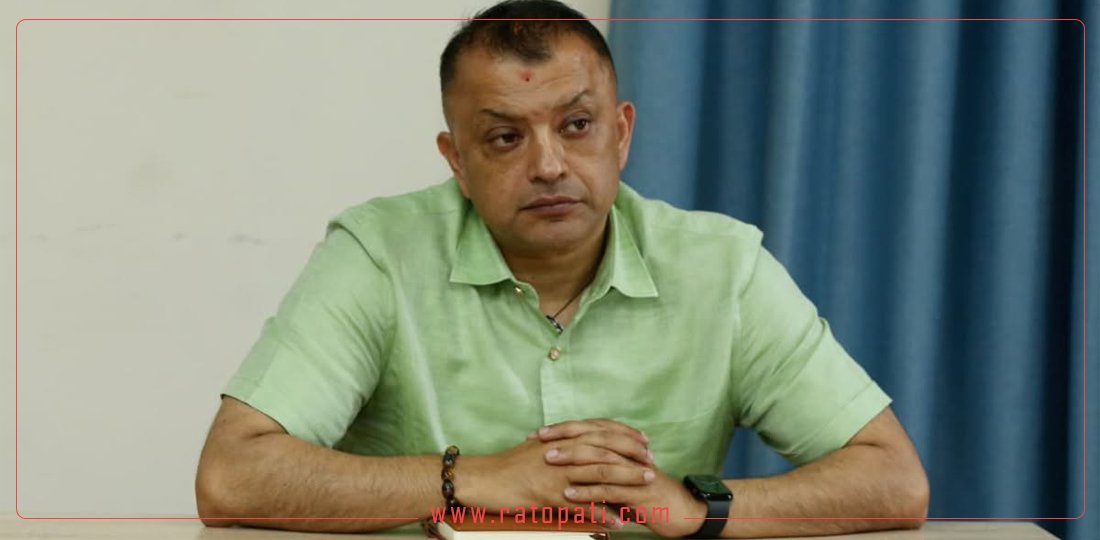
On Sunday, Nepali Congress leader Gagan Kumar Thapa addressed a program organized in Pokhara regarding suggestions for constitutional amendment. He did not give any reaction regarding the provincial government during his address. When journalists showed interest in this matter, he did not want to give any immediate reaction.
This specific news has been automatically translated by AI. As a result, there may be some inaccuracies or language errors.
_yw4FyrVD5F.jpg)