Book Discussion on 'Communicative Classroom': A New Paradigm for Teaching-Learning

I will advance the context from two practical incidents. The first incident was during the winter vacation of Minapachas. Schools used to run 'Winter Camps' during the holidays. One day during that time, a teacher was teaching a student a math problem in school. He tried four or five times, but the student could not learn.
I was watching this scene from a distance. After seeing all this, I told the teacher, 'Teach me this, I will teach the child.' He taught me, and then I taught the student the way to solve that problem. She learned the method of solving it at once.
The second incident, a primary class student showed a lesson from a book and said, 'Sir, there is a mistake in a sentence in this lesson.' I asked him to show me the wrong sentence in the book, and he showed it. The sentence was, 'Plants have a big hand in rain.' I asked him, 'Why is this wrong?'
He said with a confident voice, 'Sir, plants have a big 'leaf', not a 'hand'. It was written 'hand' by mistake.' If I had said, 'No, this is correct,' his learning would have stopped. What do both the above examples show is that communication plays an important role in learning.
Learning in the classroom becomes powerful when communication becomes dialogue, not fear.
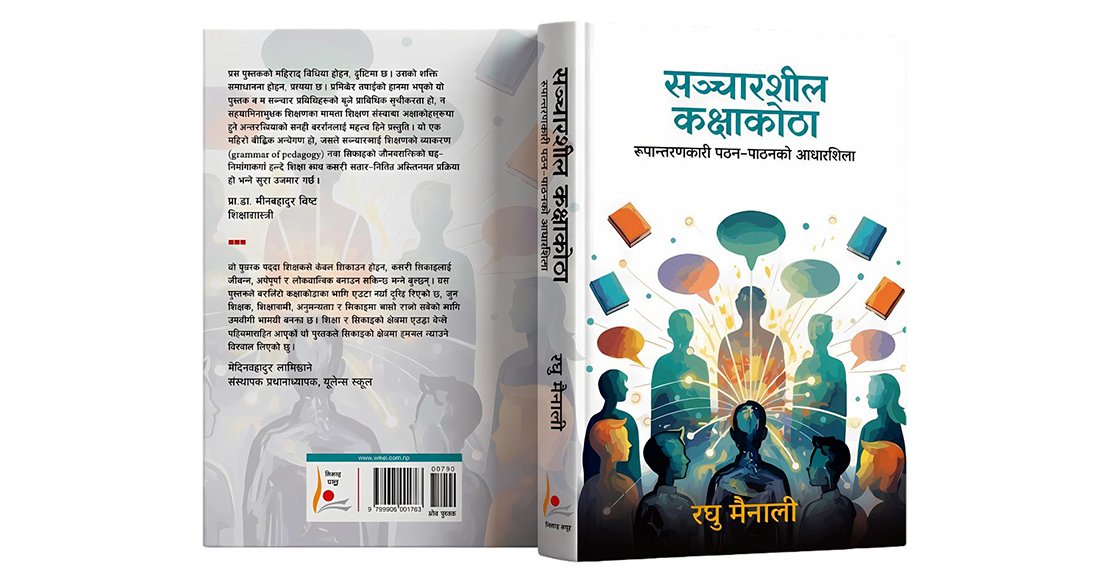
The book titled 'Communicative Classroom: The Foundation of Transformative Pedagogy', written by communication expert and long-time educator Dr. Raghu Mainali, redefines the classroom not just as a place for knowledge construction, learning skills, and concept development, but as an active community of dialogue, interaction, and participation in learning, in the continuously evolving journey of modern teaching-learning.
Through the book, the methods, approaches, and examples presented explain and analyze in a deep yet simple way how a communicative classroom challenges the traditional structure of classroom operation and how meaningful interaction between teachers and students can make learning lively, relevant, and effective.
The methods, approaches, and examples presented through the book provide today's teachers with an important foundation to transform their classrooms into more capable, inclusive, and inspiring spaces. This book creates a journey of transforming learning into dialogue. The classroom should not be a place to narrate knowledge, but a community to construct meaning.
We teachers do not have a single thought and understanding about communication. Because we lack the understanding of 'what makes communication happen?', we are unable to use communication correctly in learning.
Teachers should be facilitators of dialogue, not givers of information. Learning should not be one-sided, but participatory and relevant. A communicative classroom is not a change in structure, but a change in thinking, where learning is transformed into dialogue.
The first chapter of this book 'Communicative Classroom' presents communication as the cornerstone of effective teaching in the classroom.
We teachers do not have a single thought and understanding about communication. Because we lack the understanding of 'what makes communication happen?', we are unable to use communication correctly in learning. Teachers should not just transfer information, facts, data, definitions. The teacher's job is to create an environment that builds knowledge, teaches skills, and develops concepts by incorporating students' thoughts, experiences, and interpretations, and develops creative thinking and critical thinking in students.
Communication plays an indispensable role in creating such an environment. When teachers use linguistic, cultural, and relational aspects with sensitivity, learning becomes clear, inclusive, and two-way, transforming the classroom into a center of meaningful dialogue.
This chapter also covers common communication errors in the classroom, such as unclear messages, assumptions-based understanding, or incorrect cultural interpretations. Understanding all these elements is crucial for teachers because only effective communication can create an environment where students listen, understand, and engage in learning activities.
The second chapter clearly reveals how communication is actually formed, flows, and constructs meaning in the classroom.
In this chapter, teachers realize that 'communication' is not just an act of speaking and listening, but a complex yet interesting process shaped by context, medium, environment, and relationships. The language used in the classroom, the teacher's message, the student's response, the physical arrangement, or the digital platform all contribute to determining the quality of learning.
This chapter, presented with simple and lively examples of these diverse aspects, inspires teachers to reconsider their daily practices. It is extremely useful material for every teacher to understand how clear, sensitive, and context-appropriate communication can change the learning environment in the classroom.
The third chapter of this book accepts the classroom not just as a physical space but as a 'learning environment' created by communication.
This chapter is very inspiring for teachers who want to make learning open, safe, and dialogue-friendly.
This lesson explains the various dimensions of communication with interesting examples. It is written in detail how the communication a teacher makes in the classroom affects the student's learning.
For example, when a teacher uses accusatory language like 'Why don't you pay attention in class?', students immediately become defensive, but when the teacher uses descriptive and supportive language like 'How can we make this activity better?', students enthusiastically participate in learning activities.
This chapter is very inspiring for teachers who want to make learning open, safe, and dialogue-friendly.
The fourth chapter deeply analyzes the common problems in teacher and student behavior and communication seen in the classroom. The teacher's 'image and style' create distance and fear in students, which is a hindrance to learning.
This lesson also emphasizes the importance of the teacher's 'mindset'. For example, the teacher's fixed mindset of 'students don't learn' makes the class discouraging, whereas the teacher's growth mindset of 'they can learn' transforms the entire learning environment.
The teacher's communication behavior has a profound impact on students' confidence and participation. This chapter analyzes this reality in detail, making it extremely useful material for teachers. This chapter serves as a very useful resource to make teachers conscious of reconsidering their own behavior, voice, perceptions, and daily communication.
The teacher's clear explanation builds the student's understanding. The teacher's face, gestures, smile, or frown can change the classroom environment in an instant.
The fifth chapter teaches us to look at, understand, and apply communication in the classroom through a sociological lens. The classroom is actually a 'small society', where the student's 'home, family, language, habits, and thoughts' come together to stage a social drama. Teachers teaching in schools in the linguistically and culturally diverse Nepali society need to understand the sociology of communication.
If teachers do not use their power wisely in communication, students' learning will be weak. This lesson can be very useful material for teachers to understand not only 'how to understand' their students but also 'why it is important to understand'.
The sixth chapter has become a very useful, must-read material for teachers who want to transform learning in the classroom into a lively, shared, and organized initiative.
The teacher's clear explanation builds the student's understanding. The teacher's face, gestures, smile, or frown can change the classroom environment in an instant. The teacher's expression 'You must understand no matter what!' increases stress.
This chapter very practically explores how the teacher's behavior, voice, expression, and coordination profoundly impact students' thinking development. This lesson helps to understand why communication in the classroom is multidimensional, which helps teachers make learning meaningful.
The seventh chapter presents various perspectives on learning not just as 'theoretical matters' but as a living force connected to the teacher's daily practice. Different perspectives on learning open different windows to view learning.
Teachers must understand these perspectives. Teachers who know these perspectives can make learning meaningful. They can create a learning experience that is transformed according to the students' needs, equitable, and effective, rather than a 'one-size-fits-all education' in the classroom.
It centers on the idea that 'a good teacher does not get stuck in one method, but knows the art of using which method when'.
To transform Nepali education, what do we want? Education that produces 'goods to sell in the market'? Or citizens who can question, think, and communicate?
This fundamental question is effectively raised in Chapter Eight. In the Nepali context, education that produces goods to sell in the market has been dominant for decades. The main goal of education seems to be to pass exams, memorize facts, and bring 'excellent results' to enhance the school's prestige.
This limits teachers to 'information-giving machines' and students to 'notebook-filling devices'. In such a system, the tradition of questioning, debating, and constructing meaning through dialogue remains weak, resulting in strong memory but weak critical consciousness. Education should now shift towards creating citizens who can question and think critically.
Prioritizing open dialogue between teachers and students on social issues like 'caste, gender, or inequality' not only helps students remember the lesson but also helps them identify their society.
In science studies, dialogue like 'Why does this happen?' increases experimentation, testing, and inquisitiveness. If we do not prioritize communication in learning, what kind of citizens will we produce? It is time to ask questions. This lesson gives us this profound theoretical consciousness.
The 'Communicative Classroom' put forward by this book is not just a technique of teaching-learning; it is a fundamental transformation of the perspective of looking at education.
The final lesson 'Communicative Pedagogy' presents the approach of making communication methods the focal point of the classroom. It makes teaching-learning lively not by limiting it to a teacher-centered or fact-centered process, but through dialogue, interaction, collaboration, and meaning construction between students and teachers.
In Nepali classrooms, the tradition of teachers explaining and students listening has been common. The teacher should not just be a communicator of messages but also a guide and participant. The importance of communication methods for teachers is immense. It helps create an inclusive and motivating classroom, free from the traditional 'strict order-discipline' style. This method offers both challenges and opportunities for teachers.
The 'Communicative Classroom' put forward by this book is not just a technique of teaching-learning; it is a fundamental transformation of the perspective of looking at education. In such a classroom, knowledge is not a subject to be taught, but a process constructed through dialogue.
Teachers are facilitators of learning, not instructors. Students are not just listeners, but active co-travelers in constructing meaning. A communicative environment that respects questions, ideas, disagreements, mistakes, and experiences makes learning fear-free, relevant, and connected to life.
When the classroom transforms into a safe community for speaking, listening, thinking, and feeling, education fulfills its fundamental purpose of creating responsible, thoughtful, and aware citizens, not just helping them pass exams. This is why the communicative classroom method is not an alternative to modern education, but an indispensable foundation.
In summary, this book presents an approach to making the classroom not just a place for knowledge transfer, but a lively environment for dialogue, participation, and meaning construction. It inspires teachers to reconsider their roles.
Highlighting the limitations and effects of the prevalent 'information-giving-listening' and 'strict discipline' styles in the classroom, the book offers teachers both challenges and opportunities to build classrooms that foster active participation, inclusivity, dialogue, and critical thinking.
Reading this book, teachers understand not just how to teach, but how to make learning lively, meaningful, and democratic. This book has provided a new vision for the changing classroom, which has become useful material for teachers, educators, researchers, and everyone interested in learning.
(From the introduction of the book 'Communicative Classroom: The Foundation of Transformative Pedagogy' written by senior journalist, teacher, and communication expert Dr. Raghu Mainali. - Editor)
This specific news has been automatically translated by AI. As a result, there may be some inaccuracies or language errors.