Rastriya Swatantra Party Convention Addresses Internal Factions and National Challenges


In Nepal's political parties, 'party conventions' are considered important opportunities to strengthen internal unity, engage in ideological debate, and move forward with new energy by preventing fragmentation. However, as the upcoming convention of the Rastriya Swatantra Party approaches, it is seen as a crisis resolution for the conflict between the establishment and the non-establishment factions, which have emerged as internal power centers, as it reaches the threshold of the central convention after local, district, and provincial level conventions.
While preparations are in full swing for the first convention starting in Chitwan on Sunday, it is understood that within the Rastriya Swatantra Party, efforts are being made at the leadership level to work towards a unifying convention by reconciling differences between the power centers that have emerged at the provincial level.
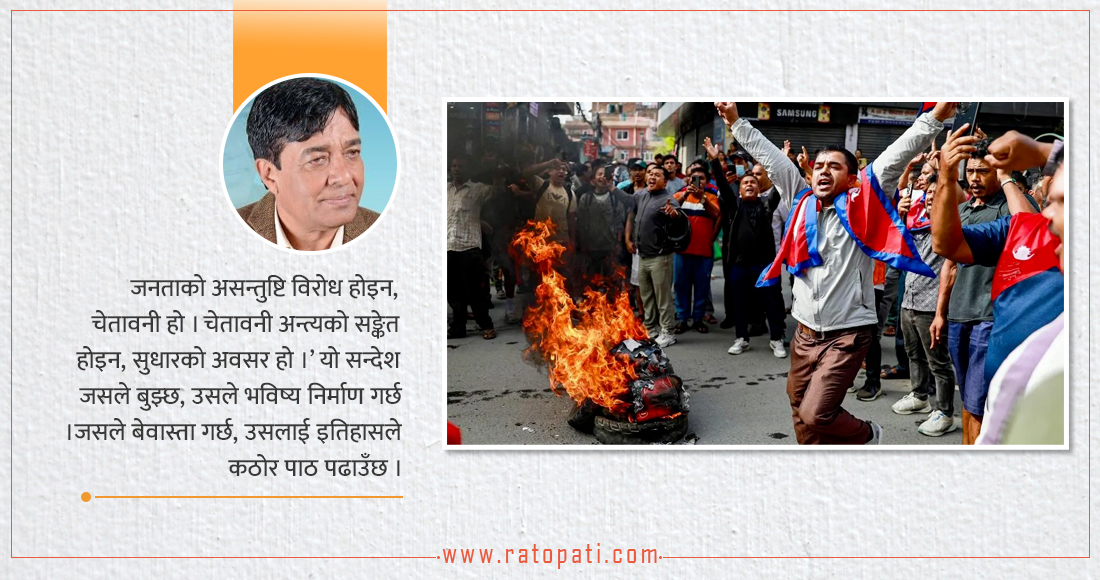
The leadership of the Rastriya Swatantra Party, just beginning to emerge from the ruins of the Gen Z movement, faces many responsibilities. The combined pressures of social, economic, technological, and environmental side effects experienced by the Gen Z generation, along with insecurity, unemployment, and political instability faced by the previous generation, have been significant.
For basic livelihood, they were forced to undertake risky foreign travel and work against their will. They faced severe inequality in accessing quality education and healthcare. However, with the changing times, this generation connected with digital technology. That is, the market economy put mobile phones and social media in their hands for information. While they found a medium to connect with each other and express political dissatisfaction, they were also introduced to some faces from the previous generation, labeled as 'political pollution'.
Nepal fundamentally needs an economically self-reliant democracy. If economic democracy continues to shrink, and we only rely on loans or grants from neighboring or donor countries, we will not get anywhere.
Today's generation is a new digital generation. The more updated one can be in the world of information digitally, the easier it is to be infected by misinformation. Nevertheless, the current growing generation is capable of examining and understanding the qualifications, capabilities, attachment to positions, greed, state exploitation, and tendency to present false details of themselves and the previous generation. They are also scrutinizing the leadership of the new generation.
This is why this generation is ready to raise its voice in the same way, from the parliament to the streets, against the tendency to fool ordinary people by presenting false figures. For this reason, the Rastriya Swatantra Party should not only consider the achievements of its four-year journey as its convention but also examine its shortcomings by keeping public expectations at the center.
Nepal fundamentally needs an economically self-reliant democracy. If economic democracy continues to shrink, and we only rely on loans or grants from neighboring or donor countries, we will not get anywhere. We need to move beyond yesterday's beggar economy mindset, attract foreign investment, and uplift the country's economy through our own resources.
Our primary schools to universities are transforming into a kind of substandard ruins. The culture of reading is heading towards extinction. Health facilities are being used for commercial purposes and are becoming inaccessible to ordinary people. Infrastructure such as roads, irrigation, electricity, drinking water, communication, and transportation is inadequate or substandard. Due to infrastructure development not being environmentally friendly and insufficient planning for rural development, there is rapid migration from the entire hilly region. The capitalist market of our neighbors has devastated our agriculture. We are transforming into a country that imports more than it produces.
Foreign investment is essential for the overall development of the country. It is also the state's responsibility to mobilize domestic capital and preserve, use, and protect indigenous skills. Foreign investment is primarily suitable for high-tech large projects and 'mega-industries' that are not possible with domestic capital and technology. It is immediately necessary for the government to organize international conferences targeting foreign investors to attract investment and highlight areas of opportunity for foreign investment in Nepal.
Land that was cultivated until a decade ago is now lying fallow. The embryo of industrialization has been aborted. Along with the lack of industrialization and the lack of modernization and distribution in agriculture, one-third of the total working population, i.e., members of Nepali lower-middle-class families, are forced to go for foreign employment. The inequality between the rich and the poor is at its highest in history. The convention should pay attention to such sensitive issues.
Even as the country reaches a 'golden cabinet' and 'golden economy', it remains dependent on a consumerist economy. It is seen that more than one-third of the total budget depends on remittances sent by Nepali workers from abroad.
The problems of non-resident Nepalis have not yet been resolved. There is no basic guarantee of good governance and no guarantee of investment for them to invest in Nepal. The government appears to be unaware of the 'Hotel Hilton' project that Shesh Ghale was planning to complete a few weeks ago. Children of Nepali mothers like Ghale, who have invested billions of rupees, want to invest in Nepal. However, instead of respect and encouragement from the government, they are only facing policy obstacles and insecurity.
Even as the country reaches a 'golden cabinet' and 'golden economy', it remains dependent on a consumerist economy. It is seen that more than one-third of the total budget depends on remittances sent by Nepali workers from abroad. As the culture of entrepreneurship declines, production has sharply decreased. The country's economy is limited to customs, revenue, and remittances.
To make the overall economy productive and dynamic, public and private investment needs to be increased. However, the bitter reality before us is that instead of a liberal economy, neo-liberal economic policy views only private sector investors and capitalists as the backbone of development and infrastructure.
After the Gen Z movement, the country is currently struggling with narrow economic activities. It will take at least a year for most of our business sectors to return to their previous state. The tourism sector will be affected for even longer. The food, telecommunications, and information technology sectors can recover faster than others. However, looking at most sectors, it seems that it will take some time for the market to return to its previous state.
What I mean to say is that if there were government policies to support all types of industries and businesses that contribute to the economy, the Nepali economy could become dynamic quickly. In such a situation, a public-friendly monetary policy would have to play a role.
The government must create an environment for investment in the market and for selling its services and goods. However, the situation in the market is not yet stable. This is because politics has not been able to stand fully on its own feet.
It is hoped that this historic first convention of the Rastriya Swatantra Party will play a role in establishing the party and politics, resolving internal differences, and moving the country forward, not backward. However, if this convention is used as a super-glue to avoid internal disputes, it will not add any enthusiasm to the public again.
This specific news has been automatically translated by AI. As a result, there may be some inaccuracies or language errors.