Inter-caste Marriage in Nepal: A Social Transformation
Nepal's social structure has long been influenced by the caste system. We have heard about the history of the Dalit community being left behind socially, economically, and culturally. Marriage was seen as a means of maintaining caste purity, so marrying outside one's caste was socially unacceptable.
In the past, couples marrying between Dalit and non-Dalit castes faced social exclusion, family estrangement, and in some cases, violence. However, with education, urbanization, democratic movements, and the expansion of communication media, changes have begun to be seen in society.
The issue of inter-caste marriage in Nepal is not just a question of marital relations between two individuals; it is directly linked to social structure, caste power relations, family control, and social change. Especially marriages between Dalits and non-Dalits challenge the deeply rooted caste mentality in Nepali society, thus creating debate and controversy for a long time.
Although the constitution grants equal rights to all citizens and considers caste discrimination a legal offense, in practical life, inter-caste marriage has not yet become a completely normal social practice.
Inter-caste marriages hold the potential to reduce caste prejudice in the long run, increase social integration, and develop a sense of equality in the new generation.
is not entirely detached from the existing reality of Nepali society. Family acceptance can provide emotional security, social support, and financial assistance to couples entering inter-caste marriages. Especially in communities where caste prejudice is still strong, family support can play a significant role in protecting couples from social pressure and exclusion. But here the question arises: is a marriage successful just because the family accepts it, and unsuccessful just because they reject it?
If a couple is living a life based on respect, trust, and equality despite family opposition, can it be called a failure? And if a marriage with full family support ends in divorce, how can it be considered successful? These questions highlight the need to view inter-caste marriage not just through the lens of family acceptance but from a broader social and sociological perspective.
However, there is another side to the perspective that considers family acceptance as the ultimate criterion for marital success, which is not discussed enough. In Nepali society, there are many examples of marriages, completed with the full support and consent of the family, that later faced crises for various reasons.
In some cases, as the relationship between the couple deteriorates after marriage, family members themselves become the cause of conflict. Stress between mother-in-law and daughter-in-law, family interference, disagreement on financial decisions, inability to live life freely, excessive pressure from family expectations, or lack of respect between the couple push the couple towards mental stress. In some cases, couples who married with full family support have been forced to live separately, while due to love, misunderstandings between the couple, and extramarital affairs, divorce has ultimately occurred.
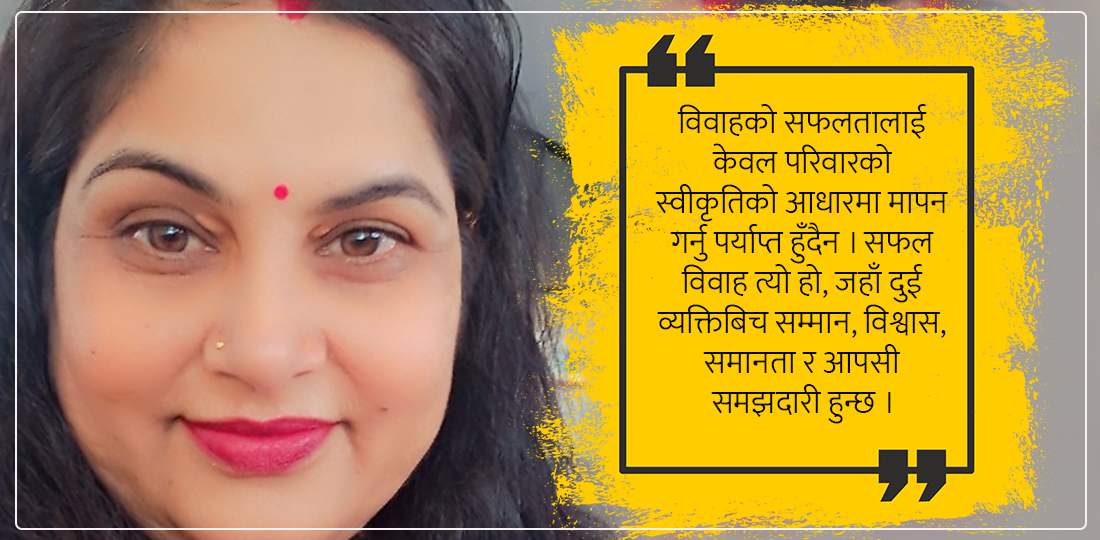
Measuring marital success solely on the basis of family acceptance is not enough. A successful marriage is one where there is respect, trust, equality, and mutual understanding between two individuals.
This clarifies that family acceptance can facilitate marriage, but it does not guarantee the stability or success of the marital relationship. If family support alone were the basis of success, all marriages solemnized in the presence of family would have to be successful in the long run.
The history of inter-caste marriage in Nepal is not just a history of individual love stories; it is a history of social power, caste structure, and changing struggles. For centuries, the caste system used marriage as a means of maintaining social boundaries. Marrying into the Dalit community was considered socially unacceptable. Although legal equality has been established today, inter-caste marriage is still challenging at the practical level.
Inter-caste marriage is not just a matter of personal relationships; it is also a social process of breaking down caste structures. When Dalits and non-Dalits marry, it is not just the relationship between two individuals, but also a practice of reducing the distance between two social groups. It helps to weaken the 'us and them' division in society and establish new practices of equality.
These marriages hold the potential to reduce caste prejudice in the long run, increase social integration, and develop a sense of equality in the new generation.
The history of inter-caste marriage in Nepal is not just a history of individual love stories; it is a history of social power, caste structure, and changing struggles
For example, in a village, after a Dalit young man and a non-Dalit young woman get married, there is initial opposition from the family and community. But over time, as their children, participation in festivals, and family relationships expand, the relationship, initially considered impossible, becomes normal. This starts a process of gradually reducing social distance. For this reason, inter-caste marriage is also seen as a means of social transformation, not just a personal decision.
Therefore, measuring marital success solely on the basis of family acceptance is not enough. A successful marriage is one where there is respect, trust, equality, and mutual understanding between two individuals. Family support can make that journey easier, but concluding that the relationship will automatically fail in its absence is also not correct.
Overall, the unacceptability of Dalit-non-Dalit marriage is a complex social issue that cannot be understood solely from a caste perspective. It involves caste, class, prestige, tradition, and social pressure. For real change, along with legal provisions, social consciousness, education, and the development of a mindset that places human relationships above caste are necessary.
(The author is a professor at Padmakanya Campus.)
This specific news has been automatically translated by AI. As a result, there may be some inaccuracies or language errors.