Analysis of Electoral Defeat: Internal Weaknesses Hamper Party Progress
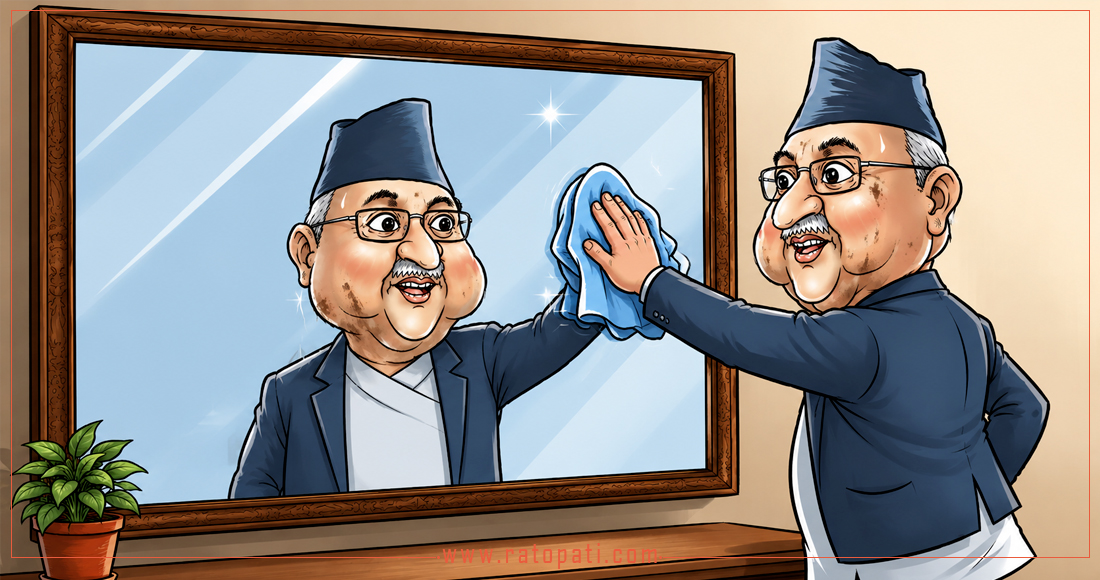
‘उम्र भर गालिब यही भूल करता रहा
धूल चेहरे पे थी आइना साफ करता रहा’
This Nazm by the famous poet Ghalib is very popular. This small Nazm says a lot and also strongly satirizes a particular tendency.
The true internal strength of any political party or movement is tested only when it faces unexpected defeat or a serious setback. Defeat and victory in politics are natural democratic processes. However, the self-reflection and reaction after defeat determine the future, maturity, and level of consciousness of that party.
It is an established psychological truth that every weak person pays more attention to the past. Being serious only after defeat shows that. Looking objectively at the past election results, it is clear that a big and serious wave has come in Nepali politics.
In the past elections, old political parties that had been rooted for years and had been running the country did not achieve the expected and desired victory. This result was not just a change in arithmetic figures, but a strong push given by the general voters through a silent rebellion against traditional political style, monopoly, and behavior.
The CPN (UML), which claimed to be popular and strong, also felt a big shock. This shock is so serious that it has been forced to review the party's organizational arrogance and ideological continuity.
The discussions that have come to the surface so far, the public expressions and answers of the leadership appear very superficial, lip-service, and unaccountable.
As soon as the election results were fully public, the same question has been arising intensely and critically inside and outside the party – why did the party lose the election? In a democracy, any organizational or political failure is considered an essential condition for a ruthless, objective, and transparent review. A serious review of this defeat should also happen within the party. It is certainly happening.
However, the discussions that have come to the surface so far, the public expressions and answers of the leadership appear very superficial, lip-service, and unaccountable.
Instead of openly accepting their weaknesses and policy deviations, the way the leadership and responsible bodies are diverting the issue is only covering up the core of the problem instead of solving it. Therefore, if we are to say 'as is', 'votes were less, the election was lost.' Or rather, 'not everyone can win, we lost because others won,' as if we have no responsibility for losing the election.
Such irresponsible, light, and self-indulgent arguments can neither satisfy the honest workers who worked day and night nor can they set a correct organizational roadmap for the upcoming elections.
There is an established bad culture in the Nepali communist movement and the overall political sphere – to blame abstract, invisible, and external forces for hiding one's internal weaknesses and to appear as a saint. Instead of considering this unexpected defeat of UML as a result of their own working style, individual ego, and lack of transparency, some top leaders have tried to dismiss it by taking refuge in a traditional political slogan.
In political terms, 'Geopolitical influence, i.e., internal and foreign powers want to weaken the communist movement, it is its effect.' Does this statement not amount to distrusting the people? Perhaps, but this is not new, the question of how to stop it is important.
When the main reason for defeat is considered only as 'external forces' or 'foreign conspiracy', it indirectly raises serious questions about the consciousness, wisdom, and decision-making capacity of the sovereign citizens of one's own country. Concluding that the general voters, the majority of Nepali citizens, are directly mobilized by external forces, is it not an insult to the mandate? Such a mentality that considers voters as unintelligent and mobilized tools further weakens and distances the emotional connection between the party and the people.
If we consider the narrative that public opinion and general citizens are only mobilized by external forces to be true, then the utility and existence of the party's vast organization, committees, and cadre force spread up to the ward and neighborhood level are questioned. What were the organizations active up to the neighborhood, the cadres mobilized in them, and the leaders operating them doing? Are the cadres naive or the leaders incompetent? Are these questions not serious? Should not the cadres and leadership of a vibrant and dynamic party be able to gauge the public's dissatisfaction and changing psychology in time?
If the committees in villages, neighborhoods, and wards cannot understand the public's dissatisfaction and the feelings of the new generation, then it is the overall defeat of the organization. Whatever is said about betrayal, internal conflict, vote change, etc., it is fundamentally the weakness of the leadership. Are these and similar issues included in the review? If a realistic review is to be done, these must be taken seriously. It cannot be hidden that internal conflict, factionalism, and the seeds of betrayal are also actually the product of flawed leadership and discriminatory management.
The tendency to impose from the center, disregarding the party's established criteria and local committee recommendations, created disappointment among the cadres. In some places, it felt like the ticket was 'hijacked'.
Another major and stinging reason for the electoral defeat is the contraction of internal democracy and the extreme lack of transparency in the candidate selection process. There can be many aspirants before the election who want to contest. Not everyone will get a ticket. However, there was no transparent method or satisfactory explanation given as to why those who got the ticket got it and why those who didn't, didn't. Due to the short-sighted and opaque decisions in ticket distribution, strong dissatisfaction and rebellion had escalated.
The tendency to impose from the center, disregarding the party's established criteria and local committee recommendations, created disappointment among the cadres. In some places, it felt like the ticket was 'hijacked'. The leadership appeared silent and like a spectator on this issue. This chaos and arbitrariness in ticket distribution created an artificial and stinging dividing line within the party. An situation was created where those who got the ticket were victorious and those who didn't were defeated. This had a deep negative impact on the psychology of the cadres.
Not only this, but the party's election slogan, agenda, and campaign style also appeared completely traditional, rigid, and irrelevant to the aspirations of the new era. Election campaigns were not futuristic. The song of past good deeds was sung, the same speech was repeated.
When UML entered the electoral arena, instead of presenting a vision according to the demands of the new era, it tried to cash in on decades-old achievements as a political vote bank. Positive and beneficial issues brought by the Manmohan Adhikari-led government were raised, which were issues from 32 years ago. Expecting this to influence today's 18-year-old voters was unimaginable.
It was not possible to bind today's new generation, who have opened their eyes in the open era of the internet, digital technology, and globalization, with only the old stories of 'Build Your Own Village' or old-age allowance from 32 years ago. The new generation was looking for concrete assurance of good governance in the present and employment in the future, which was nowhere to be seen in the party's campaign.
Similarly, the issue of nationalism was also limited only to emotional slogans and a means of collecting election votes, and its practical and long-term aspect was completely ignored. The 'pointed map' incorporating Kalapani, Lipulek, and Limpiyadhura, territories encroached upon by India, was presented as a symbol of patriotism. However, reliable policies and plans to improve the living standards of the citizens in those areas were not presented.
Although passing the map was a historic step, the lack of concrete plans for the basic education, health, and physical infrastructure of the people in the border areas gave rise to serious suspicion that the issue was only used for narrow political interests.
The party made the physical development work done during its own government in the past its main success. It sang the song of the reconstruction of Dharahara, Rani Pokhari, Durbar High School, and other structures destroyed by the earthquake. The construction of tunnels and Marich Diversion was discussed. However, while these physical structures illuminated the capital and a few limited areas, they did not add any warmth to the daily lives and hearths of the poor citizens in remote areas. If the expected impact was not seen even in those places, for the people in remote areas, it was like 'gold in Lanka, but my ears are empty' or 'fruit of the sky, die with eyes wide open'.
Those who did not get tickets were seen as 'inferior' characters who did not understand politics at all. Even cadres and conscious voters were treated like machine parts.
In this self-indulgence of physical development and the intoxication of obtaining election tickets, the candidates showed a kind of extreme arrogance and pride, which further annoyed the conscious voters. Those who received tickets as candidates in the election considered themselves winners, the best, and omniscient. Overall, it felt like they considered themselves akin to 'Alexander the Great'. This pride and arrogance were so ugly that they looked down upon their own old comrades and peers who did not get tickets.
Those who did not get tickets were seen as 'inferior' characters who did not understand politics at all. Even cadres and conscious voters were treated like machine parts. Such inhuman politics brought the vibrant dialogue between the party and the people to a halt. There was no serious discussion anywhere about what the future of the country would be, how prosperity and happiness would be achieved.
The 'door-to-door' campaign was done with garlands, shawls, and music. The public did not get the opportunity to openly discuss with the potential representatives (candidates) about the party leadership, the movement, and future plans. Artificial fanfare and flattery took the place of debate and ideas. The candidates seemed to be under the illusion that they could influence voters by accepting the honor of sponsored garlands and shawls.
The aspect of organizational management and election mobilization appeared even more disappointing, narrow, and plagued by factional revenge. The situation was such that even rival leaders from the general convention were not properly utilized in election campaign management. Cadres who did not become candidates and established and capable leaders from 'other factions' were not provided an environment to be fully active in the election campaign. Instead of strengthening internal democracy and coexistence within the party, trying to settle factional scores just before the election proved to be suicidal for the party in the end.
The party's campaign style also shifted from being idea, policy, and movement-oriented to extreme personality worship and deification, which had the opposite and negative effect on society. Far from challenging the monstrous portrayal of party chairman KP Oli as 'unbearable to carry', even those who deified him by saying 'there is no alternative to KP Oli' were not seen carrying banners with his photo.
Even the slogan recently set by the party was not used. The leadership failed to understand that centering the vast movement of ideas only around an individual leads to organizational contraction and breeds disgust among the general public.
Looking at the national-level election debates and the activities of the top leadership, it is clear how narrow a circle the party was trapped in. Looking at the national debates, it seemed as if there was no election anywhere except in Jhapa's Constituency No. 5. The chairman and senior leaders were not seen actively engaged in extensive election campaigns outside their own constituencies. When top leaders of national stature feel insecure in their own constituencies and remain focused only there, it is natural for a defensive and weak psychology to be created among the cadres across the country.
After all, if the past of ‘धूल चेहरे पे थी आइना साफ करता रहा’ is repeated, what will happen? It is for the concerned to think. Others can only say ‘Ram Ram’.
When the tradition of respecting the past, the basis of building trust in the present, and the bright dream of the future are all weak, it was difficult to expect a different outcome from the elections held. A vibrant political party must have the glory of history, concrete plans for the present, and a clear roadmap for the future. However, this time UML only had the deposit and interest of history; it had no new and strong perspective or program to attract the new generation for the present and future.
The most worrying and ironic thing is that even after such a big shock and decline in public opinion, the party leadership still does not want to gauge the reality on the ground. Even now, not enough attention is being paid to the reality of the present and the bright future. One cannot improve oneself by shifting all the blame elsewhere. As long as the leadership does not free itself from the self-indulgence of placing the burden of defeat on others and remaining pure, the process of reform cannot even begin.
After all, if the past of ‘धूल चेहरे पे थी आइना साफ करता रहा’ is repeated, what will happen? It is for the concerned to think. Others can only say ‘Ram Ram’.
In the course of development of politics and society, it may happen sooner or later, but there is nothing that cannot be corrected and nothing that cannot be transformed. Where is there anything that cannot be corrected? Where is there anything that cannot be reached? The only question is – where to focus the vision and steps?
The historical path ahead is not to keep wiping the mirror, i.e., blaming external forces, opponents, or voters; rather, it is to clean the dust from one's own face, i.e., to firmly focus both vision and steps towards internal democracy, transparent working style, collective leadership, and a people-oriented socialist direction. Restoring the lost prestige and public trust in politics is not easy.
(The author is a former secretary and central party school department member of UML.)
This specific news has been automatically translated by AI. As a result, there may be some inaccuracies or language errors.


_6FSvCrCShE.jpg)