Debate on Local Elections: Party-based vs. Non-party System in Nepal
The discussion on constitutional amendment in Nepal has sparked debates from various angles on the form of governance and the electoral system. In this context, the Election Commission's recent 21-point suggestion to the government, with the 13th point stating 'Local level elections should be non-party,' has created a new stir in political and intellectual circles.
Specifically, the Rastriya Swatantra Party (RSP) has been advocating for making the local level non-party since its initial phase. But, will changing the form of elections increase the effectiveness of our local government? Or is the root of the problem not in the system but in our political tendencies? These questions require serious contemplation.
- Global Practice and the Meaning of Partisanship
Looking at democratic practices worldwide, both types of local election practices are seen in both successful and unsuccessful situations. In European countries, such as Denmark, local government elections are held on a fully party basis. I have personally observed the meetings of the local government in Denmark and their working style. Representatives are elected from parties, but their performance shows no flaws.
- So, How Did the Party System Itself Become Bad?
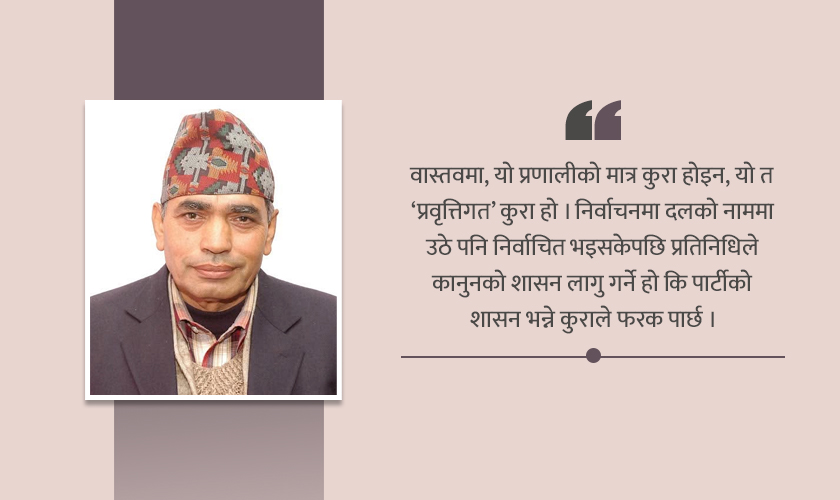
In reality, this is not just a matter of the system; it is a matter of 'tendency.' Even if one runs in the election in the name of a party, after being elected, it matters whether the representative enforces the rule of law or the rule of the party. Party discipline and governance should only apply within the party. When a person becomes a people's representative, they must work within constitutional and legal limits as a common representative of all citizens.
The problem lies here – even after being elected, representatives present themselves only as party workers, which fosters partisanship and anarchy.
- That Historic Debate in the Constituent Assembly
There was a long and extensive debate in the Constituent Assembly about what the local level elections should be like. I myself am a witness and participant in that debate. At that time, there were mainly two clear factions. The Madhesh-centric parties were of the opinion that local elections should be non-party. Their argument was that division on a party basis at the local level affects development and social harmony.
On the other hand, major parties like the Nepali Congress, CPN-UML, and Maoist were in favor of the party system. There was a solid basis for choosing the party system. There was a fear that if representatives were elected individually, they would not be accountable to anyone, and there would be no mechanism to control them. Who will control them if they are elected independently? Can the assembly alone control them? Elections on a party basis are designed so that party discipline applies, and if they commit corruption or become anarchic tomorrow, the party can take action, and their position can be lost. However, in practice, instead of stopping their representatives from doing wrong, parties have tended to protect them, which has led to questions being raised about the system itself.
- Federalism and the Contradictory Structure of Parties
Our country has moved to federalism, but our political parties are still stuck in a unitary structure and mentality. This is the biggest contradiction of federalism. After moving to federalism, everything from ticket distribution to decision-making processes should happen at the local level. But even today, to get a ticket for a ward chairman or mayor, one has to go to the central office in Kathmandu.
If the parties were truly federalized, the lower-level committees would distribute tickets, and they would have to take credit or blame for their good or bad work. Currently, tickets are distributed by the center, but no one takes responsibility for the work. Citizens cannot question the leaders sitting in Kathmandu, and local representatives have the backing of the center. This structural flaw has weakened local government.
- The Illusion and Reality of Non-partisanship
Does non-party elections solve all problems? Some examples from our history and present do not confirm this. Even during the Panchayat era, elections for village panchayats were held. In student union elections, panels like 'progressive' or 'democratic' would contest, but behind them, there was strong 'backing' from the parties. Even today, we have a system of party defection to make positions like President, Vice President, Speaker, and Deputy Speaker 'non-partisan.' But in practice, have we felt them working above party lines? No.
In neighboring India, local elections are non-partisan, but even there, parties have influence in practice. Therefore, merely writing 'non-partisan' on paper does not change people's thinking and behavior. In party-based elections, there is a provision for losing one's position if the party takes action, but in non-party elections, even that is not the case. This also carries the risk of making representatives even more autocratic.
- The Disease of Budget Distribution and the Culture of 'Sycophancy'
Another major obstacle to the effectiveness of our local level is the wrong style of budget distribution. We often hear that 30-40 percent of the total budget is concentrated only in the constituencies of the Prime Minister, influential ministers, or the Finance Minister. What kind of democratic culture is this? Even within the same party, the tendency to hoard budgets only in the main leader's area, leaving out everyone else, has crippled the local level.
The solution to this problem should be sought through legislation, not by changing the electoral system. We need an indicator-based budget system. There should be a law for budgets to be allocated based on the needs of a region, its population, and geography, not based on the influence of leaders. Currently, local representatives are in the unfortunate situation of having to go and 'flatter' ministers or officials to get budgets. They make many promises to the public during elections, but the budget is in the hands of the center. Unless this culture of 'sycophancy' is ended, people will not get relief, regardless of whether the system is party-based or non-party.
- Need for Cultural and Tendency Reform
Our democracy is still in the process of 'socialization.' In Europe and America too, there were many problems at the local level in the beginning. Gradually, they became responsible. After being elected, it takes time to develop the behavior of being a common person for all citizens, not just for a faction or party.
Currently, in some local levels, village or municipal assemblies have not been held. This is a serious issue. Not holding assemblies means local democracy is stalled. The responsibility for this lies not only with the concerned mayor or chairman but also with the party that nominated them. Why don't parties pressure their representatives to hold assemblies and work for the public? Because the parties themselves are not responsible. The media and civil society should not just question the mayor but also hold the party that gave them the ticket accountable.
- Conclusion
In conclusion, whether local level elections are party-based or non-party is not an end in itself. It is merely a technical aspect. The main thing is the purification of our political conduct and tendencies. As long as there is no law-based budget system, a guarantee of good governance, and federalization of parties, the debate on changing the system alone cannot bring about change in people's lives.
We need to focus the debate on changing tendencies and strengthening the law rather than changing the system. The main need of the hour is to establish a culture where elected representatives treat both those who vote for them and those who don't equally, and parties make their representatives accountable to the public.
Unless these things are rectified, whether you make it party-based or non-party, the result will be the same. To strengthen the local level, considered the root of democracy, there is no alternative to bringing purity in rules, laws, and conduct.
(Based on a conversation with Sapkota, Constituent Assembly Member and expert on local governance, by Phaneendra Nepal)
This specific news has been automatically translated by AI. As a result, there may be some inaccuracies or language errors.



_6FSvCrCShE.jpg)