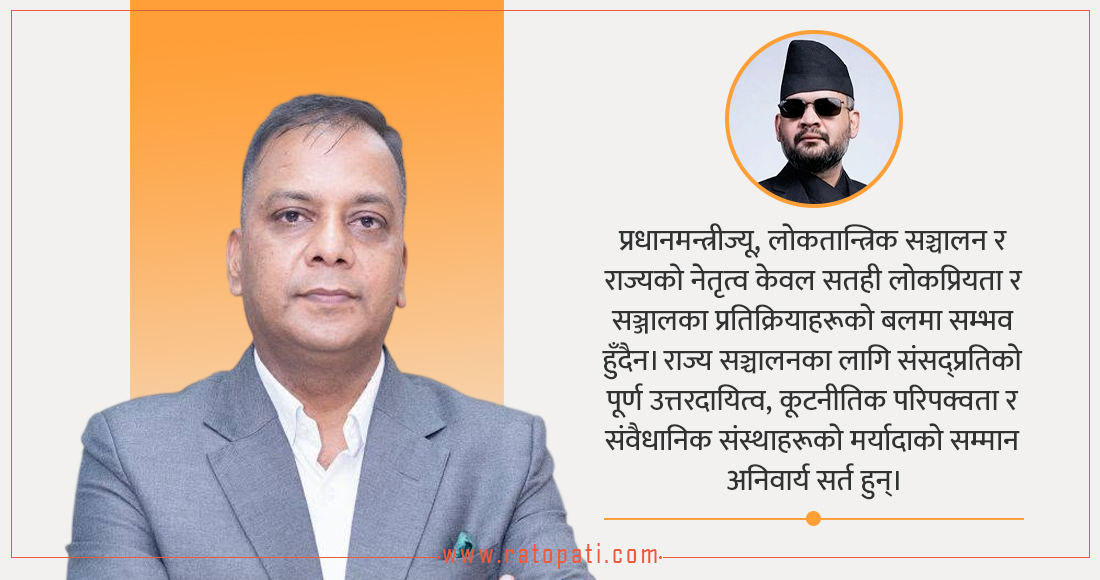
Prime Minister Balen Shah's Actions Undermine Parliamentary Supremacy


The political scenarios that have unfolded in Nepal's parliamentary history in recent days have raised serious questions about the future of democracy. In particular, the actions of Prime Minister Balen Shah ‘Balen’, who holds the responsibility of the country’s executive head, have flouted democratic values and principles by disregarding the supremacy and dignity of parliament.
The Prime Minister walking out midway while the President was reading the government’s annual policy and program in the joint session of parliament was not just an ordinary political incident. It was a violation of state dignity and extreme disregard for parliament. This irresponsible behavior shown by the Prime Minister himself, the proposer, while a respected institution like the President was presenting the government’s roadmap, has struck at the very soul of the parliamentary system.
Not only this, but a commotion occurred in parliament on Wednesday when Prime Minister Balen Shah was not present at the time of presenting the proposal for discussion on the policy and program, and parliament could not function. In Thursday’s session, the Prime Minister was sought, but the discussion on the policy and program was advanced without his presence.
In a parliamentary system, the Prime Minister must be accountable to parliament. However, Balen assigning the Finance Minister as a ‘proxy’ even during the discussion of an important proposal like the policy and program indicates his lack of accountability to parliament. Opposition parties have also made the same accusation. Parliament is not just a building made of bricks and mortar; it is a forum where the voice of the sovereign people is expressed.
The Prime Minister walking out midway while the President was reading the policy and program was not an ordinary incident; it was extreme disregard for parliament and a violation of state dignity.
Every activity here represents the nation’s image and political culture. However, such behavior by the Prime Minister feels like a mockery of Nepal’s parliamentary practice.
In a parliamentary system, the executive must be fully accountable to parliament. It is the Prime Minister’s constitutional and moral obligation to respond to discussions on the policy and program and to answer the questions raised. However, by evading his accountability and not being present in parliament, it exposes the increasingly arbitrary character of the Prime Minister.
It is natural for opposition parties to object to this issue and boycott the session, as only the presence of the opposition keeps parliament alive and forces the government to remain accountable to the people. When the head of government himself fears facing parliament or considers it an unnecessary hassle, the fundamental pillars of democracy begin to shake.
The tendency to evade parliament and run away from the questions of the people’s representatives ultimately fuels authoritarianism. The Prime Minister’s move has not only insulted parliament but has also betrayed the trust of the people who elected him.
Previously, the style the Prime Minister adopted of ruling through ordinances by repeatedly bypassing parliament clearly shows that he believes in autocratic rule more than democratic processes.
Bringing laws through the backdoor by ending the session while parliament is in session or without giving parliament any work is a mockery of parliamentary democracy. Issuing laws through ordinances for the benefit of a handful of people, which should have been thoroughly discussed and amended in parliament, has made a mockery of the rule of law.
The style of ruling through ordinances by bypassing parliament clearly shows that the Prime Minister believes in autocratic rule more than democratic processes.
Such practices reduce parliament to mere formality and open the way for the executive to exercise unchecked power. In a democracy, the principle of separation of powers and checks and balances is very important, but the Prime Minister has interfered with the jurisdiction of parliament and tried to forcefully impose his decisions. This has disrupted the balance between the state organs.
Such ungenerous steps taken by the Prime Minister against the parliamentary system and practices reflect his indifference towards the country and its people. This disrespect towards parliament, the forum of the people’s representatives, is actually disrespect towards the people themselves. In a democratic system, the behavior of individuals is as important as the processes and systems.
The arrogance and ego shown by the Prime Minister are weakening the system itself. When the ruler begins to consider himself above parliament and the law, the fragrance of democracy fades, and dictatorial tendencies emerge.
It is unfortunate that at a time when Nepal needs to institutionalize the federal democratic republic achieved through long struggle and sacrifice, an individual in a responsible position is attacking the system in this manner.
The Prime Minister’s tendency has set a wrong precedent for the future as well. If today’s behavior is taken lightly, other rulers in the future will also dare to disregard parliament in the same way. Maintaining the dignity of parliament is not just the responsibility of the opposition parties; it is primarily the duty of the ruling party and the head of government. However, here, the protector appears to be the destroyer.
Not participating in the discussion on the policy and program and evading questions also confirms that the government lacks a clear vision and logic. The fact that parliament, where discussions and debates should be held on the fundamental problems of the people, the country’s economic situation, and good governance, is itself becoming a victim of boycott and disregard has increased concerns about the country’s direction.
Democracy is not just about winning elections and coming to power; it is a continuous process of dialogue, consensus, and cooperation. The Prime Minister must listen to the voices of the opposition parties and address their legitimate demands. Governance conducted by paralyzing parliament or bypassing it cannot gain long-term legitimacy.
The executive must be fully accountable to parliament. Governance conducted by paralyzing or bypassing parliament cannot gain long-term legitimacy.
The Prime Minister must understand that he has reached that position because of parliament and that he remains there with the confidence of parliament. Therefore, he should not do anything to erode the very foundation on which he stands. An ungenerous attitude towards parliament weakens democratic institutions, which will inevitably have a direct impact on the country’s development and stability.
In the current situation, it is also necessary for civil society, the intellectual community, and the media to raise their voices against such non-parliamentary activities. A deep analysis is needed of how the Prime Minister’s actions are weakening the democratic system. The entire system should not be tarnished due to the whim or arrogance of one individual.
Instead of patching up the minor loopholes in the parliamentary system and strengthening it, it is extremely regrettable that the Prime Minister himself is trying to dismantle it. It is a mockery of democracy for someone who has sworn to work for the benefit of the country and its people to insult such a dignified institution as parliament.
In conclusion, the recent activities shown by Prime Minister Balen Shah have lowered Nepal’s political culture to a very low level. Actions such as leaving parliament while the President was addressing, showing no accountability in parliament, and trying to rule through ordinances have portrayed him as an ungenerous and arbitrary ruler.
Such steps have attacked the fundamental spirit of democracy and increased the risk of creating disillusionment with the system among the people. If the Prime Minister does not mend his ways and does not accept the supremacy of parliament, it will certainly push the country towards further instability and constitutional crisis.
The preservation of democracy requires respect for parliament, the rule of law, and accountable leadership as essential conditions. Any practice conducted by disregarding these conditions will ultimately destroy the system. Therefore, becoming aware in time and restoring parliamentary dignity and demonstrating democratic conduct is the primary need of the hour.
The people are watching, and history will surely make a harsh evaluation of every such step. The Nepali people who love democracy will never forget this brutal attack on parliament, and politics may have to pay the price for it in the future. There is no alternative to making parliament vibrant and respected to keep democracy alive.
This specific news has been automatically translated by AI. As a result, there may be some inaccuracies or language errors.