National Human Rights Commission Report Highlights Issues, Raises Questions on Accountability

The National Human Rights Commission's report attempts to cover various dimensions of the events of Bhadra 23 and 24. The report raises some serious issues and has recommended further investigation and necessary legal action to the Government of Nepal. Such recommendations aimed at identifying the real culprits, ensuring legal accountability, and providing justice to the victims are important.
According to the report, a fake social media account and content were created and broadcast in the name of the Nepal Police with the intention of deliberately escalating the protest on Bhadra 23 into a clash and using young people, especially school students, as human shields. The Commission has suggested identifying and impartially investigating the individuals involved in this act.
Similarly, the report also raises serious questions about the role of campaigns or groups such as 'Hami Nepal' and 'TOB'. Indicating that there may have been an attempt to influence or control the movement, the Commission has recommended an impartial investigation into the roles of the concerned parties and the initiation of necessary legal processes.
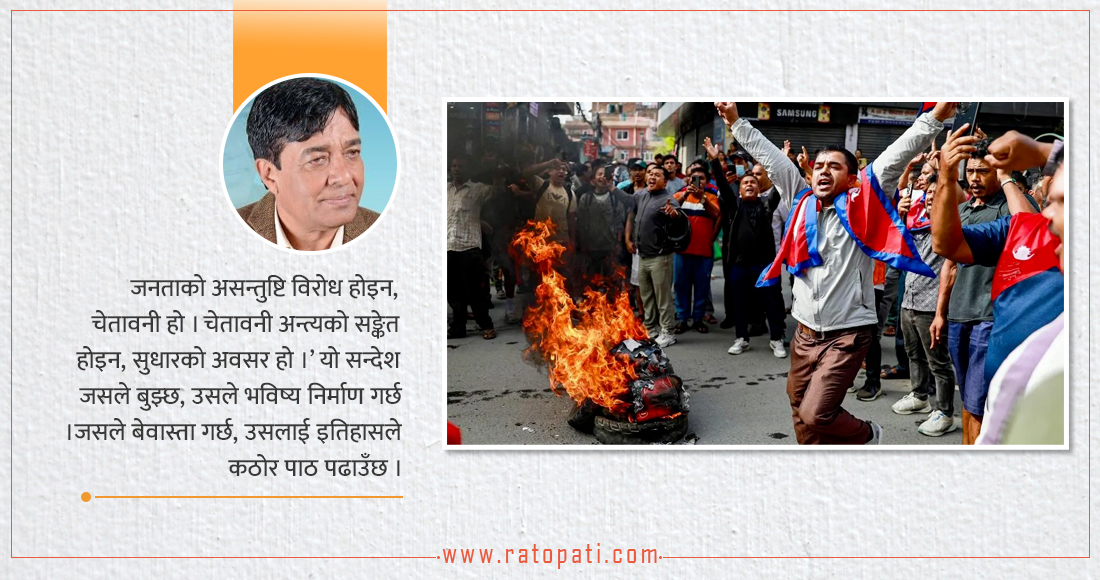
The Commission has evaluated the events of Bhadra 24 as organized criminal activities that went beyond the limits of a normal political demonstration. In this context, it has been suggested to bring the potential roles of the current ministers, members of parliament, and ruling party leaders within the scope of investigation and to proceed with the necessary legal procedures.
The Commission has depicted the incident of a large number of prisoners escaping or being made to escape from jail as a serious security challenge. According to the Commission, after this incident, violence, looting, and other undesirable activities increased. The Commission has recommended an impartial investigation into the individuals, political party leaders, or other parties involved in this incident and action according to the law. Furthermore, it has been mentioned that the deaths of some prisoners due to clashes and confrontations during the escape should also be brought within the scope of the investigation.
The Commission concludes that misleading information, provocative statements, and incitement spread through social media have further tensed the situation. Therefore, the Commission has advised the government to identify the individuals involved in such activities and initiate the process of necessary legal action.
While the report identifies those involved in similar incidents with specific names, it appears to remain silent regarding the current Prime Minister, Speaker, and Chief of the Army Staff in cases of similar incidents. Such a contradiction in matters of human rights is a serious issue.
Acts of arson, vandalism, looting, and damage to important state bodies, national assets, business establishments, and private property in the name of protests or political dissatisfaction should not be excused under any pretext. Public pressure should be created on the government to identify the individuals involved in such criminal activities and take action according to the law after impartial investigation.
Despite the positive aspects of the report, some conclusions and recommendations appear contradictory and require reconsideration. For example:
1. Question Regarding the Responsibility of the Prime Minister and Home Minister
There does not appear to be clear evidence in the report that the then Prime Minister or Home Minister directly ordered human rights violations during the youth movement on Bhadra 23, was involved in such acts, or could be held legally responsible. In such a situation, recommending action by creating retrospective legal provisions seems inconsistent with Nepal's constitution, the rule of law, and the principle of legal certainty.
2. Inconsistency in the Standard of Leadership Responsibility
If the principle is based on the idea that political or institutional leadership is ultimately responsible when subordinate bodies fail to fulfill their duties, then that same standard should be applied equally to all bodies. However, while leadership is emphasized in the context of civil administration in the report, a different approach appears to be taken regarding the Nepali Army.
In the context of the army, which operates under strict discipline, chain of command, and institutional control, holding only lower-level bodies responsible while directly holding leadership responsible in other bodies can raise questions about the impartiality and consistency of the report.
3. Analysis of Army Deployment
The report interprets the government chief's failure to deploy the army despite a serious security situation as a weakness. However, it does not analyze the practice and existing system where the army is deployed as an important state mechanism to maintain peace and security after the District Administration Office issues a curfew order. It appears to draw a one-sided conclusion without a comprehensive evaluation of the legal process, administrative mechanisms, and coordination among security agencies.
4. Conclusion Regarding Social Media Regulation
The report interprets the government's decision to bring social media platforms under a registration process as a restriction on fundamental rights. However, regulations, legal registration, and accountability for digital platforms are practiced in many democratic countries worldwide.
Therefore, rather than automatically interpreting any regulatory measure as an attack on freedom of expression, it is necessary to study its objectives, necessity, proportionality, and comparative international practices. Based on this, holding the communication minister directly responsible appears to be a conclusion made without legal basis.
5. Question Regarding the Mandate of the Nepali Army
The report suggests that the Nepali Army could not perform its role effectively without receiving further orders. However, the conclusion that the army, deployed for the security of national assets, sensitive infrastructure, and important government bodies, requires special additional orders in every situation to fulfill its responsibilities does not seem factual.
In situations where there is a direct security challenge, it is the responsibility of the security agencies to adopt necessary security measures within their assigned mandate. The comment made as the Prime Minister's responsibility, without adequate analysis of this aspect, appears incomplete.
- Conclusion
The National Human Rights Commission's report has the positive aspect of highlighting important aspects of the events and pointing out the need for accountability and investigation. However, some of the report's conclusions require reconsideration regarding legal basis, application of equal standards, interpretation of leadership responsibility, and analysis of the roles of security agencies. Therefore, it would be appropriate to review and revise the relevant parts of the report to be more consistent with facts, evidence, the constitution, and prevailing legal provisions.
(Pokharel is the General Secretary of the CPN-UML)
This specific news has been automatically translated by AI. As a result, there may be some inaccuracies or language errors.