CPN-UML Faces Internal Challenges Amidst Shifting Political Landscape

To fulfill the dream of building a new society, we must not only change the old society but, more importantly, be able to change ourselves. In this regard, Karl Marx said, 'We must prepare ourselves to build a new society.'
CPN (UML) is a political force formed to build a new Nepal that is peaceful, prosperous, happy, and egalitarian. This party has been built by the blood and sweat of thousands of its leaders and cadres to free Nepali society from corruption, poverty, and exploitation.
This party is not a weapon to fulfill personal interests and ambitions through the 'manliness' of any particular leader, but only a means to serve the country and the people. It is a human nature worldwide for the general public to expect all their needs and desires to be fulfilled through any political party and government.
However, the leaders and cadres of a party that considers socialism its political goal must build a character qualitatively different from others, capable of working for the benefit of the people more than their own, throughout their lives.
The principles, policies, and all activities of the Communist Party, along with the government and the entire state power, are means of social transformation. The end goal is the happiness, prosperity, and well-being of the people.
For that, it is imperative for the party to have not only the right perspective, policies, programs, and action plans but also corresponding conduct, working style, and the ability to transform them into practice. Due to the past background of Nepali society and the current economic-social situation, it is natural for self-centered individualistic thinking and tendencies to exist to a greater or lesser extent within UML, as in various other parties. However, in recent times, that tendency has begun to appear in a very dangerous form. Mainly, the higher one goes, the more individualism increases.
In the process of operating and moving forward with the party, it is natural to lead the overall development and prosperity of the country by solving all the problems of the people through the government and state power. Democracy, people's power, and socialism are also political means of serving the people.
In the situation where UML has joined the government or led it, it has had significant opportunities to do maximum work for the country's development and people's prosperity, and some good work was done then. But along with that, new problems also started appearing within the party.
In the situation where UML has joined the government or led it, it has had significant opportunities to do maximum work for the country's development and people's prosperity, and some good work was done then. But along with that, new problems also started appearing within the party.
Some leaders and cadres who dedicated their long lives to serving the people, facing immense hardship, suffering, and deprivation, began to show wrong changes not only in their conduct and behavior but also in their thinking and tendencies due to the new opportunities for comfort, facilities, and respect gained after reaching power.
Instead of transforming the old structure, tendency, and working style in government and power into a democratic character, the old structure began to change them according to their character. Increasing association with various intermediaries and corrupt individuals led to the flourishing of wrong tendencies. At times, questions began to arise about some leaders. Within the party, there was no mechanism to question such matters, investigate them, or distinguish between right and wrong.
Although a powerful disciplinary commission was formed according to the constitution, it gradually became practically powerless. Furthermore, factionalism within the party did not create an environment for impartial investigation and recommendation for action. Anyone under scrutiny found protection under the umbrella of their faction. The tendency to protect one's faction members, regardless of the severity of their criminal actions, increased. Thus, the process of the party correcting itself was obstructed.
During the Panchayat era CPN (Masal) and from 048 to 051 BS in the UML period, the party's main mass base was the working class. However, as power-centric politics became dominant, the relationship with the fundamental class gradually began to break. Millions of working-class people in the country expressed their faith and voted for UML as their party. The unification of the two parties in 074 BS, forgetting all weaknesses, led the people to support the formation of a two-thirds majority communist government.
However, after the unconstitutional dissolution of parliament and the split of the party, the old faith began to waver among a significant section of the people. In fact, the journey of Nepal's communist movement, which had reached the pinnacle of history, began to decline from that point of parliamentary dissolution. The question remains serious: why did the leadership at that time move towards easily ending that achievement?
For a long period in history, the cadre base, which was rooted in the masses, became power-centric, detached from the people except during periodic elections. The poor, suffering, and working class of society became mere tools for voting for a particular party in every election. Seeing that the communist party, which was supposed to make them aware and organized, was distancing itself from them, that class began to exercise its discretionary power based on temporary gains towards the end of the election.
Within a section of the party, the psychology that 'power, authority, and money' are everything, and that principles and ideas are nothing but emotion and pretense, gradually took root. Since holding important party positions was necessary to reach various levels of power, the tendency to form strong factions and seize power continuously increased. In the party, individuals who praised a particular leader were prioritized over those committed to policies, ideas, and principles, and honest towards society, country, and people.
Extreme individualistic tendencies increased within the party. Ultimately, the notion that 'policy is not primary, the leader is primary' was established, replacing the idea that 'the leader is not primary, policy is primary.' Thus, faith in ideas within the party ranks became secondary.
It was openly declared that conducting criticism and self-criticism within the party was a way of creating unnecessary contradictions, and thus its relevance had ended. Thus, the subject of criticism disappeared within the party. This was an essential element for the existence and development of communist and democratic parties. However, after removing it from the party's practices through its own procedures, it was natural for problems to increase in various areas.
The tendency to question certain mistakes and weaknesses made during party work and government operations weakened. Those who questioned were labeled as anti-party elements and pushed to the sidelines, a tendency that increased from top to bottom.
After the dissolution of parliament in 077 BS, the possibility of any particular party forming a majority government ended, and political instability increased. Subsequently, the game of some key leaders of the party becoming prime minister and others becoming ministers intensified. In this process, the incident of Bhadra 23-24 and the election results of Falgun 21, 082, have led to a situation where not only the communist movement but also the democratic movement and old parties have had to face the biggest defeat in elections.
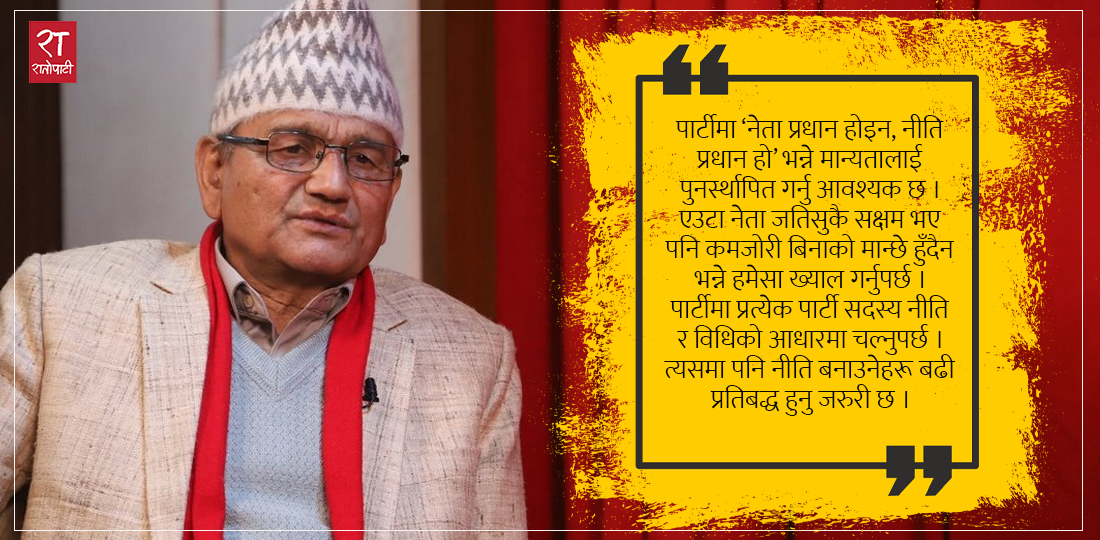
It is necessary to re-establish the principle that 'policy is primary, not the leader' within the party. It should always be remembered that no leader, however capable, is without flaws. Every party member must operate based on policy and procedure. Moreover, those who formulate policies need to be more committed.
Given the aforementioned tendencies appearing within the party and various political developments that have brought the party to its current state, there is no alternative but to undergo a comprehensive transformation from top to bottom through serious and factual review and move forward in a new way. If we can introspect on the significant achievements and shortcomings of the government related to the party and correct them with determination, there is a possibility for the Nepali communist movement to reach new heights again. For that, UML needs to do some things immediately.
First and foremost, it is necessary to conduct a factual review of all the shortcomings in party operations and government operations, not just in the last general election but overall. We must embrace the positive aspects of the past and be determined to correct mistakes.
Not only Nepali society today but the current era everywhere feels the need for new leadership. New means leadership that is superior and capable in every field compared to the past. Without this, we cannot instill confidence in the party among the general public. Specifically, a maximum age limit and a fixed term should be set for leadership positions in party and government operations. This will instill hope and confidence in the new generation.
The principle of operating a communist party on the basis of collective leadership has been written in documents. However, in practice, a system of single leadership has been established. Not only communist parties but democracy can never be consolidated without establishing the principle of collective leadership. This is an essential element for real democracy. Similarly, how to implement the principle of collective wisdom and collective effort in practice? It is necessary to find new ways in this regard. Only then can a developed consciousness be fostered throughout the party.
It is necessary to re-establish the principle that 'policy is primary, not the leader' within the party. It should always be remembered that no leader, however capable, is without flaws. Every party member must operate based on policy and procedure. Moreover, those who formulate policies need to be more committed.
A practice of healthy criticism and self-criticism with a sense of duty should be established periodically within the party. Only then can a clean and strong party be built. This will help in removing the dirt and filth within the party.
The tendency to disagree with every wrong thing and support the right should be established in the party to end factionalism. Every party cadre should be assigned a concrete responsibility, however small, and a scientific system should be established to evaluate them based on the results of their work.
It is necessary to reorganize the party committees from bottom to top in a systematic manner. Learning from past experiences, it is essential to realize that the goal can only be reached by building a party composed of capable and honest individuals, not by any leader forming a strong faction. The extremely dangerous and suicidal habit of being unable to work without factionalism must be completely changed.
Tolerance and respect for different opinions, both within and outside the party, is a very important tenet of people's multi-party democracy. This tenet is dying within the party. Therefore, we need to reorganize our minds according to this tenet. Any leader or cadre of the party should have the legal right to express their differing opinions not only within the party but also publicly after informing the party committee if deemed necessary. However, doing so requires firmly implementing the majority decision of the party. Otherwise, chaos will ensue.
When selecting candidates for any level of representative, the upper committee should make the final decision based solely on the suggestions of the party members of the respective level.
As new leadership will be formed according to new methods, it would be appropriate to organize old leaders and cadres into various levels of advisory committees and establish a practice of holding joint meetings with the secretariat members of the respective committees once a year at the center and twice a year in the lower committees to seek opinions and consultations, and present them with subject matter in the formal meetings of the respective committees.
A legal practice of periodically reviewing the work of one's government should be established in the relevant committees from the center to the ward level. This practice had weakened in UML. In the past, proper coordination between the party committee and the government could not be achieved.
At this time, since the primary responsibility is to reorganize UML completely, uniting with other leftist parties without reorganization would be counterproductive. Therefore, it is appropriate to adopt the goal of immediately engaging in functional unity and cooperation on various common issues, forming electoral alliances in the upcoming provincial and local levels, and after the situation matures, uniting with like-minded leftist parties and moving forward.
In today's advanced era of science and technology, it is necessary to train the entire party ranks with scientific Marxist ideology concerning the operation of life and the world and to build a skilled workforce for the use of technology. It is necessary to develop a Marxist and socialist perspective, democratic values and norms, patriotic spirit, determination to serve the country and people, and the belief that 'a good party must be built to build the country,' utilizing their expertise gained from various educational institutions within the country and abroad.
If we can build a transformed UML party through in-depth discussion and deliberation within the party on the aforementioned and other issues, we can surely realize the dream of a prosperous and developed Nepal and happy Nepali people, not just a majority in elections.
This specific news has been automatically translated by AI. As a result, there may be some inaccuracies or language errors.


_6FSvCrCShE.jpg)