Prime Minister Balen Shah's Absence Creates Parliamentary Stalemate and Diplomatic Concerns

When the federal parliament moved out of its New Baneshwor structure and into its own new building within Singh Durbar, a hope arose in the general public - not only will the physical distance between the executive and legislature be bridged, but there will also be unprecedented ease in the diplomatic and political pace of state operation. The executive head's office is within the centralized administrative center of Singh Durbar, and a few meters away is the sovereign parliament of the country, the House of Representatives. The distance between the two buildings, if measured on foot, is at most five minutes.
However, this five-minute walk has today proven to be the most remote, difficult, and mysterious journey in the country. The Prime Minister Balen Shah's working style, who entered Singh Durbar as an alternative to traditional politics and as a 'symbol of hope and trust' for the contemporary generation, has now made the parliament building a victim of peculiar uncertainty and indecision. Prime Minister Shah, known for his experimental and aggressive decisions while in local government, has become a 'rare figure' for the parliament after reaching the highest executive position in national politics.
This is a serious paradox in management history, where the entire House of Representatives seems to be losing direction due to the physical absence of the Prime Minister.
Nowadays, as soon as a session of the House of Representatives begins, the same constitutional question echoes: 'Where is the Prime Minister?' Not only is it an angry voice from the opposition benches, but even within the internal discussions of ruling party MPs, there is growing concern and dissatisfaction over the absence of the executive head. In a parliamentary system, the Prime Minister must be fully accountable to the parliament. However, due to the regular absence of the Prime Minister, many stalled bills, policy decisions of public concern, and long-term development plans are locked away in the drawers of parliamentary committees.
Parliament became so entangled that, due to the deadlock caused by the lack of proper bills and agendas from the executive head, the sessions of the House of Representatives are being repeatedly postponed without even entering the agenda. The irregular or postponed sessions of parliament are not just a political deadlock, but also a heavy burden on the state treasury, which is on the verge of bankruptcy. Examining the internal financial statements and administrative data of the Federal Parliament Secretariat reveals that the operational costs of the House of Representatives are quite high.
According to the Secretariat's daily cost estimates, about four hundred thousand rupees are spent daily solely on the physical management, system operation, and maintenance of the new parliament building. Similarly, five hundred and fifty thousand rupees are spent daily on meeting allowances, transportation, and special facilities for the honorable MPs, and one hundred and fifty thousand rupees are spent daily on deploying Secretariat staff, electricity, water, and various administrative tasks. Thus, adding all these categories, the total daily expenditure for running the parliament amounts to approximately eleven hundred thousand rupees.
In parliamentary democracy, running a state is not a trivial matter like writing brief and aggressive comments on social media to incite public emotion.
This means that even if a session of the House of Representatives is postponed for a single day without any concrete discussion or entering the agenda, it directly results in an unproductive expenditure of nearly eleven hundred thousand rupees of the state, which amounts to tens of millions in losses when calculated monthly, and is ultimately a waste of valuable revenue collected from the sweat of the general taxpayers. However, the country has incurred losses many times greater than this financial loss at the policy level.
When parliament is constrained, issues of people's daily livelihoods, inflation, unemployment, and national security are overshadowed. The delay in the law-making process for months leaves some state bodies in a legal vacuum. For a democratic country, this parliamentary vacuum is the height of insensitivity.
In parliamentary democracy, running a state is not a trivial matter like writing brief and aggressive comments on social media to incite public emotion. It requires institutional maturity, constitutional dignity, and the patience to answer every question.
- Centralization of Ministries and Institutional Silence
Prime Minister Shah has an established working style: he prefers to publicize his views on internet walls rather than on formal platforms or the parliament's rostrum. However, when the budget session of the parliament began, the intense debate expected on the country's economic roadmap and future direction was met with mere silence from the executive head. It is a parliamentary convention for the Prime Minister himself to be present to address the serious questions raised by MPs in the House of Representatives on the government's policy and programs before the budget statement.
Once in the Prime Minister's chair, his style of neglecting the supreme legislature of the state, the House of Representatives, is gradually turning the sacred trust of the people into disappointment.
However, only the squabbling and accusations between political parties were visible there. Even after the budget statement, due to the Prime Minister's unclear direction, the parliament could not get a concrete agenda for the serious discussion that should have taken place in the House of Representatives regarding measures to address the country's economic crisis. If the Prime Minister is truly unable to attend parliament due to being busy day and night with country development and administrative reform work, then another serious administrative question arises: why has he accumulated nearly half a dozen important ministries of the country himself?
Keeping ministries, considered the backbone of the state, with oneself for a long time has led to extreme sluggishness in administrative work. This practice of centralizing state powers instead of decentralizing authority and evading accountability is in no way democratic. The Nepali people, fed up with the inaction and institutional corruption of old political parties, saw an alternative leadership and a foundation of hope in Balen Shah.
He carries the great expectations of the general youth and change-advocating citizens on his shoulders. However, his style of neglecting the supreme legislature of the state, the House of Representatives, after taking the Prime Minister's chair is gradually turning the sacred trust of the people into disappointment. Letting this public trust go to waste under the guise of party politics and propaganda will be fatal for the country.
- Land Ownership and Diplomatic Immaturity
While the House of Representatives was caught in a vortex of policy uncertainty and internal disputes, a few days ago (May 31), Prime Minister Shah unexpectedly stood at the parliament's rostrum. Parliament and the general public expected him to reassure the parliament about the country's slow economic situation, unemployment, and the progress of national pride projects. However, his address took an unexpected and diplomatically very sensitive turn.
From the rostrum of the House of Representatives, without any technical verification, he claimed, 'We always say that others have encroached upon our land, but if we look at historical facts, Nepal has also encroached upon the land of neighboring India.'
The Prime Minister attempted to portray Nepal as an 'aggressor' in front of the entire parliament and the international community, using the superficial basis of local residents occupying land and the relocation of some border pillars due to river course changes during the monsoon season. For the Prime Minister of a sovereign country to make such a serious statement for the parliamentary record, without any official survey maps, historical documents, or reports from a diplomatic commission, is an act against national interest and is condemnable. Facts and technical details regarding the border completely refute this claim.
Some supporters of the Prime Minister, instead of accepting this serious diplomatic error, are trying to prove the baseless claims as true on social media, calling it 'new patriotism'.
According to Buddhinarayan Shrestha, a senior expert on Nepal-India border affairs and former Director General of the Department of Survey, Nepal has never encroached upon Indian territory in an organized or state-level manner throughout history. There are indeed practical problems of cultivation for local farmers on both sides in the no-man's-land (where neither country can build any physical structures) in some areas due to changes in river flow, which is technically called cross-border occupation. This is a regular process that has been resolved by survey teams from both countries.
The historical fact is that in areas like Lipulek, Limpiyadhura, Kalapani, and Susta, Nepal has always been the 'victim' of border encroachment despite having historical evidence. The Treaty of Sugauli of 1816 and maps from that period provide irrefutable evidence that all territories east of the Mahakali River belong to Nepal. The Prime Minister failed to distinguish between the practical use of local land and the sovereignty of the national border.
But ironically, some supporters of the Prime Minister, instead of accepting this serious diplomatic error, are trying to prove the baseless claims as true on social media, calling it 'new patriotism'.
Even some responsible leaders and MPs from the ruling coalition partner, the Rastriya Swatantra Party (RSP), are trying to spread confusion by interpreting this issue abstractly in parliament and the media. They are saying, 'The Prime Minister did not mean that; he was only touching upon the aspect of border management.' Senior foreign policy experts of Nepal have strongly objected to this statement. Their clear opinion is that every word spoken by the head of government is considered the official and diplomatic stance of the state, which can be presented as evidence in international forums in the future.
The Nepali people want to see you as a responsible and visionary guardian of the country, not just a social media warrior who always keeps parliament in uncertainty.
Considering this diplomatic risk, the Ministry of Foreign Affairs had to hastily issue a clarification statement to mitigate the serious controversy created by the Prime Minister. The Ministry of Foreign Affairs had to clarify through a statement that the Prime Minister's statement is not different from Nepal's established official stance on the border and that it only indicated the practical situation of the no-man's-land. It is certainly not a pleasant situation for the country's Prime Minister to speak imprudently and for diplomats to cover it up in international forums.
- Rule of Law and Institutional Dignity
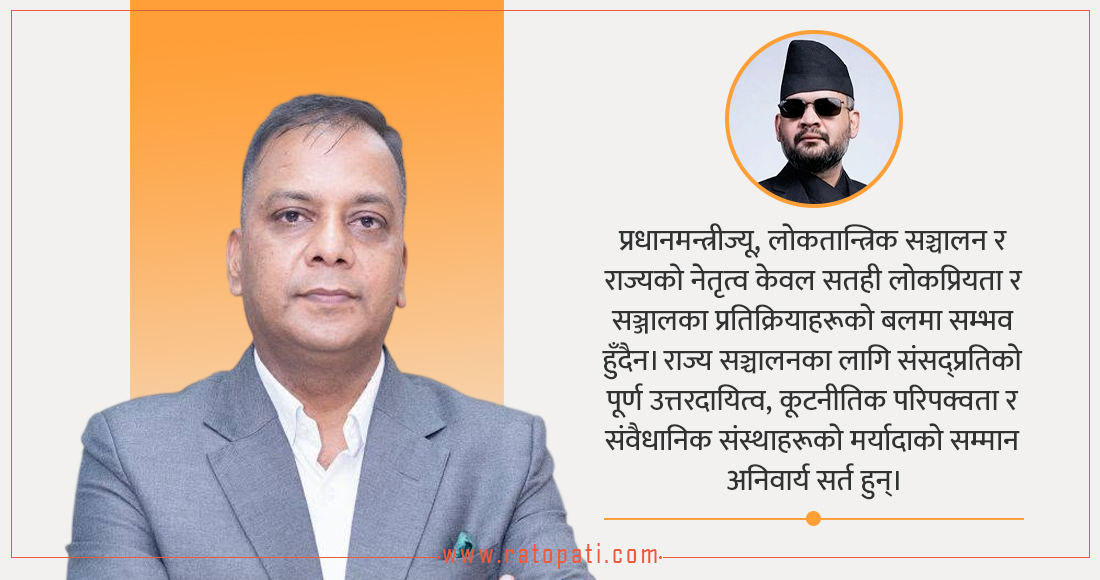
Prime Minister, democratic governance and state leadership are not possible solely on the basis of superficial popularity and social media reactions. Managing local administration in Kathmandu and steering the entire country's diplomatic and economic ship from Singh Durbar are qualitatively different matters. Full accountability to parliament, diplomatic maturity, and respect for constitutional institutions are mandatory prerequisites for state governance.
If you are truly burdened by your workload, immediately delegate the ministries you hold to the respective ministers and decentralize authority. Step out of your office in Singh Durbar, cross this five-minute physical distance, and regularly attend the rostrum of the House of Representatives. Face the public concerns raised by the MPs democratically, and stop making immature statements that could damage the country's national interest and reputation.
The Nepali people want to see you as a responsible and visionary guardian of the country, not just a social media warrior who always keeps parliament in uncertainty.
Awareness in time!
(Karna is a member of the National Assembly from the Nepali Congress.)
This specific news has been automatically translated by AI. As a result, there may be some inaccuracies or language errors.