Nepali Congress Faces Internal Crisis Amidst Rising Populism

In Nepal's democratic journey, some political parties are not just 'parties' but also custodians of history. Among these parties, the Nepali Congress is a political institution that has played a decisive role in institutionalizing the ideas of democracy, civil liberties, pluralism, and constitutionalism in Nepali society.
Therefore, the weakening of the Nepali Congress is not just the weakening of a single party, but the weakening of the democratic ethos itself. And, the unity of the Nepali Congress is not just an organizational necessity, but a historical necessity linked to the democratic future of present-day Nepal.
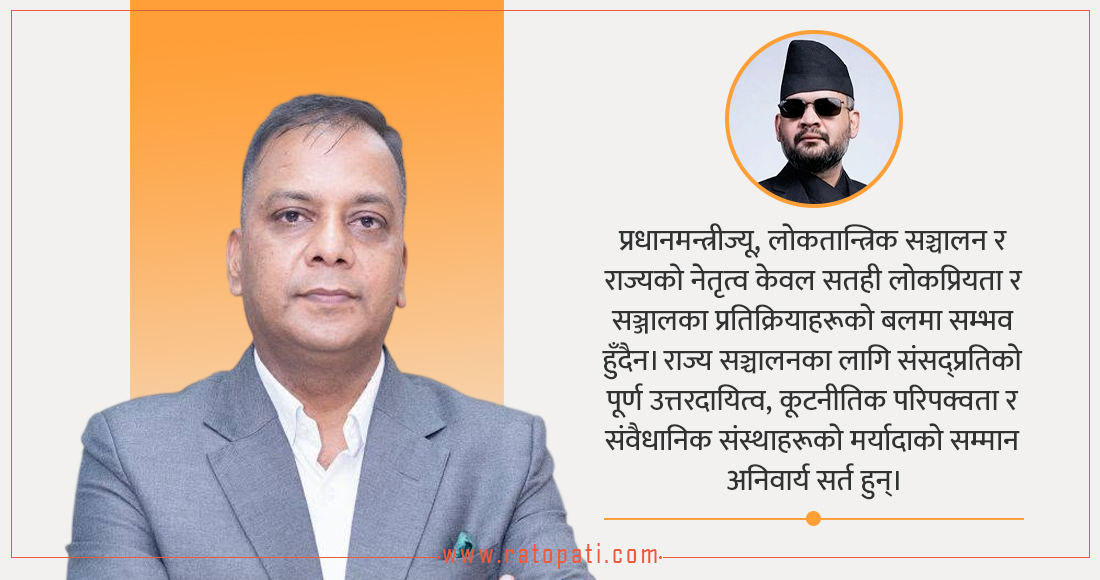
Today, Nepal stands at a unique political juncture. The public is disillusioned with the old parties, but there is an equal duality of hope and apprehension towards new forces. In this transitional phase, the highly populist political style led by Balendra Shah is trying to redefine the relationship between state power and public opinion in a new way.
This trend cannot be understood merely as 'new politics'. It also harbors the potential for concentrating power through direct public support, bypassing democratic institutions.
Democracy is not just a process of winning elections. Democracy is institutional restraint, power balance, dialogue, respect for dissent, and the rule of law. However, lately, a 'dopamine politics' seems to be developing in Nepal, where performance is prioritized over decisions, personality over institutions, excitement over debate, and popularity over process. While such politics may appear attractive on social media, it can be dangerous for democracy in the long run.
Democracy is not just a process of winning elections. Democracy is institutional restraint, power balance, dialogue, respect for dissent, and the rule of law. However, lately, a 'dopamine politics' seems to be developing in Nepal, where performance is prioritized over decisions, personality over institutions, excitement over debate, and popularity over process.
For this reason, the unity of the Nepali Congress has now become a question of democratic defense, not just a party matter. The Nepali Congress and democracy have a historical relationship. When studying the history of democracy in Nepal, the Nepali Congress cannot be studied in isolation. From the movement against the Rana regime to the change of 2007 BS, from the anti-Panchayat struggle to the People's Movement of 2046 and the journey to the republic, the Congress has played the role of a carrier of democratic consciousness.
The core strength of this party is not just elections, but a political culture. That culture is the plurality of ideas, space for dissent within the organization, the capacity to tolerate criticism, and ultimately, the practice of building consensus through democratic processes. For this reason, even though there are factions within the Congress, those factional rivalries have generally been seen as democratic competition.
However, the Congress itself is currently going through a serious self-crisis. Organizational distrust, the political use of discipline, opacity in membership distribution, intergenerational distrust, and psychological distance among leaders are weakening the party. Even more dangerous is that the struggle within the Congress is increasingly taking on a managerial and personal character rather than an ideological one.
The Congress itself is currently going through a serious self-crisis. Organizational distrust, the political use of discipline, opacity in membership distribution, intergenerational distrust, and psychological distance among leaders are weakening the party. Even more dangerous is that the struggle within the Congress is increasingly taking on a managerial and personal character rather than an ideological one.
When a democratic party begins to lose its internal democracy, it gradually loses the moral authority to protect democracy in society.
Today, the tendency to elevate individuals over the system is increasing in Nepal. The era of social media has further intensified this trend. The style of dismissing any institutional process as slow and presenting unilateral decisions as fearless leadership is becoming popular. The political rise of Balendra Shah is a result of this social psychology. He represented the dissatisfaction with the old parties, which were corrupt, tired, and distant from the people.
However, the problem begins where public dissatisfaction is transformed into distrust of institutions. Public opinion is important in a democracy, but public opinion must also be operated within institutional norms, legal processes, and constitutional limits. If a popular leader leans towards the psychology of 'I am the state', democracy gradually begins to shrink. The portrayal of courts, parliaments, parties, media, and civil society as obstructive forces is not a good sign for democracy. Democracy does not always die from tanks; sometimes it dies from excessive applause and excited crowds.
Therefore, the Nepali Congress needs to remember its historical responsibility. If democratic forces themselves remain divided and directionless, the vacuum will be filled by individualistic power centers. Why is the Nepali Congress unable to unite? The crisis within the Congress is not just a clash of leadership; it is both a structural and psychological crisis.
First, there is a serious lack of trust within the party. Leaders have begun to see each other not just as competitors, but as threats. Second, transparency in organizational decisions has weakened. Questions of impartiality have arisen at many levels, from the distribution of active membership to the selection of the central committee. Third, workers feel that disciplinary actions have sometimes been used as political weapons. Fourth, the Congress has not given adequate respectable space to the new generation, while the new generation also seems to be losing organizational patience.
For this reason, a parallel psychology has developed within the party. One faction considers itself the legitimate power, while the other considers itself the moral power. When legitimacy and morality stand at separate poles, the organization weakens. In such a situation, the Congress can be united not just by speeches, but by structural consensus. This requires some bold political decisions.
First, the concept of a general convention for unity should be advanced. It seems difficult to resolve the current dispute through normal processes. A general convention for unity can provide an opportunity for a new legal and moral beginning. Second, a joint working committee should be formed by adjusting the committee formed from the 14th general convention and the structure after the special convention. This will not just be a power-sharing arrangement, but a process of mutual acceptance.
Third, a working executive committee representing all factions should be formed. The Congress needs to move beyond the psychology of 'winners' or 'losers'. Fourth, an independent and universally acceptable election committee should be formed to ensure the upcoming general convention is fair and credible. If there is no trust in the electoral process within the organization, the talk of democracy will be limited to slogans.
Fifth, past disciplinary actions should be reviewed. If political dissent is treated like a crime, a culture of fear will develop within the party. The Congress needs to be made an organization of dialogue, not of punishment. Sixth, the distribution of active membership should be made completely transparent. If membership itself becomes a tool of control, democratic competition becomes impossible.
And finally, the 15th general convention should be transformed not just into a leadership selection program, but into a convention for unity. Along with this, a serious discussion is needed on why an advanced understanding between Dr. Shekhar Koirala and Gagan Thapa is necessary.
Dr. Shekhar Koirala represents the traditional democratic heritage, organizational patience, and ideological continuity of the Congress. Gagan Thapa represents the aspirations, dynamism, and language of change of the new generation. If a trusting collaboration is built between these two streams, the Congress can unite old experience and new energy in the same political direction.
The most discussed topic within the Congress today is the relationship between Dr. Shekhar Koirala and Gagan Thapa. These two leaders are not just two individuals; they also represent two psychologies within the Congress.
Dr. Shekhar Koirala represents the traditional democratic heritage, organizational patience, and ideological continuity of the Congress. Gagan Thapa represents the aspirations, dynamism, and language of change of the new generation. If a trusting collaboration is built between these two streams, the Congress can unite old experience and new energy in the same political direction. However, if distrust grows between them, it will not only divide the leadership but also divide the future generation of the Congress.
Historically, many democratic parties have weakened due to personality struggles. The Congress must not repeat that mistake. The need of the hour is not 'who is the bigger leader', but 'how to build a strong democratic force'.
An advanced understanding between Dr. Shekhar and Gagan is a matter beyond personal equations. It can become the basis for the future ideological reconstruction of the Congress. If they agree on a common minimum democratic agenda, organizational reform, and a fair general convention, the Congress can be revitalized.
Nepal is not just in a crisis of government today; it is in a crisis of political culture. Distrust of institutions, personality cult, sensationalist politics, and ideological emptiness are gradually weakening democracy. At such a time, the unity of the Nepali Congress will not be an ordinary party event. It can become a process of restoring democratic balance. The Congress must now understand that a divided Congress weakens not only itself but also democracy. And history does not always forgive the party that prioritizes itself at the moment of its historical responsibility.
Seeking 'ilu ilu' or 'I love you' within the Nepali Congress is not about seeking superficial romance; it is about rediscovering the trust, intimacy, coexistence, and political tolerance that is being lost within the party. Today, more than ideological conflict, a psychological distance is visible within the Congress. Leaders within the same party have begun to treat each other more like obstacles to be overcome than as fellow travelers or even competitors. In such a situation, the organization will not be saved by structure alone; it also needs an emotional and moral embrace to hold the party together. That embrace is political 'ilu ilu'.
Democratic parties do not survive on bylaws alone; they survive on 'mutual accommodation'. That is, the acknowledgment that 'you are also necessary, and I am also necessary'. The crisis of the Congress is the crisis of this acknowledgment. All factions consider themselves the true Congress but find it difficult to accept the other faction as an essential part of the Congress. Therefore, seeking 'ilu ilu' within the Congress today is not about destroying each other, but about seeking a culture of accepting coexistence, finding the maturity not to turn disagreement into enmity, restoring dialogue between generations, and making the organization not just a machine for gaining power, but a common democratic home.
The debate for an advanced understanding between Shekhar Koirala and Gagan Thapa is essentially a political version of this 'ilu ilu'. This does not mean personal love; it means understanding the mutual historical necessity. Looking at the history of the Congress, major movements have succeeded when leaders have placed common goals above personal ambitions. And the Congress has weakened when the ego of 'the party cannot run without me' has become bigger than the consciousness of 'democracy cannot run without us'.
This question is even more important in today's time because individualistic and sensationalist politics are strengthening outside. If intimacy, trust, and dialogue do not remain within the democratic forces themselves, democracy will be limited to electoral arithmetic. There are many things within the Congress today – factions, strategies, equations, general conventions, power struggles. But perhaps one thing is lacking – the democratic sensibility that 'if you are not there, I will be weak'.
Therefore, the search for 'ilu-ilu' within the Congress is actually a search not for love, but for democratic coexistence.
This specific news has been automatically translated by AI. As a result, there may be some inaccuracies or language errors.