Remembering Nirmal Lama: A Look Back at Political Ideals and Unity


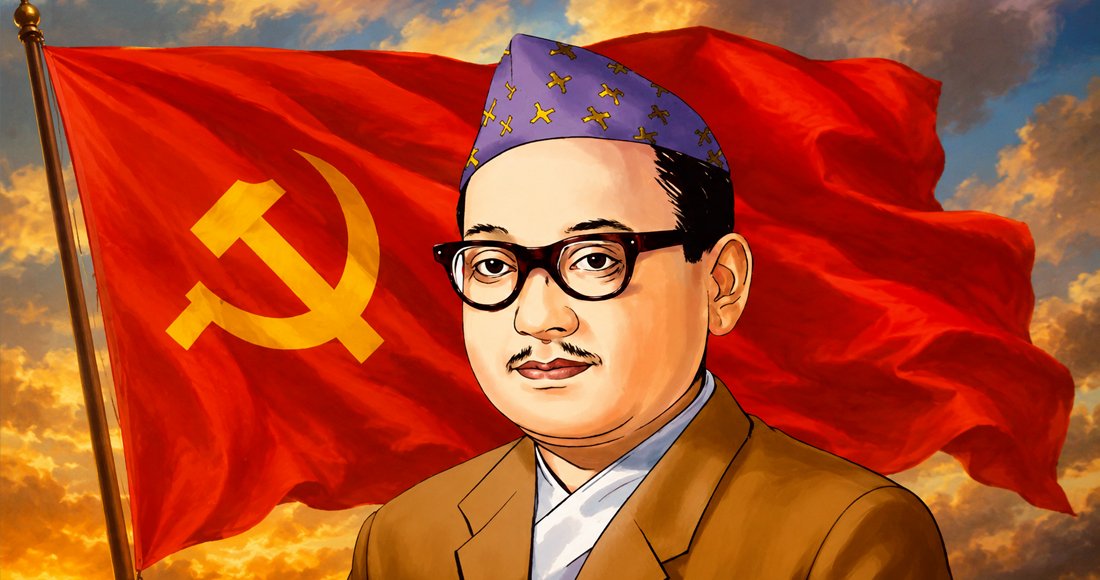
On the occasion of the 26th death anniversary of Comrade Nirmal Lama, the CPN (Masal) expresses high respect towards Comrade Nirmal Lama and offers him revolutionary greetings.
He has made a great contribution to Nepal's democratic and leftist movement. It is a matter of happiness that he and I have worked together in Nepal's communist movement. In that connection, I also had a very close and intimate relationship with him.
We both participated together in the district party secretaries' training program organized in Kathmandu in 2011 BS. At that time, he was the secretary of the Kathmandu District Committee, and I had come to participate in that training program as the secretary of the Pyuthan District Committee. Similarly, we also worked together in the Darbhanga Plenum. He also made a significant contribution to the majority obtained in favor of the Constituent Assembly in that plenum.
In 2026 BS, in Kathmandu's Bhadrakali Jail, we passed three proposals together for a month-long gathering to unite the then-divided party. Those proposals later greatly helped in uniting the party by forming a central nucleus.
Later, by forming a central nucleus, we worked together to unite the party that had been divided into separate factions, and as a result of that effort, the party's fourth general convention was held in Varanasi in June 2031 BS. The party that was formed then was the largest communist party in Nepal at that time.
Later, due to the impact of the Naxalite movement that emerged in India at that time on our party, extremist 'leftist' tendencies also appeared in our party, and our party split. Comrade Lama and I waged a strong ideological, political, and organizational struggle together against that extremist 'leftist' deviation. Thus, there are many important and glorious pages of cooperation between Lama Ji and us within the party.
It may not be irrelevant to mention here, or not mentioning those things would be to present or cover up history incorrectly, that in the course of working in the party, we also had many disagreements. Even when preparing the three documents in Bhadrakali Jail, there were some disagreements between him and us. At that time, we considered the Nepali Congress as a party of the national capitalist class.
And, changing the analysis that considered it a friendly force for the new democratic revolution, we analyzed it as a party of the feudal, comprador, and bureaucratic capitalist class, considering it an enemy force. He disagreed with our analysis. However, after coming out of jail, he agreed with our analysis made by the Bhadrakali Jail gathering at that time. He has also mentioned that in his memoirs. Thus, unity in opposition and opposition in unity were inherent in our relationship. Thus, in one way or another, the nature of the relationship between him and us was dialectical. Later, the relationship between us also continued to progress dialectically in the same way.
A serious disagreement arose between us on the question of utilizing the Panchayat elections. In many meetings, gatherings, or conferences of the party's central committee, serious disagreements arose between us and him. Later, when neither Lama Ji nor I were in the central committee, a serious disagreement arose within the party. In connection with that disagreement, 6 members of the central committee resigned from the central committee and also made their resignations public. To consider that incident, a party conference was held in Gorakhpur in 2040 BS.
A serious disagreement arose between Lama Ji and us regarding the resignation of the 6 members and their making it public, and due to that reason, the party was also split. After that, the party was divided between CPN (Masal) and CPN Fourth Convention. That was a very sad and unpleasant event in our party's history. It caused great damage to the party. We feel that if some understanding could have been reached between us at the Gorakhpur conference, that sad event could have been prevented and should have been prevented. If that had happened, the party could have been saved from much damage in the subsequent days. Thus, the split that occurred in the party at that time was a serious mistake. Who was responsible for how much? Its evaluation is necessary, or history will evaluate it.
After the fifth general convention, the party split into 'thin' and 'thick' Masal/Mashal. After that, discussions about party unity took place between our party CPN (Masal), CPN (Fourth Convention), CPN (Mashal), and the Proletarian Workers' Organization. However, other parties insisted on party unity from the first day of the meeting. But we emphasized that party unity should be achieved only after discussing all the disagreements between us in detail. As a result, we could not reach an agreement on party unity. After that, party unity took place among the other parties, and CPN (Unity Center) was formed. Lama Ji's leadership 'Fourth Convention' also joined it, and we remained separate from it. Later, the Fourth Convention also separated from it, and under Lama Ji's leadership, it continued to exist separately as CPN (Unity Center).
After that, many secret meetings took place between Lama Ji, Comrade Chitra Bahadur KC, and me. All those meetings used to take place at Lama Ji's house in Mhepi. However, since Lama Ji stepped down from the leadership of the Unity Center and passed away soon after, the talks for unity with him did not yield any meaningful results. Even after Lama Ji's death, the conversation with him continued, and our party united with the Unity Center. But that unity could not last. We feel that if Lama Ji had been alive and remained in the leadership of the Unity Center, our unity would have been strengthened, as it was during the time of the Fourth Convention. That unity would have been stable, and it would have contributed greatly to Nepal's communist movement.
From the brief description above, it is clear that Lama Ji and I had a very close relationship. Even though disagreements arose between us from time to time, or even if those disagreements developed into a split at some point, we maintained a very close and friendly relationship amidst those disagreements. This explains the dialectical nature of unity and opposition between him and us. In the final period of his life, that friendly relationship took on a very close and deep form. However, due to his health and death, that relationship could not progress concretely. We are very sorry for that.
In an article written immediately after Comrade Lama's death, I had also compared the relationship of unity and opposition with him to that with my father Khimbikram. I had a very intimate relationship with him. He had made significant contributions to the formation of the party and the peasant movement in Pyuthan. The residential training camp that lasted for three months in Pyuthan in 2010 BS was a unique example not only of Nepal's communist movement but of the entire political history of Nepal. No such long residential camp has been held in Nepal before or since. Father Khimbikram had a significant contribution to the operation of that camp. The Communist Party was formed in Pyuthan during that camp. He also actively and significantly contributed to many peasant movements or political movements in Pyuthan. However, during the peasant struggle related to him, we had a sharp struggle with him. Despite such a struggle, we both, father and son, had a very intimate relationship, and throughout our lives, both father and son loved each other very much. We both used to fight with each other, but even while fighting, we both loved each other very much. The relationship between Comrade Nirmal Lama and me was similar.
My relationship with Comrade Kamalraj Regmi was also similar. In 2010 BS, I had applied to him for party membership. We participated together in many peasant struggles and party programs. But later he joined the Panchayat system, and contradictions arose between us. However, even during such contradictions, we maintained a friendly relationship personally.
In 2072 BS, he reapplied for party membership. At the time of submitting that application, he said, 'I had taken your application for party membership before. Now I am submitting my application to you for party membership.' But unfortunately, he did not live long after that. In this regard, it may not be irrelevant to mention Comrade Chitra Bahadur KC. It is generally known that he and I have had a close relationship in the party for a long time. However, that relationship has also had many instances of mutual opposition.
In 2048 BS, a sharp disagreement arose between him and us regarding the utilization of parliamentary elections. He was in favor of utilizing the elections, while we were in favor of boycotting them. His vote became a majority in the central committee. However, the boycott was a majority in the conference. Although his vote was in the minority at the conference, he firmly stood by the majority decision without hesitation. His spirit greatly helped the unity and discipline of the party not only at that time but also later.
Later, on many occasions, disagreements arose between him and us. But we accepted all those disagreements dialectically, which always maintained a strong unity between us. Similarly, due to disagreements with Lama Ji, even though there was a split between us, we moved towards re-unification despite that split. Unfortunately, due to his untimely death, such unity could not materialize.
Comrade Lama is no longer among us. Nevertheless, his invaluable contributions to the party and the revolution are before us. And, we believe that they will continue to provide continuous education and inspiration to advance the unfinished tasks of the party and the revolution. One important dream he had was party unity.
We also tried to fulfill his dream. But it was not successful. In fact, such unity can only progress on the basis of Marxist-Leninist principles, revolutionary political lines, Leninist organizational systems, and proletarian spirit. Such unity will be in the interest of the party. We must continue to strive for such party unity. And, such principled unity will help advance the party and the revolution.
(Speech given by Singh on the occasion of the 26th death anniversary of leftist leader Nirmal Lama on Sunday)
This specific news has been automatically translated by AI. As a result, there may be some inaccuracies or language errors.