Farmers Face Devastation as Wildlife Destroys Crops Across Nepal

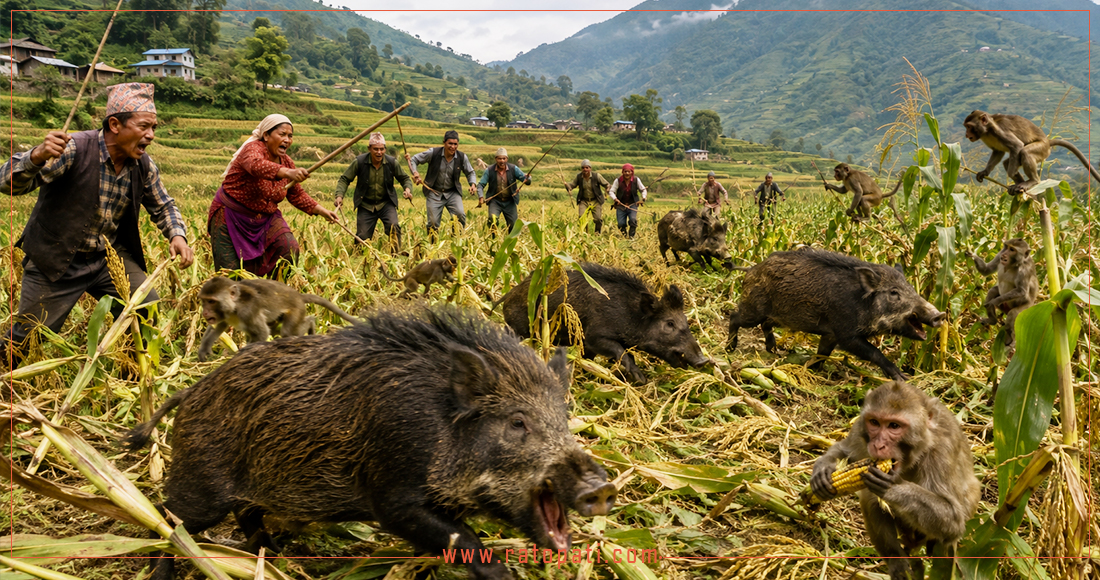
Kathmandu. When the sweat of Nepali farmers, who are weaving beautiful dreams of the future by looking at the lush maize plants covering their fields, is destroyed in a single night, the pain knows no bounds. In Nepal, which is called an agricultural country, it is now a great struggle for farmers not only to cultivate crops but also to protect them from wild animals.
Villages from east to west and from hills to the plains are plagued by the terror of wild animals. Prem Nepali, a farmer from Simaghata, Resunga Municipality-6, Gulmi, is currently suffering from such unbearable pain.
He became emotional after his maize crop, nurtured with months of hard work and loans, was destroyed by monkeys, wild boars, and hail just as he was about to harvest. 'Hail and monkey attacks in one night destroyed months of hard work. Who understands the pain of a farmer?' he lamented.
A similar heartbreaking fate is being faced by farmer Badri Parajuli of Puchhartar, Jyamdi, Bhumlug Rural Municipality-9, Kavre. His field is now dominated by wild boars and porcupines, not the value of human labor and hope.
Parajuli, disheartened after his hard-earned crops were destroyed overnight by wild animals, expressed his anger and pain, writing, 'What to do now? The local, provincial, and central governments are just there to see and hear the people's problems!'
The fact that state mechanisms remain mute spectators while wild animals destroy the sweat of farmers and the hard work poured into the soil clearly exposes the policies of Singha Durbar and the helplessness of the local governments, often called the 'Singha Durbar of the villages'.
Farmers in Bhadgaun, Sinja Rural Municipality-6, Jumla district, have been forced to adopt a unique measure due to the unbearable nuisance of monkeys. As monkeys began destroying their ripening crops, 165 households in the village collectively raised Rs 100 per month and appointed local Prem Bahadur Damai as a 'watchman' to drive away the monkeys.
Prem Bahadur receives a monthly salary of Rs 16,500 for scaring away monkeys. The situation of having to hire a watchman by cutting down on their own expenses, as the government is nowhere to be found to protect their hard-earned money, mocks the country's policies and plans.
Farmers in the Bardibas and Bhangaha areas of Mahottari are fed up with the combined attacks of wild boars, porcupines, nilgai, and monkeys. Nilgai and wild boars destroy cabbage, peas, and wheat in the fields overnight, while monkeys in the daytime steal maize hung in the courtyards of houses.
In some villages, wild boars have established permanent dens in sugarcane fields and even attack people, creating a situation where villagers are afraid to go out into their fields.
Residents of Jorayal Rural Municipality, Doti, are forced to forgo hunger and sleep due to the terror of monkeys, wild boars, and foxes. As wild animals began destroying maize and paddy crops, farmers stay awake in the fields twenty-four hours a day. Despite banging tin, using torches, and relying on dogs for guard duty, the entire crop is destroyed in the blink of an eye.
Farmers in Chhatreshwari Rural Municipality, Salyan, are also complaining to the government. Nepali farmers are currently caught between the Forest Act and wildlife conservation laws. The government recently declared the red monkey and wild boar as 'agriculture-harmful wildlife', bringing a policy that farmers will not be punished if they kill them while driving them away from fields, but this does not seem to be a long-term solution to the problem.
- Efforts are underway: Department of Agriculture
Rajendra Koirala, Deputy Director General of the Department of Agriculture, provided information about the management of damage caused by wildlife and government efforts. According to him, although there is no clear mechanism for direct relief or compensation for crop damage by wildlife under normal circumstances, efforts are being made to address this problem from technical and managerial aspects.

He pointed out the need to work at both policy and practical levels for a long-term solution, as agricultural insurance cannot cover all types of damage caused by wildlife.
Deputy Director General Koirala stated that the government is making efforts in various phases to control and manage harmful wildlife.
'Options such as training various stakeholders, relocating them, and sterilization are being discussed and tested for monkey management. As this problem is not one that can be solved in a day, it requires long-term and continuous effort,' Koirala said.
Damage caused by animals like wild boars and porcupines is mostly concentrated at the local level. While this damage may seem minor to large commercial farmers, it causes significant financial hardship to small and subsistence farmers.
The entry of wildlife into villages and farmlands is also linked to environmental and social changes. In recent times, there has been a lack of sufficient natural food for animals in forest areas. 'Discussions are also underway on plans to plant native fruit trees in intermediate areas and ensure their food in the forest to reduce such problems,' Koirala said.
According to him, some alternative and biological methods are also being tested to mitigate the problem, besides traditional methods. In some places, plants like 'Kauso' are being planted as a biological fence to drive away monkeys. As they cause itching upon contact, monkeys hesitate to come into fields.
Similarly, activities like beekeeping also help keep wildlife away to some extent, according to technicians. According to Deputy Director General Koirala, participatory management involving local levels, farmers, and technicians can be the most effective way to protect crops.
'If farmers' crops are damaged by wildlife, it is advisable to immediately inform the local agricultural branch or the concerned government agency and get it documented. This will provide actual data on what type of wildlife is causing how much damage in which area, and it will be easier for the government to determine future strategies accordingly,' he said.
- Human-Wildlife Conflict Management Task Force to Prepare Clear Action Plan
The Human-Wildlife Conflict Management Committee (Task Force) has submitted an interim report to the Minister of Agriculture, Forest, and Environment, Gita Chaudhary. Minister Chaudhary mentioned that the problems faced by farmers due to monkeys in various districts of the country are becoming extremely serious and that the government is committed to finding a long-term and practical solution.
She emphasized the issue of crop destruction, farmer displacement, and direct impact on agricultural production due to monkeys, stating that this problem should be viewed not just from a wildlife conservation perspective but as a national issue linked to farmers' livelihoods and food security.
She stressed the need to study the actual situation in the affected areas and move forward with implementable solutions in coordination with local levels, stakeholders, experts, and the community.
In the meeting, the Task Force presented its interim report prepared for the mitigation of human-wildlife conflict, offering various suggestions for minimizing damage caused by monkeys and other wildlife, improving the compensation system, enhancing public awareness, and long-term management.
Minister Chaudhary expressed the ministry's firm commitment to reducing human-wildlife conflict through the study of the suggestions received and necessary policy decisions, legal reforms, and effective implementation.
This specific news has been automatically translated by AI. As a result, there may be some inaccuracies or language errors.


_4Q3tr9rk0M.jpg)