Nepal Faces Socio-Psychological Transition Amidst Growing Resentment and Inequality


I have been observing some social events happening in Nepal with special interest for the past decade. As a student of sociology, these events have repeatedly led me to a serious question – is the psyche of our society changing?
A few years ago, when a beekeeper from Chitwan went to Dang with his hundreds of hives for grazing, an unknown person poisoned 44 of his beehives. The culprit was never found. In 2077 BS, during the Corona pandemic, when Rajendra Shrestha, who was farming fish in Darbung, Gorkha, was in isolation, poison was poured into his fish pond, destroying all the fish, but no clear conclusion was reached about that incident.
In Chitwan, a commercial farmer's banana plantation was destroyed overnight, and another farmer's cattle shed was set on fire, where the tragic scene of cows and calves burning to death was widely spread on social media. A few years ago in Chitwan, two people died from electric shock from the electric fence installed around a pond to prevent fish theft. According to the police, they had gone to steal fish with nets. After the peace process, such incidents, especially related to agriculture and small enterprises, have become frequent in Nepal.
But recently, these trends have not been limited to personal damage. During the movement of 082 BS, incidents of arson, vandalism, and looting occurred in various parts of the country targeting commercial houses, private property, and industries. Understanding these incidents merely as crimes can miss a deeper psychological aspect of society. Because there was not just violence; there seemed to be a deep social dissatisfaction that could not easily accept the labor, progress, or potential prosperity of others.
Seen this way, it is felt that Nepal is going through not only a political transition but also a deep socio-psychological transition. Envy, anger, and dissatisfaction that have been suppressed within society for a long time sometimes explode on the streets in the form of protests, sometimes appear on social media as harsh reactions, and sometimes manifest as the gradual disappearance of compassion in the social psychology of daily life.
Today, the amount of anger in society seems to have increased. But that anger is manifesting more as social comparison, class insecurity, and internal dissatisfaction than as clear political consciousness. Therefore, understanding today's Nepal requires more than just a political perspective. It is also necessary to observe it from the viewpoints of class consciousness, social psychology, and modern consumerist culture.
To understand this class structure, it is appropriate to compare it with the historical process of how the middle class was formed in Western societies. In Western societies, the middle class emerged as a class that gradually developed with industrialization, a productive economy, institutional development, long-term labor stability, and the expansion of civil rights.
There, the middle class was not just a result of consumption, but a result of production and institutional stability, which gave them comparative economic security, social confidence, and a basis for public morality. But Nepal's middle class is a result of rapid social transition. Here, foreign employment, remittances, bank loans, the real estate market, private education, and consumerist aspirations have simultaneously created a class. For this reason, its economic base is unstable, but its aspirations are extremely high.
Greek philosopher Aristotle and French sociologist Pierre Bourdieu have explained the middle class from two different historical and social perspectives. Aristotle viewed the middle class as a class that maintains moral balance in society, is rational and restrained. According to him, the middle class is a stable force between the arrogance of the excessively rich and the anger of the excessively poor, which sustains democracy and social peace.
But Bourdieu interprets the middle class in modern society as a 'class struggling for prestige', where people are constantly competing not only for economic security but also for social recognition, cultural status, and respect. Looking at Nepal's current middle class, Bourdieu's concept seems much closer than Aristotle's ideal. Because the Nepali middle class is not a confident class developed from a stable, production-oriented economy; it is a class that has grown amidst rapid social transition, foreign employment, debt, consumerist culture, and social insecurity.
Here, people try to prove their social status through houses, land, cars, private schools, English conversation, lifestyles seen on social media, or symbols of consumption. Therefore, Nepal's middle class aligns more with Bourdieu's described 'status anxiety' and socially comparative middle class than with the stable and public-interest-oriented class imagined by Aristotle.
The real progress of any civilized society is measured by how it treats its weaker members; Nepali society is failing in this regard.
But it cannot be limited entirely to Bourdieu's framework. Because Nepal's middle class is still in a transitional state. It is still economically insecure, but culturally it wants to associate itself with the upper class. This paradox makes the Nepali middle class simultaneously aspirational, insecure, competitive, envious of the rich, and sometimes devoid of compassion for the lower class.
This is where the sociology of envy begins. Envy is not just a personal weakness; it is also a structural emotion produced by modern unequal society. American sociologist Thorstein Veblen gave the concept of 'conspicuous consumption' on this subject. According to him, in modern society, people consume goods not only for use but also to display their social status. In Nepal, social media has intensified this culture.
Today, people are competing more with the lives of others than with their own lives. Society seems to be accustomed to creating an artificial picture of success presented by Instagram, TikTok, and Facebook, rather than people's real struggles and lives, where prosperity is the sole basis of respect. In such a situation, not being able to go abroad, not being able to consume desired goods, and not being able to show economic progress like others despite earning something, and constantly feeling left behind, causes dissatisfaction and envy within people. From a sociological perspective, this is a natural process.
But the biggest paradox of Nepal's current society is seen elsewhere. Everyone wants to become rich, but deep resentment and distrust towards the rich have increased here. However, compassion for the poor seems to be weakening. A psychology is growing in society where people are angry at the success of the rich, and at the same time, can easily react harshly when a slum is demolished, a laborer is displaced, or a poor person commits suicide.
German philosopher Max Scheler called this contradiction among the middle class 'ressentiment'. When people feel insulted, unsuccessful, or insecure but cannot directly confront the real power, that suppressed anger is directed towards weaker groups. Such psychology is used to establish a truth different from reality and embrace it, and to hate the success of others to hide one's own weaknesses.
Therefore, sometimes in such a society, dissatisfaction with the rich and harshness towards the poor come together. The attacks on the houses of businessmen, private property, industries, or houses of politicians involved in opposition politics during recent protests in Nepal should be understood in this context. The mob is not just burning houses; it is burning the symbol of its long-suppressed humiliation, anger, and dissatisfaction.
According to French thinker René Girard, in modern society, people desire the social position of others more than objects. When a large population of society feels deprived of opportunities, unemployed, and humiliated, and a small group appears extremely wealthy and accessible, property ceases to be merely private property; it becomes a symbol of injustice. This is why anger often explodes on symbolic property during moments of protest. This psychology and behavior were contrary to the traditionally established coexistence and brotherhood in Nepali society, which the Nepali middle class had developed within itself as it was rising to the middle class.
But there is another dangerous aspect here. If that middle-class anger is not transformed into consciousness, it can turn into blind destruction, not a movement for justice. History has shown that when economic inequality, unemployment, and humiliation deepen in society, but political leadership cannot lead it in a meaningful direction, anger generates more symbolic violence than structural change. Much of the anger seen in Nepal today is this directionless dissatisfaction.
Not only this, but in recent years, society's behavior towards the poor has become increasingly harsh. Many people were seen to easily support the demolition of slum settlements, saying 'the law must be enforced'. Undoubtedly, the state has the right to maintain legal order. But the question is, can the system be above humanity? When a family becomes homeless, when two living people commit suicide, when children end up under the open sky, shouldn't society's first reaction be compassion?
If the satisfaction of 'illegal encroachment removed' becomes greater than human suffering, it is not just an administrative change. It is a moral change. If, in the name of establishing order, the state abruptly demolishes a landless slum without providing alternative housing, and the middle class unconditionally supports it, then the tendencies of such a society must be considered.
This is because this class believes that they have achieved their current economic progress through hard work and struggle, while the landless are lazy, yet they are living on public land, which is an injustice to them. When evidence emerged that some wealthy individuals had encroached on government land through political connections, this class's anger reached its peak. Consequently, they even justify inhumane displacement and the suicides caused by it.
Political thinker Hannah Arendt wrote, 'When society begins to normalize suffering, inhumanity becomes institutionalized.' A state that has lost compassion may appear strong from the outside, but it becomes morally weak from the inside. Such a state does not build peace; it builds suppressed explosions. Because poverty is not just an economic condition, it is also an experience of constant humiliation. And a society that is constantly humiliated can one day become explosive.
The young minds, watching helplessly before the state, their last hope and ideal guardian, while slum settlements are being demolished, can become underground explosive energy for new rebellions tomorrow. History often shows examples of successful revolutionary leaders to notorious jihadis being born due to deep-rooted injustice, oppression, and atrocities in their young minds.
The renowned German philosopher Karl Marx explained history as a history of class struggle. While his ideas cannot be mechanically applied to today's Nepal, one truth remains relevant – when inequality intensifies, opportunities are limited, and a large population begins to feel futureless, invisible tensions begin to rise within society.
For the time being, the middle-class elites may consider a harsh ruler their messiah, and initially, the middle class may support a strong state. Because they feel a strong controller is needed to save the system. But continuous attacks on the working class affect the country's overall economic system and the labor and consumer markets, and as the economic crisis deepens, that insecurity eventually turns towards the middle class as well. History has shown many times – suppressed anger eventually turns back on the controlling structure.
Nepal stands at a decisive juncture today. Aspirations are high here, but opportunities are limited. Comparisons are widespread, but social trust is weakening. People are getting tired not only economically but also emotionally. In such a situation, if society loses compassion, even if we appear modern from the outside, we can transform into a cruel society from the inside. If this kind of middle-class consciousness prevails in our society for a long time, and if our state does not institutionalize economic progress and transform into a capable and, as Aristotle said, politically stable compassionate middle class, then the danger of another conflict remains alive.
No society survives on laws, development, and competition alone. Society ultimately survives on coexistence, justice, and compassion. If the tears of the poor stop touching society, then that society, even if economically prosperous, is traveling towards moral poverty.
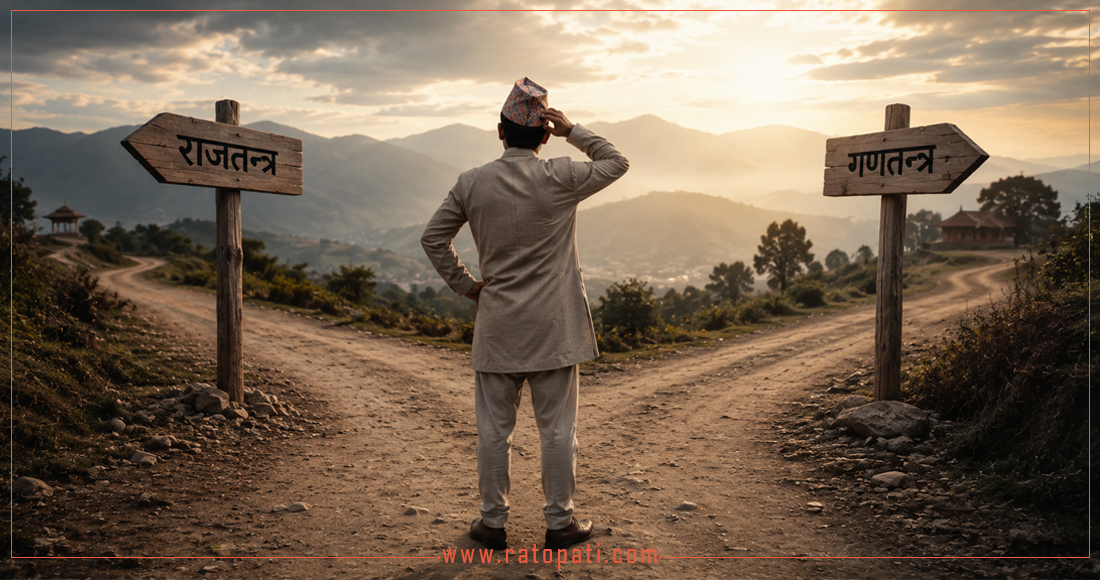
Nepal stands at a crossroads today, where the state needs to demonstrate not only the strictness of law but also the moral power of compassion. Establishing order is the state's responsibility, but if the system begins to be established at the cost of humanity, it will not bring stability but ultimately generate deep dissatisfaction. A state that views the poor, landless, unemployed, or marginalized communities merely as 'problems' will never be secure in the long run. The state must define development not only in terms of roads, buildings, and investment but also in terms of citizen dignity, social justice, and human dignity.
Similarly, Nepal's middle class needs to introspect the growing insecurity and comparison-based consciousness within itself. Society does not survive on individual success alone; it survives on mutual empathy and shared human relationships. If the middle class begins to legitimize only its own struggle and views the suffering of the weaker class as 'incompetence' or 'illegality', it will ultimately make its own society harsh and unstable. The real progress of any civilized society is measured by how it treats its weaker members. Nepali society is failing in this regard.
Ultimately, we must ask ourselves a serious question. Do we want to be just a prosperous society, or a prosperous society with humanity? Because prosperity devoid of compassion is ultimately a sign not of civilization, but of social decline.
(The author is a postdoctoral researcher at Harvard Medical School.)
This specific news has been automatically translated by AI. As a result, there may be some inaccuracies or language errors.