The Crisis of Legitimacy: Navigating Internal Strife within the Nepali Congress


In Nepal's democratic history, the Nepali Congress is not merely a political party; it is a living tradition of movements, ideologies, and struggles. From the end of the Rana regime to the restoration of multi-party democracy, this party has played a pivotal role in shaping the nation's political trajectory. However, the internal strife, leadership disputes, and questions of legitimacy currently plaguing the party have not only weakened it but have cast doubt upon the entire democratic structure.
The court has recently issued a clear ruling, affirming the legitimacy of the Nepali Congress under the leadership of Gagan Thapa. This judicial decision is not merely a legal formality; it serves as a foundation for political stability and institutional discipline. When a judicial body resolves a contentious issue, accepting that resolution is a fundamental requirement of democratic culture.
Unfortunately, some factions within the party are attempting to reject this ruling through various arguments and interpretations. This is not only unethical but also contrary to the party's long-term interests.
Disagreements within political parties are natural. Debates over ideology, strategy, and leadership are the very soul of democracy. However, failing to recognize the boundary between debate and rebellion is dangerous. When a legally established leadership is rejected, it is no longer just a disagreement with an individual; it becomes a challenge to the institution itself. This is the exact problem currently visible within the Nepali Congress.
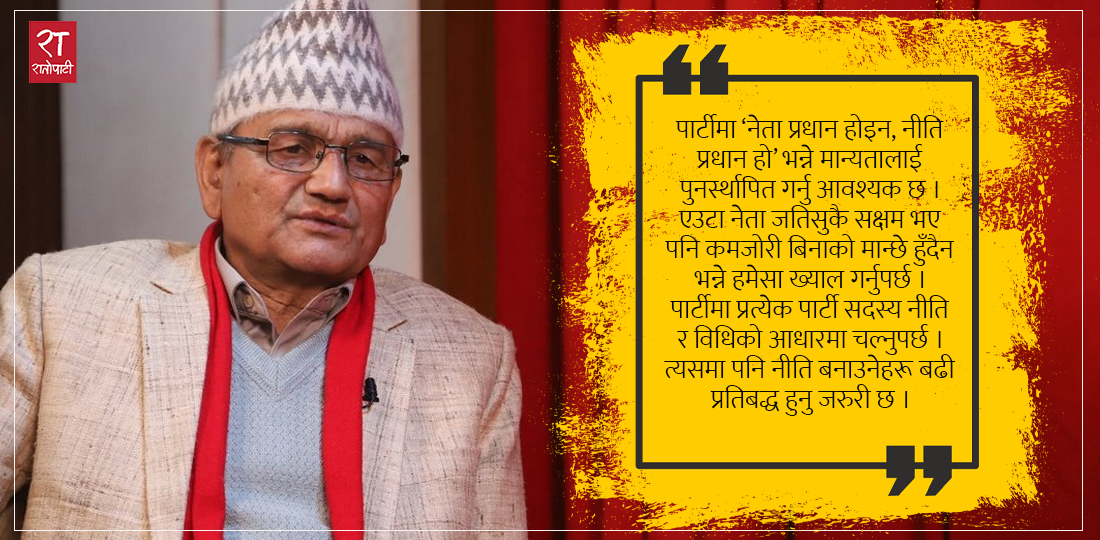
It is natural to be dissatisfied with leadership, but the solution must be sought through institutional processes.
How morally justifiable is it for leaders who contested elections under Gagan Thapa's signature to now reject his leadership? If that leadership was not legitimate, why was it acceptable to accept a ticket at that time? And if it was acceptable then, is rejecting it now not opportunism? Such double standards undermine the moral foundation of the party.
Politics is not just a means to acquire power; it is a field of values and commitments. It is natural to be dissatisfied with leadership, but the solution must be sought through institutional processes. Attempting to create parallel structures or publicly declaring the leadership illegitimate while rejecting the court's verdict weakens not only the party but also the country's democratic practice.
In today's world, democracy is not limited to elections. It is based on institutional stability, adherence to rules, and a culture of consensus. When rules and processes are weakened within a major political party, the impact is felt in national politics. Instability within a historic party like the Nepali Congress sends a wrong message to other parties that 'power is greater than rules'.
In a transitional democracy like Nepal, such a trend is even more dangerous. Here, democratic institutions have not yet fully matured. Political parties are the main pillars of democracy. If those pillars weaken, the entire structure falters.
Another dangerous aspect of internal strife is the erosion of public trust. Citizens expect stability, clarity, and leadership from political parties. But when constant disputes, accusations, and tendencies to reject leadership are visible within a party, public frustration grows. This ultimately breeds distrust in democracy itself.
The General Convention is not just a means for leadership change; it is also an opportunity to redefine ideology and direction.
The only way out of this situation is to return to institutional processes. The statute of the Nepali Congress clearly provides for the selection of leadership through a General Convention. If anyone is dissatisfied with the current leadership, the solution should be sought by competing in the General Convention. This is the democratic path.
The General Convention is not just a means for leadership change; it is also an opportunity to redefine ideology and direction. Today, the Nepali Congress is facing not only a leadership crisis but also a crisis of ideology and strategy. In such a situation, it is necessary to strengthen the General Convention rather than avoiding or undermining it.
Accepting Gagan Thapa's leadership is not about blind support for an individual; it is about respecting an institutional decision. In democracy, the process is greater than the individual. If the process itself is rejected, any decision can be challenged tomorrow, leading to anarchy.
The current dispute within the Nepali Congress is not just about leadership; it is also a question of morality. Politics remains healthy as long as the spirit of morality and accountability remains alive. But when personal ambition rises above institutional discipline, problems begin.
Today, there is a need for self-reflection. All factions of the party must ask themselves: Are we working to strengthen democracy? Or are we weakening it for our own interests? Is our struggle for values or for positions?
The question today is not just about the future of the Nepali Congress; it is a question linked to the future of Nepal's democratic journey.
History has shown that parties like the Nepali Congress can emerge from crises. But for that, a clear vision, consensus, and institutional commitment are required. That is the challenge today. Ultimately, democracy is not a static achievement; it is the result of continuous practice and struggle. If political parties cannot strengthen their internal democracy, national democracy will also weaken.
Therefore, the roadmap ahead must be clear: fully accept the court's decision, maintain institutional respect for the legitimate leadership, and build a new consensus through the participation of all sides in the upcoming General Convention. Only this path can make the Nepali Congress strong again and keep Nepal's democracy secure.
The question today is not just about the future of the Nepali Congress; it is a question linked to the future of Nepal's democratic journey. If we fail to make the right decision today, the entire nation will have to pay the price tomorrow.
This specific news has been automatically translated by AI. As a result, there may be some inaccuracies or language errors.