Nepal's Recent General Election Reshapes Political Landscape, Favoring New Forces Over Traditional Parties


The general election held in Nepal on Falgun 21 has fundamentally altered the country's political equation. This election has significantly diminished the influence of traditional political forces like the Nepali Congress and CPN-UML, while sidelining older political entities that championed ethnic and regional identity issues.
The most unprecedented and surprising aspect is that, for the first time since the 2015 elections, one political party has secured an overwhelming majority, approaching a two-thirds mandate. Given that the mandate of the people is the final decision in a democratic system, under normal circumstances, the Rastriya Swatantra Party (RSP) will be the sole claimant to power for the next five years.
There are various reasons for this substantial erosion of power among traditional political parties and the rise of a new political force. Chief among these is the failure to achieve expected milestones following the restoration of democracy after 2047 BS. For 35 years, apart from King Gyanendra's direct rule, the Nepali Congress, CPN-UML, and the then-Maoists have led the governance.
In a sense, Nepal's governance revolved around these parties. Although attempts were made to stimulate the economy by adopting liberal economic policies during this period, it was insufficient to bring about significant improvements in the living standards of the general public.
Development activities, such as infrastructure construction and road network expansion, progressed, but the process was very slow. Most state bodies were mired in corruption, commissions, and financial irregularities. Appointments to bodies investigating corruption and financial irregularities were made based on political quotas.
Meanwhile, major political changes occurred in the country on the strength of the People's Movement of 2062/063 and the preceding armed conflict. Through the combined force of these two uprisings, progressive agendas such as a republican system, federalism, and secularism were incorporated into the new constitution. These movements also ensured inclusive and proportional representation.
Consequently, a progressive constitution, the most progressive in Nepal's history, was promulgated in 2072 BS, formally ending the Shah dynasty. However, the major political parties failed to control this progressive system themselves and neglected to distribute its benefits to the general public.
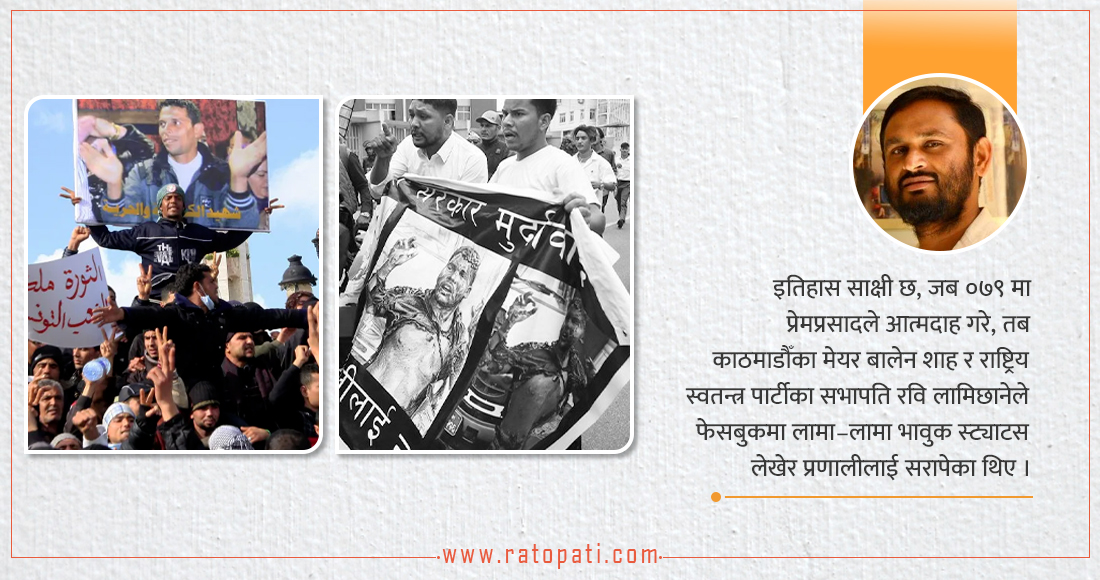
The then Mayor of Kathmandu Metropolitan City, Balen Shah, was viewed by the public as a symbol of dissatisfaction. A person who performed averagely as Mayor of the Metropolitan City was being excessively commercialized by a large segment of society.
According to the general principle of a parliamentary system, one of the major political forces leads the government, and another remains in the main opposition to pressure the government for proper functioning. However, the formation of a joint government by the Nepali Congress and CPN-UML in 2080 BS violated even the basic principles of the parliamentary system.
The powerful government, whose primary objective was stated as constitutional amendment, did not even appear to initiate the basic process for constitutional amendment. This government achieved no substantial results in favor of people's livelihood; instead, it remained focused only on stabilizing its own power. Public disillusionment with the top leadership of the major political parties reached its peak.
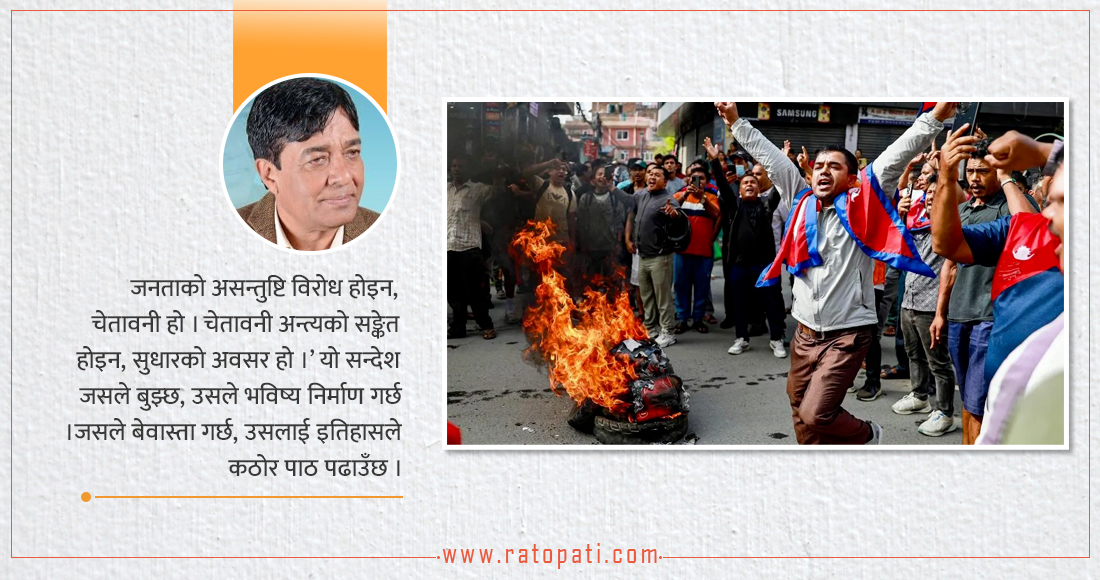
The leadership of the government was merely transformed into a musical chair of former Prime Ministers. In the midst of this, the Gen Z movement on Bhadra 23 and 24 became the decisive turning point for this election result.
The arrogance and irresponsible statements of the then Prime Minister KP Sharma Oli further agitated that movement. Although the emergency security arrangements were not fully under the control of the head of government, if he had taken responsibility for the massacre of unarmed students on Bhadra 23 and played a coordinating role, the situation at that time might have taken a different turn.
Sher Bahadur Deuba, who supported the irresponsible actions of then Prime Minister KP Sharma Oli, is equally responsible for provoking the Gen Z movement. Sher Bahadur Deuba was so eager for his upcoming Prime Ministerial post that he supported almost any move made by KP Sharma Oli.
During this period, there was a widespread debate within political parties regarding the strengthening of internal democracy, transformation, and generational change. When the major political force, the Nepali Congress, formed a new leadership under Gagan Thapa's presidency through a special general convention, a transfusion of political hope occurred. Although the leadership changed in the Nepali Congress, the dominance of the old leadership persisted in the communist parties.
As a result, even though the leadership changed in the Nepali Congress, the presence of the same old leadership in other parties meant that voters showed no inclination towards the overall old political parties. Although the leadership change in the Nepali Congress did not yield the expected results, the election outcome suggests some degree of positive improvement.
The extreme frustration and dissatisfaction among the public signaled an expression somewhere in the previous 2079 election itself. The then Mayor of Kathmandu Metropolitan City, Balen Shah, was viewed by the public as a symbol of dissatisfaction. A person who performed averagely as Mayor of Kathmandu Metropolitan City was being excessively commercialized by a large segment of society.
Although he did make some efforts at the beginning of his term. On the other hand, the Rastriya Swatantra Party was expanding its organization to the far reaches of the country.
The Gen Z movement was also used as a stepping stone to overturn and seize power. Both the RSP and the Mayor of Kathmandu Metropolitan City attempted to capitalize on the public dissatisfaction by utilizing the Gen Z movement, and a large segment of society facilitated this attempt by easily casting their mandate in the election.
There was some degree of political vendetta in the cooperative case involving RSP Chairman Rabi Lamichhane, but his supporters and well-wishers established a narrative that the incident was merely political vendetta and that Rabi Lamichhane was innocent, a narrative that the general public endorsed through the election.
Although some political prejudice was shown during the filing and prosecution of the case, the general public seemed to acquit Lamichhane themselves, without realizing that once a case enters the judicial process, it is resolved according to legal procedures. In this manner, even an individual who was sent into custody for remand by the court and later released upon posting bail with restitution was deified.
According to the general principle of law, once an accused gives one type of statement regarding the subject matter of a case in court, they are not allowed to make another statement in the same case. This means that Rabi Lamichhane's statement agreeing to pay the restitution amount set by the court is an admission of his mistake.
Nepali society is always deifying certain individuals or factions while demonizing others. This time, the lot for deification and demonization fell respectively to the new and old parties. Their top leaders fell into these two categories.
Now, legally, he cannot make another different statement, but even these legal processes were unilaterally publicized in his favor, making them heroes in the aspiration for change.
Overall, it appears that because the weight of the change-oriented vote in Nepal is significant, the public did not vote for the old forces in this election but gave the new forces a chance to be tested. Without a subtle investigation of all aspects of the Gen Z movement, all the blame was placed on the old forces, and all the credit was attributed to the new forces. Indeed, Nepali society is always deifying some individuals or factions while demonizing others.
This time, the lot for deification and demonization fell respectively to the new and old parties. Their top leaders fell into these two categories. A narrative was established that the old political parties have done nothing but wrong, and the new force can accomplish many things significantly even in a short period.
Their strategy to propagate this narrative to every village and remote area, influenced by the growing information technology and algorithms, was completely successful. The general public needed significant improvement in governance performance rather than party manifestos or ideological principles, which the traditional political forces were taking too long to deliver, leading people to change their votes in expectation of the new force.
Therefore, this election result appears less like the result of enthusiasm for the new force and more like an eruption of disgust towards the old ones.
This specific news has been automatically translated by AI. As a result, there may be some inaccuracies or language errors.