Koshi Province Faces Political Instability Amidst Frequent Government Changes

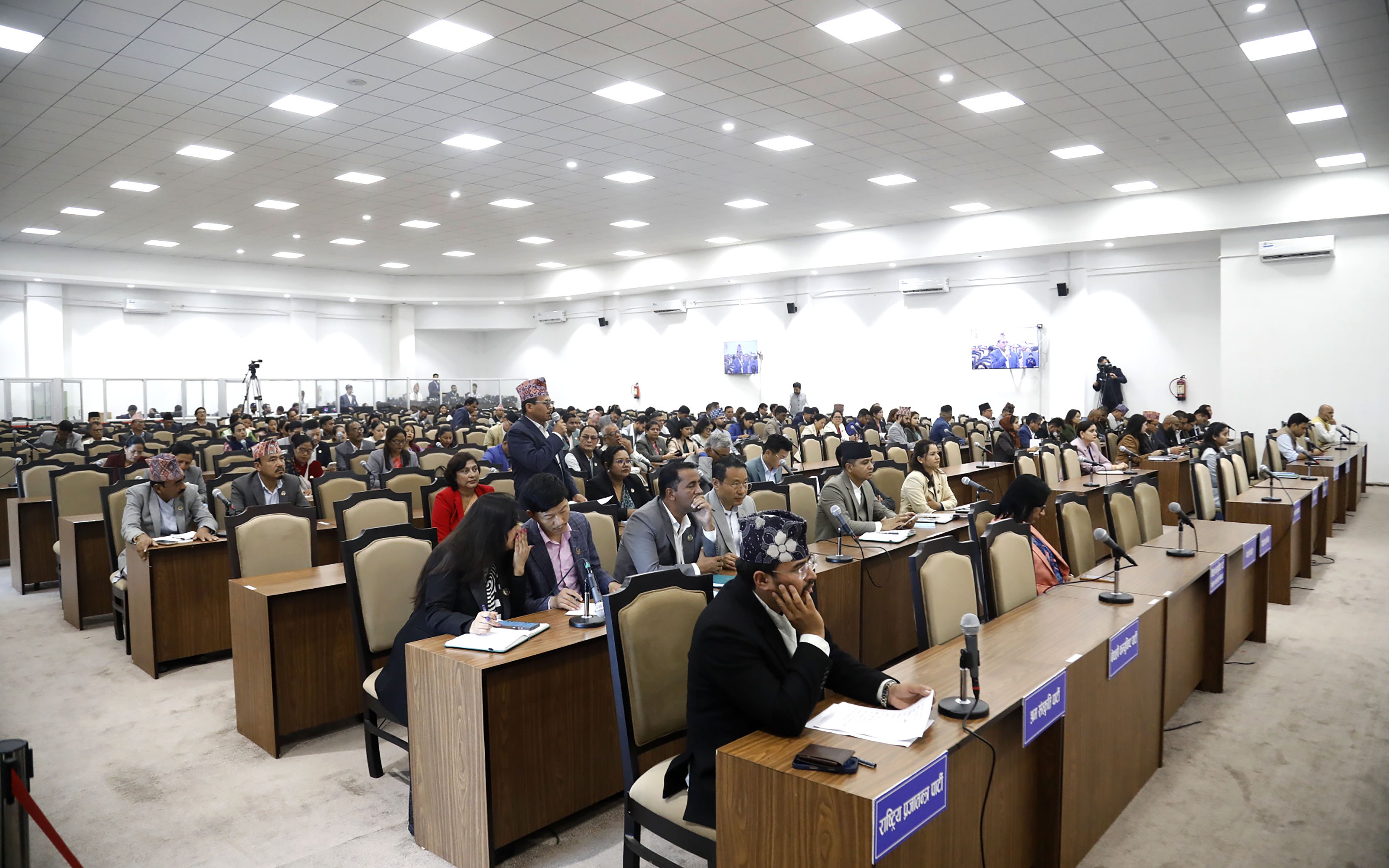
Biratnagar. The Rastriya Swatantra Party passed a proposal to abolish the provincial assembly at the first national convention held in Chitwan. The old parties Nepali Congress, CPN UML, and Nepali Communist Party (CPN) have been criticizing it. Their argument is that abolishing the provincial assembly means no federalism.
However, the games played by these three parties in the provincial assembly and provincial government have tarnished the entire provincial structure. In a way, their actions are fueling the RSP's agenda that the provincial assembly is meaningless and should be abolished.
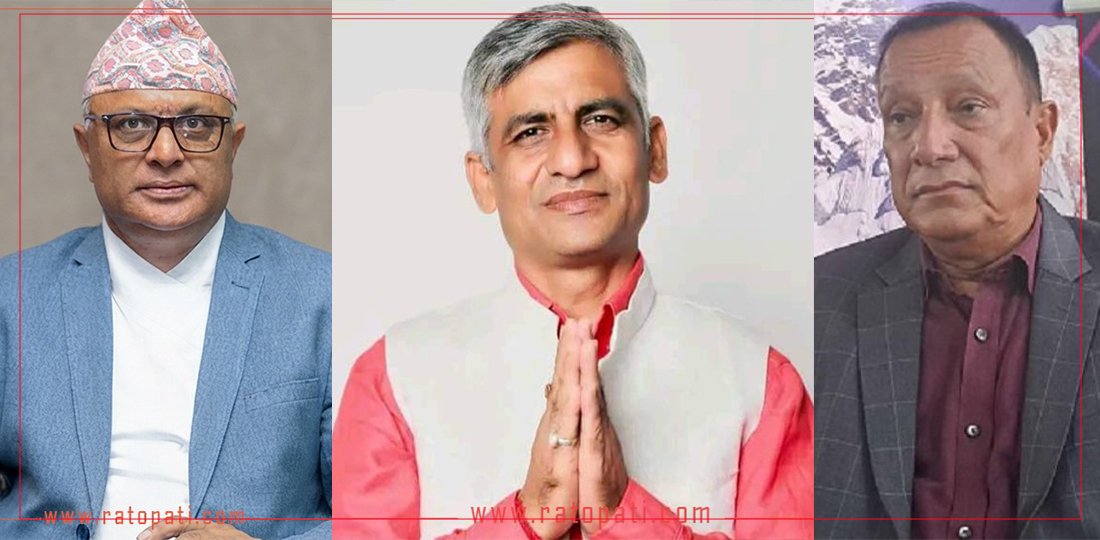
Leaders of the Congress and UML, who are in the provincial ruling coalition, are aware of this, but they are acting as they are. Uddhav Thapa, the leader of the Congress Koshi Province, who is also the party leader, said that the frequent changes in government have strengthened those who question federalism. 'The frequent changes in government in the province, with the breakdown of party equations, have not sent a good message, they have sent a bad one. This is directly raising questions about federalism,' Thapa said. He also said that Koshi Province has suffered the most. 'The Koshi Province has suffered the most from the constant breakdown and formation, and then breakdown and formation of party equations,' he said.
Vidur Kumar Limthep, Minister of Economic Affairs and Planning in the Koshi Province government from UML, also admits that it is not good to be preoccupied with government changes in the current situation. 'This is not good at all. There was so much protest, arson, and fire at Singha Durbar. Still, our preoccupation with changing the government is not good. We should have brought stability to the provincial governments,' Limthep said.
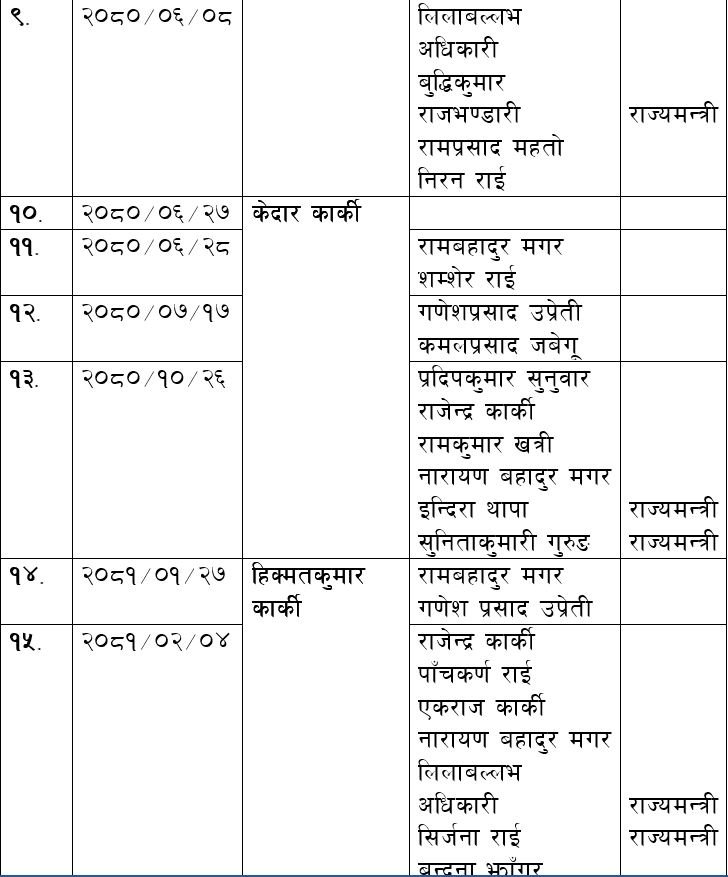
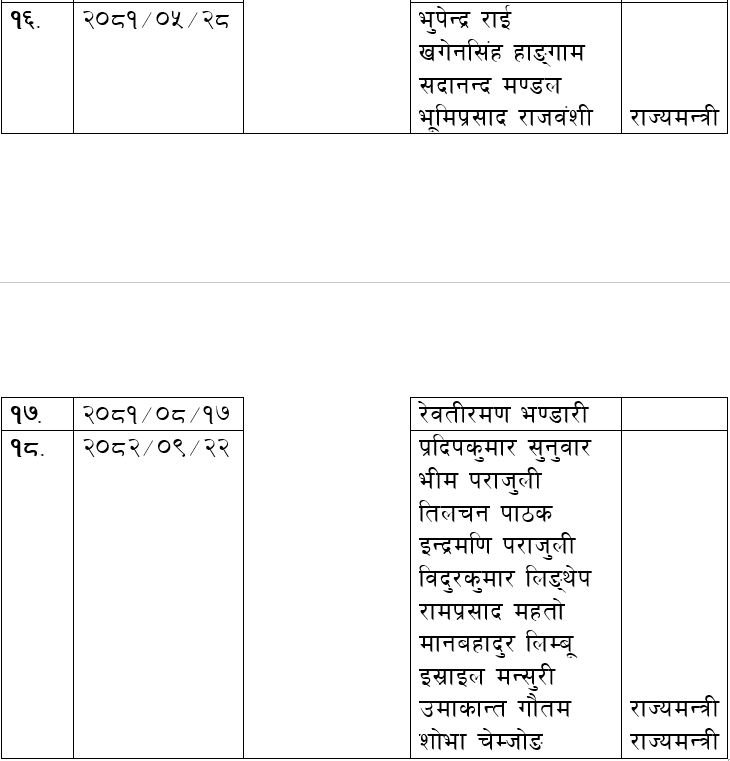
Koshi Province has become a model of political instability, power struggles, and misuse of ministerial positions for the past four years. The term of the second provincial assembly, which began on Poush 25, 2079, has been mired in the game of retaining and toppling power. During this period, the Koshi Province has seen 6 government formations and dissolutions, and chief ministers have expanded or reshuffled the cabinet 18 times to hold onto power. Now, three parties are preparing for the seventh government formation. If successful, it will be the 19th cabinet formation, and the number of those who have worn the ministerial badge will increase. However, this is unlikely to make a significant difference for the province and its people.
The post of Chief Minister in Koshi Province has become like a musical chair. During this period, Hikmat Kumar Karki, the parliamentary party leader of CPN UML, has been appointed Chief Minister the most, 3 times (on 2079/9/24, 2080/05/22, and 2081/01/27). Similarly, Uddhav Thapa of Nepali Congress became Chief Minister twice (on 2080/03/22 and 2080/04/17), and rebel leader of Congress, Kedar Karki, became Chief Minister once (on 2080/06/27). Due to court orders, the application of various articles of the constitution, and changes in alliances, no government could achieve stability.
Statistics show that chief ministers have distributed ministerial positions like lollipops out of fear of the government falling. In the 6 governments, the cabinet has been expanded and reshuffled a total of 18 times. During this period, more than four dozen people have held the positions of minister and state minister. Even though the power equations changed and the chief minister changed, some lucky provincial assembly members always remained around the power. According to statistics, the same person has become a minister up to 4 times. In 59 appointments, many faces have been repeated and tripled.
Pradip Kumar Sunuwar of Nepali Congress was appointed minister the most, 4 times. He served as a minister in both terms of Uddhav Thapa, and in the cabinets of Kedar Karki and Hikmat Karki. Kamal Prasad Jabegu and Rajendra Karki of CPN have served as ministers 3 times each. More than 13 MPs have succeeded in becoming ministers twice in the power game. These include Til Kumar Menyangbo, Nirmala Limbu, Jeevan Acharya, Buddhikumar Rajbhandari, Ramkumar Khatri, Pancha Karna Rai, Ekraj Karki, Sirjana Rai, Lilavallabh Adhikari, Ramprasad Mahato, Rambahadur Magar, Ganeshprasad Upreti, and Narayan Bahadur Magar.
What kind of alliances were formed?
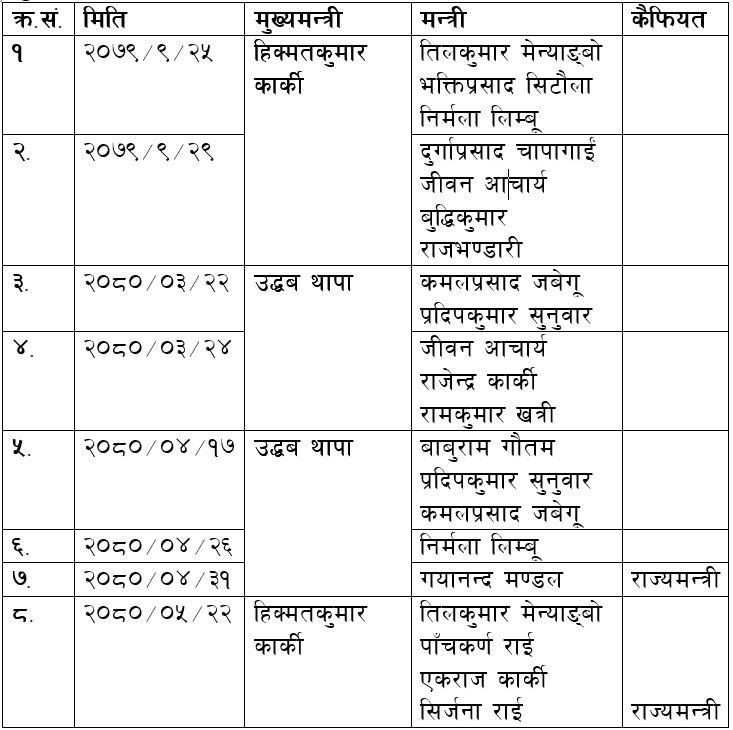
In the second term of the provincial assembly, Hikmat Karki of CPN UML became the Chief Minister for the first time on Poush 24, 2079. He became Chief Minister with the support of the then Maoist Center, RPP, and JSP. Karki reduced the 13 ministries to 9. In his first term, 6 ministers were appointed. Tilkumar Menyangbo and Buddhikumar Rajbhandari from UML, Durga Prasad Chapagain and Jeevan Acharya from Maoist Center, Bhaktiprasad Sitoula from RPP, and Nirmala Limbu from JSP were appointed ministers. After the Maoist and JSP, who were in the government, left, Karki could not get a vote of confidence on Asar 15, 2080. The Maoist and JSP left the government following a change in the central alliance.
On Asar 22, 2080, and Saun 17, 2080, Congress leader Uddhav Thapa became Chief Minister twice with the support of Maoist, CPN (S), and JSP. During that period, Thapa appointed Kamal Prasad Jabegu, Pradipkumar Sunuwar, Jeevan Acharya, Rajendra Karki, Ramkumar Khatri, Baburam Gautam, Nirmala Limbu, and Gyanananda Mandal as ministers. Unable to secure 47 MPs from the alliance of Congress, Maoist, CPN (S), and JSP, his Chief Minister post was jeopardized twice by court orders, and he lost his position.
Again, on Bhadra 22, 2080, the Supreme Court ordered the appointment of Hikmat, the same person from UML, as Chief Minister under Article 168(3) of the constitution. Accordingly, immediately after being appointed Chief Minister, he appointed three ministers and one state minister. These included Tilkumar Menyangbo, Pancha Karna Rai, Ekraj Karki, Sirjana Rai, Lilavallabh Adhikari, Buddhikumar Rajbhandari, Ramprasad Mahato, and Niran Rai as cabinet members. He resigned after failing to secure a vote of confidence. Then, on Ashwin 27, 2080, Kedar Karki became a rebel Chief Minister under Article 168(5) of the constitution. In his cabinet, Rambahadur Magar, Shamsher Rai, Ganeshprasad Upreti, Kamalprasad Jabegu, Pradipkumar Sunuwar, Rajendra Karki, Ramkumar Khatri, Narayan Bahadur Magar, Indira Thapa, and Sunita Kumari Gurung participated from time to time.
Displacing the government led by Kedar Karki, a new government was formed under the leadership of Hikmat Kumar Karki on Baishakh 27, 2081, from the then UML and Maoist Center alliance. In his cabinet, Rambahadur Rana, Rajendra Karki, Pancha Karna Rai, Ekraj Karki, Ganesh Upreti, Narayan Bahadur Burjamagar, and Lilavallabh Adhikari became ministers. Similarly, Sirjana Rai and Bandana Jhangad became state ministers. Following the change in the central government, the Maoist party again withdrew from the government. The Congress supported the UML Chief Minister Hikmat Kumar Karki. On Bhadra 28, 2081, Bhupendra Rai, Khagensingh Hangam, Sadananda Mandal, and Bhumiprasad Rajwanshi from Congress joined the government.
Lilavallabh Adhikari resigned from his ministerial post after being implicated in a human trafficking case. Following his resignation, Revatiraman Bhandari was given the responsibility of Minister of Internal Affairs and Law on Mangsir 17, 2081. Reshuffling the cabinet again, Chief Minister Karki appointed Pradipkumar Sunuwar, Manbahadur Limbu, Israel Mansuri, and Bhim Parajuli from Congress as ministers and Shobha Chemjong as state minister on Poush 22, 2082. From UML, Chintan Pathak, Indramani Parajuli, Ramkumar Mehta were made ministers, while Umakant Gautam was given the responsibility of state minister. The same cabinet is currently in place. Now, Congress is preparing to withdraw its ministers from all governments. Along with this, efforts for a new equation and a new government formation have started again in Koshi Province.
List of Chief Ministers
1. Hikmatkumar Karki (Chief Minister)
2. Uddhab Thapa (Chief Minister)
3. Kedar Karki (Chief Minister)
List of Ministers
1. Tilkumar Menyangbo
2. Bhaktiprasad Sitoula
3. Nirmala Limbu
4. Durgaprasad Chapagain
5. Jeevan Acharya
6. Buddhikumar Rajbhandari
7. Kamalprasad Jabegu
8. Pradipkumar Sunuwar
9. Rajendra Karki
10. Ramkumar Khatri
11. Baburam Gautam
12. Gyanananda Mandal (State Minister)
13. Pancha Karna Rai
14. Ekraj Karki
15. Sirjana Rai (State Minister)
16. Lilavallabh Adhikari
17. Ramprasad Mahato
18. Niran Rai (State Minister)
19. Rambahadur Magar
20. Shamsher Rai
21. Ganeshprasad Upreti
22. Narayan Bahadur Magar
23. Indira Thapa (State Minister)
24. Sunita Kumari Gurung (State Minister)
25. Bandana Jhangar (State Minister)
26. Bhupendra Rai
27. Khagensingh Hangam
28. Sadananda Mandal
29. Bhumi Prasad Rajwanshi (State Minister)
30. Revatiraman Bhandari
31. Bhim Parajuli
32. Tilchan Pathak
33. Indramani Parajuli
34. Vidurkumar Limthep
35. Manbahadur Limbu
36. Israel Mansuri
37. Umakant Gautam (State Minister)
38. Shobha Chemjong (State Minister)
List of Chief Ministers and Ministers
This specific news has been automatically translated by AI. As a result, there may be some inaccuracies or language errors.