Nepal's Political Evolution Marked by Persistent Governance Failures, Demanding Systemic Reform Over Face Value Changes


Nepal has passed through numerous stages of system changes, from the autocratic Rana regime to the Panchayat system, multi-party democracy, and now to a republican federal structure. Despite various systems bearing different names and adjectives, the stability that allows citizens to experience good governance has yet to be established as anticipated.
Corruption, malpractices, nepotism, and cronyism have become institutionalized trends rather than isolated incidents, leading to a gradual erosion of impartiality in public administration, quality of service delivery, and public trust in the state. The mindset of viewing public office as a source of privilege rather than service has made decision-making processes opaque. Conflicts of interest and influence have prevailed in public procurement, transfers-promotions, and decisions made by regulatory bodies.
This situation has not only caused economic damage but has also fundamentally devalued the rights guaranteed by the constitution. The rule of law has been mocked. It has begun to appear as if laws are directed by the leaders, rather than leaders being guided by the laws. Against this backdrop, the patience of the youth is wearing thin, and society has started demanding change in behavior rather than just in speeches.
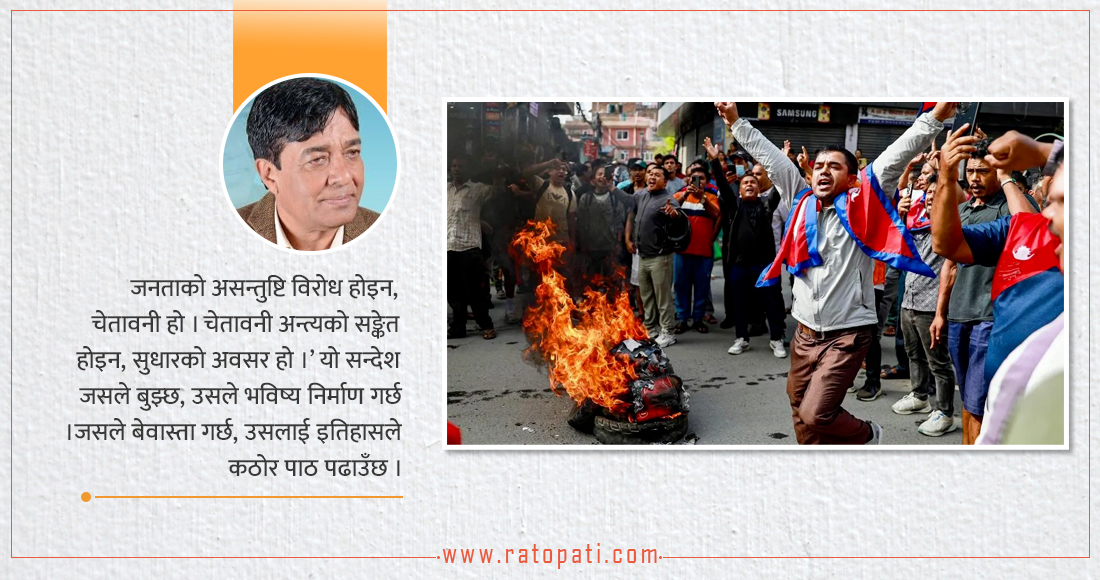
In a context where the state has failed in its basic duty of protecting public assets and addressing citizen discontent through legal means, interpreting the Gen Z movement simply as an emotional surge or anti-government agitation would be wrong, because the core intent of that movement was not merely a change of power or faces, but the re-establishment of public accountability and transparency.
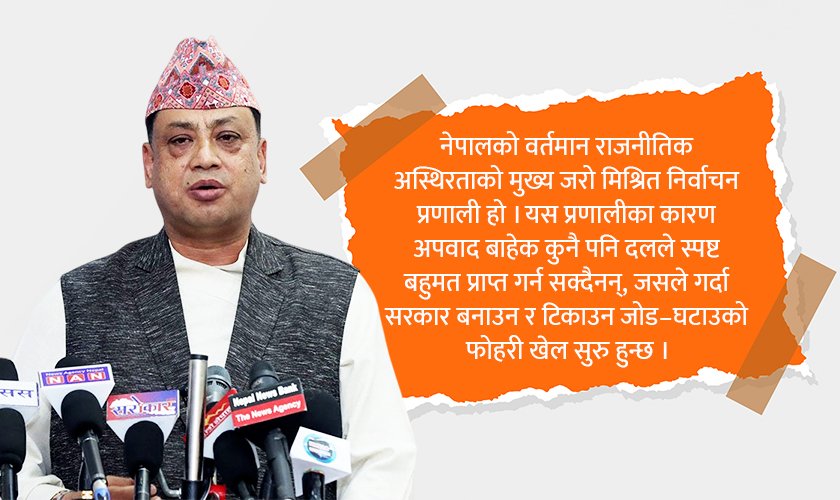
हाल नेपालमा विद्यमान कुशासनको एउटा प्रमुख कारण शक्ति–सन्तुलन र जवाफदेहिताको दयनीय अवस्था हो । संसदीय अभ्यासमा कार्यपालिका र विधायिकाबीच स्पष्ट सिमाना निर्धारण हुन नसकेका कारण दुवै निकायबीच गहिरो अन्तरसम्बन्ध कायम रहेको छ ।
However, while Gen Z activists maintained that the movement was peaceful, attempts were made by undesirable elements to infiltrate and escalate violent activities, creating an environment to build the narrative that 'the new youth are no different from the old ones.' Such activities weakened the moral purity of the movement and provided the state with an excuse for repression.
A primary cause of the current misgovernance in Nepal is the pathetic state of checks and balances and accountability. Due to the lack of clear demarcation between the executive and the legislature in parliamentary practice, a deep interrelationship exists between both bodies.
Consequently, it is a reality we all perceive that the independent oversight role of parliament has weakened, and the culture of questioning is almost dead. Instead of focusing on policy formulation, timely legal reforms, quality budget monitoring, and controlling the executive, the attention of lawmakers is diverted towards aspirations of becoming ministers, and this aspiration has fueled the trade of tickets and votes.
As candidates become dependent on flattery, sycophancy, and manipulation rather than public service, the ultimate cyclical effect has resulted in a corruption-ridden country. Our repeated experiences have taught us that merely changing individuals without reforming the structure and culture will only lead to a repetition of the same old cycle.
While seriously criticizing old tendencies, this article will be limited to an indictment without clarity on the alternative path forward. Therefore, the alternative now must be a change of heart and a change of culture, moving away from the emotional appeal of new faces. Otherwise, aimless public aspiration risks providing an opportunity for neo-opportunism again.
'New mindset' and 'new culture' are difficult questions in themselves regarding their origin and creation process. Morality is not something obtained through speeches or the study of ethics. It is public behavior constructed through a combination of institutional encouragement and punishment.
As long as the practice where good character is rewarded and weak character is punished is not strictly implemented, misgovernance will continue to take the form of culture. While the source of morality being the individual is a positive aspect, given the current scarcity of this quality, an environment for a 'new culture' can only be created through systemic reform practices.
यसपालिको निर्वाचनमा देखिएका अर्का थरी अनुहारहरू मौजुदा सांसद वा स्थानीय जनप्रतिनिधिबाट राजीनामा दिएर उम्मेदवार बन्नेहरू हुन् । यो प्रवृत्ति पनि नागरिकको दृष्टिमा नैतिक परीक्षणको विषय बनेको छ ।
This is the definition of the leader sought by the Gen Z generation. The leader we seek is not just a new face, but new ideas, new enthusiasm, and a virtuous heart.
Those who failed to honestly fulfill their positional responsibilities while in government service or other professions, and who amassed illicit wealth by linking authority and access to personal gain, are certainly new faces in the role of candidates. However, we cannot expect new reforms and good governance from the multitude of faces appearing as candidates for the upcoming election.
What we seek is not a change in the faces of candidates, but a change of mind and a change of culture. Similarly, another group of faces seen in this election consists of those resigning from their positions as incumbent Members of Parliament or local representatives to become candidates. This trend is also a subject of moral scrutiny in the eyes of the citizens.
To be elected after taking an oath before the people to remain in the position approved by the citizens for five years, work on development in that area, formulate good policies, and generally uplift the living standards of the citizens, and then to be greedy for another position before the term ends, must be seen as devaluing the mandate, betraying trust, believing in opportunism, viewing votes as mere pieces of paper rather than the trust of the citizen, and misusing the national treasury by creating a situation for new by-elections.
In a democracy, a vote is not just a number but a source of legitimate trust, and the perception has been built among the public that weakening that trust midway means shirking public responsibility. It cannot be guaranteed that a person who neglects their responsibilities and betrays their promises to citizens while chasing new opportunities will not betray the citizens again if they receive a better option in the future.
A step where someone accepts accountability to bring about extensive reform at a high level without a clear plan, credible reason, and honest dialogue with the people should not merely be termed opportunism. In the upcoming election, many have appeared to fish in troubled waters by repackaging old vested interests in new language, driven by the craze for new faces.
पुरातन कुशासनको चक्रलाई तोड्न प्रणालीगत सुधारको खाका, नैतिकता निर्माणको संस्थागत प्रक्रिया र भूराजनीतिक जोखिम व्यवस्थापन गर्ने स्पष्ट नीतिगत दिशालाई केन्द्रमा राखेर अघि बढिएन भने परिवर्तन फेरि भ्रम बन्नेछ र भ्रमले फेरि निराशा जन्माउनेछ ।
However, the new players presenting themselves as saviors in the upcoming elections have not built any concrete basis to convince the masses. The risk of a tragic demise for the Gen Z movement has increased due to self-serving cliques appearing under the guise of candidates.
Ultimately, what past experience has taught us is that the condition of the citizen does not change merely because the system changes or the faces of the leadership change. For the condition of the citizen to change, the culture of the leadership must change. The mind must begin its journey in a positive direction.
The warning from Gen Z can be addressed not just by electoral management, but only by the result of structural reform. The nation's condition will change only if the future provides us with the supremacy of law, transparency, and accountability as mandatory standards for state governance.
If we do not move forward by centering on a blueprint for systemic reform, an institutional process for building morality, and a clear policy direction for managing geopolitical risks to break the cycle of outdated misgovernance, change will once again become an illusion, and illusion will once again generate despair. And citizen despair will erupt again as a terrible volcano.
This specific news has been automatically translated by AI. As a result, there may be some inaccuracies or language errors.