South Korea Reopens E-7 Visa Process for Skilled Workers via Manpower Agencies

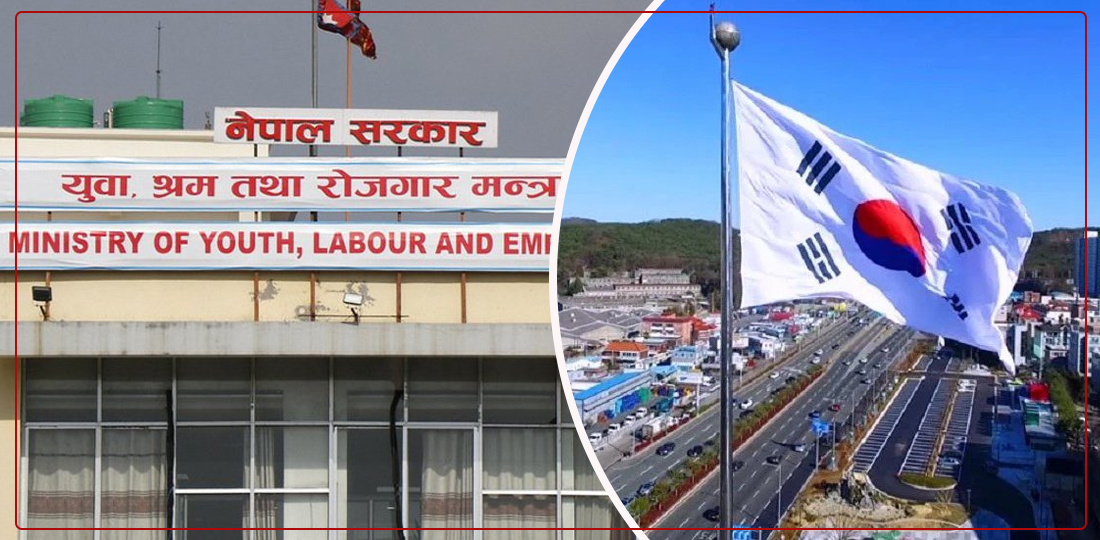
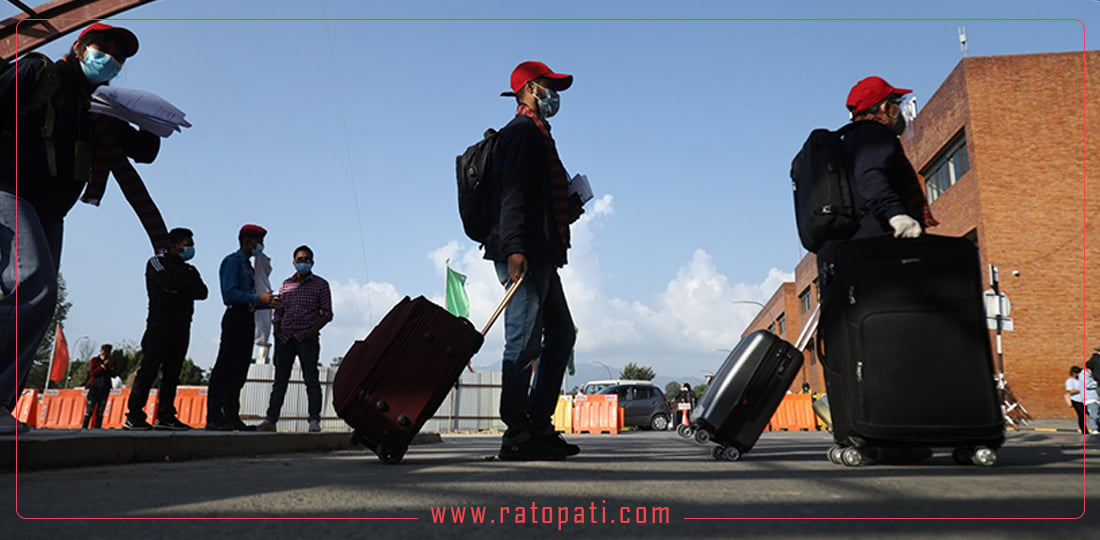
Kathmandu. The government has once again initiated the process of sending skilled workers (E-7 visa) to South Korea through manpower agencies. The E-7 visa process had been halted for a long time due to various legal and policy issues.
The process was attempted to be moved forward by the then Labor Minister Sharad Singh Bhandari but was postponed following a directive from the Commission for Investigation of Abuse of Authority. A lawsuit was also filed in court regarding the E-7 visa.
Recently, following an interim order from the Patan High Court, the Ministry of Youth, Labor, and Employment has again moved forward with the process. On Asar 16, the ministry, through a ministerial-level decision, advanced the necessary procedures.
On the same day, in a letter sent to the Ministry of Foreign Affairs, the Ministry of Labor mentioned that the process of sending workers on E-7 visas is being expedited based on the subject matter for which the ministry had previously sought directives, diplomatic notes received from the Korean Embassy, and various orders issued by the Patan High Court at different times.
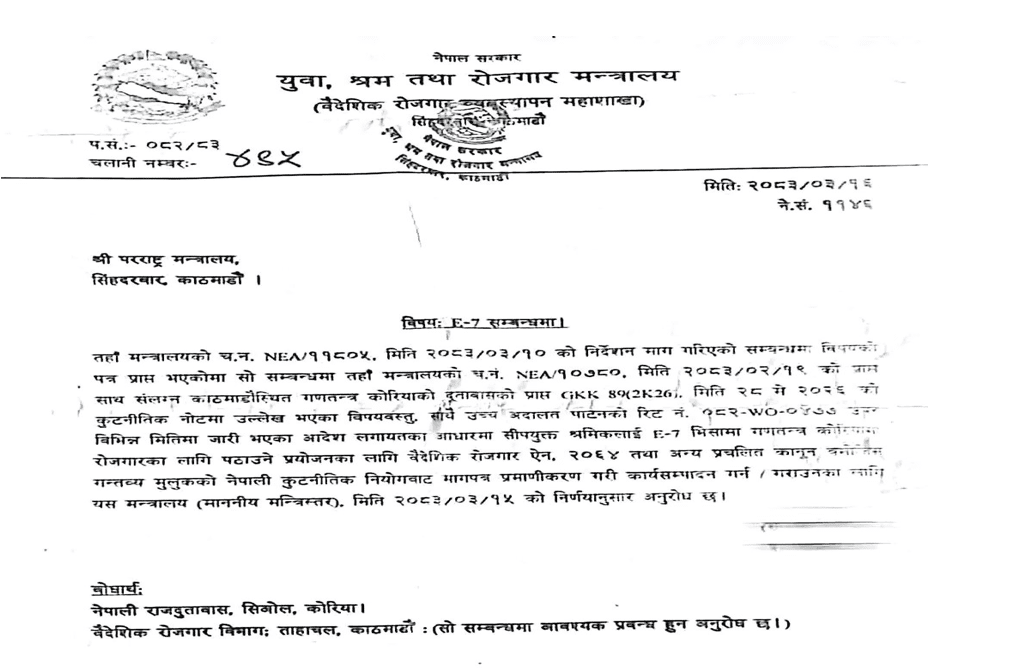
According to the Ministry of Labor, a request was made through the Embassy of the Republic of Korea to facilitate the authentication of documents for Nepali skilled workers going on E-7 visas. The Ministry of Labor has also requested the Nepali Embassy in Seoul, through the Ministry of Foreign Affairs, to authenticate the necessary documents and carry out the work.
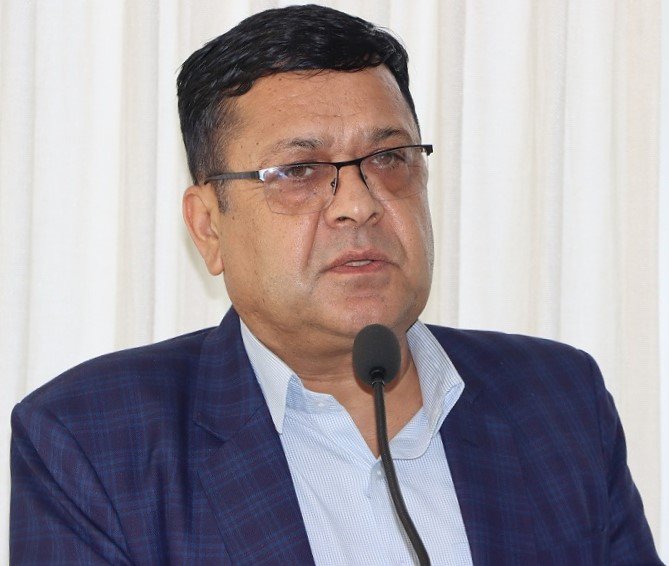
Ministry of Labor spokesperson Pitambar Ghimire stated that the ministry has decided to facilitate the process by addressing the procedural ambiguities related to the E-7 visa. He mentioned that the process is being moved forward after informing the Korean Embassy as requested.
Spokesperson Ghimire said, “We have directed to move forward with this process in accordance with the prevailing laws, acts, rules, court orders, and procedures. Accordingly, the embassy has also sent a response to the ministry's letter. The department will provide information on whether the remaining demands have been authenticated and the process has moved forward.”
G2G Proposal Rejected
According to Ministry of Labor spokesperson Ghimire, a response has been received by the ministry through the Embassy of the Republic of Korea as per the request made by the Ministry of Labor. He stated that Nepal had initially proposed sending skilled workers through the Government-to-Government (G2G) modality, but the South Korean government responded that skilled workers should be sent through the Business-to-Business (B2B) system.
Spokesperson Ghimire said, “The Ministry of Labor had proposed authenticating documents for Nepali skilled workers going on E-7 visas through G2G. However, Korea did not accept the G2G proposal. They have stated that skilled workers must be sent through the Business-to-Business (B2B) system.”
With the ministry issuing directives to move forward with the process, the path for sending skilled workers to South Korea through manpower companies, in accordance with the Foreign Employment Act, 2064, and prevailing laws, has been formally opened.
However, even though the ministry has reopened the process following a court order, the Department of Foreign Employment has stated that no demand letters have been submitted for authentication yet. According to the department, work is currently underway between the Ministry of Labor and the Ministry of Foreign Affairs regarding the E-7 visa.
With the government's decision to open the process, licensed manpower companies will now be able to send skilled workers to South Korea within the framework of the Foreign Employment Act, 2064, and prevailing laws.
Why was the process stopped in the past?
The then government had issued the 'Procedure for Sending Skilled Workers to Korea, 2080' on Falgun 11, 2080, but before this procedure could be implemented, a complaint was filed with the Commission for Investigation of Abuse of Authority.
The commission had directed to immediately postpone the process, citing that the currently operating government-level EPS system could be affected and there was a risk of fraud.
Following this, the Department of Foreign Employment halted the process. Manpower entrepreneurs filed a case in the Patan High Court against the government's decision. The court issued an interim order not to halt the implementation of the procedure, and with positive diplomatic notes received from the Korean side, the ministry has revived this process.
According to spokesperson Ghimire, the process was not stopped previously but was merely facing some ambiguity. “Based on the court order and prevailing laws and regulations, the process of demand letter authentication and labor approval will now proceed smoothly. The process from the ministry's side is almost complete. Since the procedure was already developed in the past, the process will move forward soon,” he said.
Dik Bahadur Khatri, Chairman of the Federation of Employment Agencies Nepal, stated that the government has been hesitant regarding the E-7 visa and service fee determination for South Korea.
He said, “The government still appears uncertain about the E-7 visa. It has only made a decision to open it. Other processes need to be moved forward. A procedure has already been developed for this as well. It is necessary to proceed with demand letter authentication.”
He added that it is mysterious that the ministry has not started demand letter authentication even though the court has cleared the way.
Procedure for Manpower to Send Workers on E-7 Visa
A procedure, 'Procedure for Sending Skilled Workers to Korea, 2080', has already been developed for manpower agencies to send workers on South Korea's E-7 visa. Manpower companies that meet the criteria set by the government can send workers on E-7 visas.
Manpower companies sending workers on E-7 visas must have their own training centers. Training centers with contractual agreements for full-time utilization will also be recognized.
The training center must have at least two language instructors with official certification to teach the Korean language.
Additionally, the manpower company must have an agreement with an association registered and permitted in South Korea for facilitation services for workers and for work-related purposes.
According to the procedure, the expenses incurred by workers going on this visa will be borne by the employer. The procedure states, “The expenses for airfare, insurance, health check-ups, contribution to the welfare fund, contribution to the social security fund, and labor approval when sending Nepali citizens for employment to Korea will be borne by the employer, and for others, it will be as determined by the ministry.”
Manpower companies and their contact or branch offices in South Korea are not allowed to collect any fees from workers when sending them. The procedure also stipulates that associations affiliated in Korea cannot charge any fees from workers.
The expenses for skill and language training and testing conducted by skill and language training providers must also be borne by the respective employer.
Who is eligible for the E-7 Visa?
The E-7 visa is exclusively targeted at skilled workers. The E-7 visa is a professional visa issued by South Korea to foreign nationals with specialized skills.
The currently operational E-9 visa is for unskilled or semi-skilled workers. Individuals wishing to obtain an E-7 visa must possess specific educational qualifications and experience.
According to the procedure, to go on this visa, one must have a diploma or higher educational degree and work experience in the relevant field. Additionally, applicants must be physically and mentally healthy, not be drug addicts, and possess a certificate of good character issued by the Nepal Police.
Those interested in going on an E-7 visa must pass a basic Korean language and professional skills test from a body recognized by the South Korean government. They must have received training for the relevant work from an institution authorized by the government or the Department of Foreign Employment.
The South Korean government plans to bring workers on E-7 visas in fields such as sales developers, engineers, nurses, university lecturers, designers, translation and management specialists, chefs, cooks, hotel receptionists, medical coordinators, and tourism interpreters in the hotel and service sector; welders, painters, shipbuilding, aircraft mechanics, and aquaculture technicians in technical skills; and highly skilled workers in agriculture, animal husbandry, fisheries, and construction in production and manufacturing.
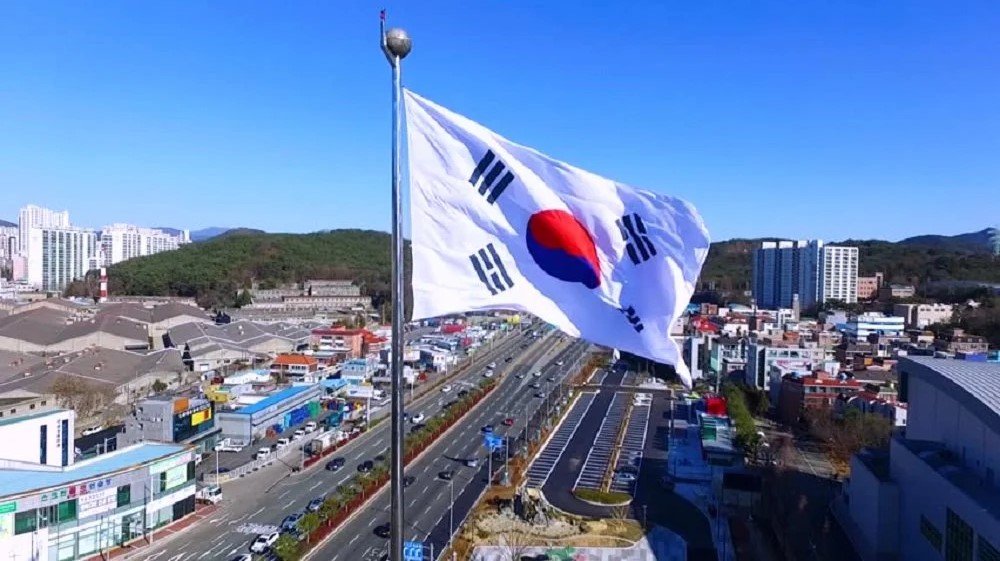
The salary for workers going on an E-7 visa is considered significantly attractive compared to the E-9 (unskilled) visa. According to the procedure, the minimum monthly salary for workers on an E-7 visa will be 2.7 million Korean Won (approximately 260,000 Nepali Rupees). However, ministry data indicates that many Nepalis currently working in Korea are earning more than 400,000 Rupees per month based on their skills.
According to entrepreneurs, skilled workers going to South Korea on an E-7 visa can earn a monthly salary of approximately 450,000 to 500,000 Rupees.
According to Chairman Khatri, there has been a significant increase in demand for technical manpower, especially welders, in South Korea. He claims that the remittances from skilled workers will also be substantial.
Another major attraction of this visa is the facility to bring family members. Workers on this visa will be able to bring their families to Korea after a certain period.
What is the impact on EPS?
With the E-7 visa process being handled through the private sector, some have expressed concerns that the government-level EPS system might be in crisis, but the ministry and entrepreneurs do not accept this.
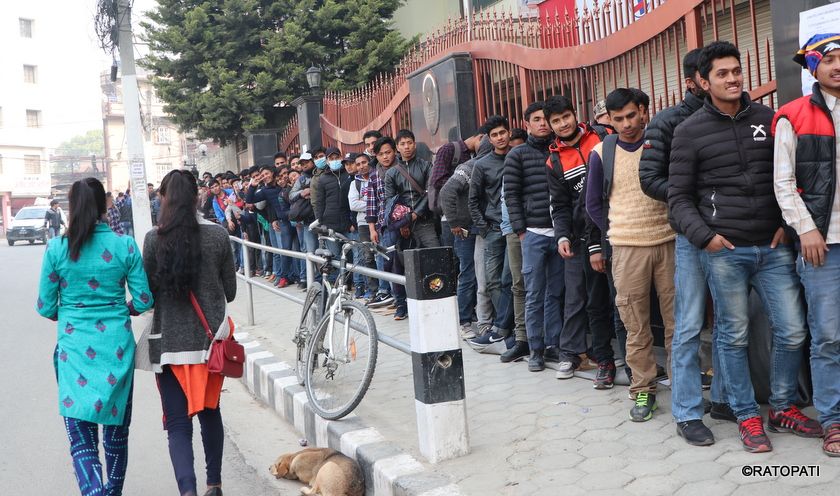
“The E-9 is for unskilled workers, while the E-7 is for fully skilled workers. The demand and selection processes for both are different,” said Chairman Khatri.
The government also claims that the E-7 system will not affect EPS and can be reviewed if problems arise in the future. Spokesperson Ghimire also stated that there will be no impact as the E-7 visa and EPS system are different.
Korea has recently started bringing workers on E-7 visas from 15 countries, including Nepal. More than 7,000 Nepalis who previously went through EPS have already changed their visas to E-7 status.
Now that the path to go directly as skilled workers from Nepal has opened, it is believed that this will make foreign employment for skilled manpower more secure and dignified.
This specific news has been automatically translated by AI. As a result, there may be some inaccuracies or language errors.


_cvUCBlwFTZ.jpg)