Mango Production and Price Trends in Nepal

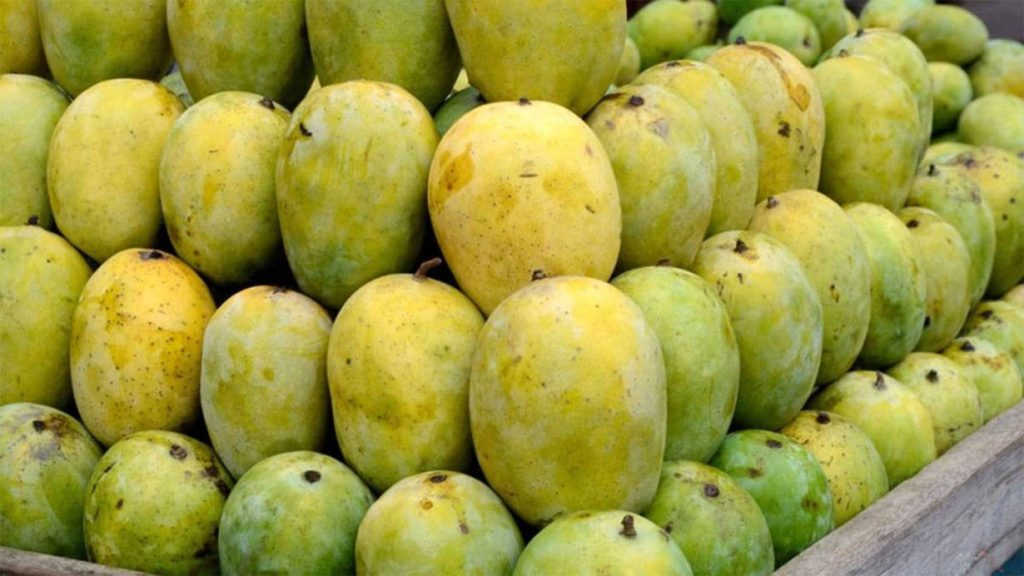
Kathmandu. Looking at the latest statistics of mango production, its area, production and productivity are seen to be increasing. The price has mostly been seen to increase rather than decrease.
It is alleged that there is a big difference between production and consumer prices because there are at least three levels of traders from mango-producing farmers to general consumers. In Nepal, various varieties of mangoes produced domestically and imported from India and China are consumed from Baishakh to Ashoj.
According to Amar Baniya, Chairman of the Nepal Fruits Wholesale Traders Association, Kuleshwor, mangoes worth approximately Rs 2 billion each from domestic production and imports from India, and Rs 1 billion from China are consumed annually in Nepal. Mangoes have been imported in larger quantities from China only in the last two years.
According to the Kalimati Fruits and Vegetable Market Development Committee, the price of mango (Mandalh) and mango (Dasheri) on Monday was a minimum of Rs 180 and a maximum of Rs 200 per kg. Different prices are seen in other wholesale markets and various cities.
Binay Shrestha, Information Officer of the committee, informed that 1,230 tons of mangoes have been imported in the Kalimati market from Baishakh to date, of which 280 tons of mangoes were imported from India.
Mango prices are comparatively high this year
He stated that the price of mango has not fallen much compared to the past, and mentioned that the Maladaha variety of mango is sold the most in Nepal, followed by Dasheri, Kalakate, Chosa, and Amrapali. The main mango season ends with Asar, after which mangoes are available in smaller quantities.
According to the data of the National Horticultural Development Center under the Ministry of Agriculture, Forest and Environment, the area, production, and productivity of mango cultivation are increasing within the country. In the fiscal year 2078/79, 498,859 tons of mangoes were produced in an area of 53,458 hectares across the country. Similarly, in FY 2079/80, 513,055 tons of mangoes were produced in an area of 52,449 hectares.
Likewise, in 2080/81, a total of 517,552 tons of mangoes were produced in an area of 52,975 hectares, informed Mahesh Chandra Acharya, Chief of the Center. In FY 2081/82, 505,137 tons of mangoes were produced in an area of 52,433 hectares.
According to him, about 77 percent of Nepal's mango production comes from Madhesh Province. Despite the increase in production, a large quantity of mangoes is also imported from India. According to the center, a total of 9,654,292 kg of mangoes were imported from India in the fiscal year 2081/082, while 8,812,966 kg of mangoes were imported in the last fiscal year 2082/083.
Mango, the King of Fruits
From a climatic perspective, mangoes, which can be cultivated from the Terai to the inner plains of the mid-hills, are also called the king of fruits. Due to the alternate bearing nature of mangoes, good production is sometimes obtained only once in 3-4 years.
According to experts in the field, unfavorable weather during the flowering season in the production areas, decreased production in some districts, slow initial Indian imports, increased transportation, labor, and packaging costs, and high demand with low supply at the beginning of the season are reasons why mango prices do not decrease.
For its long-term solution, experts suggest policy arrangements such as expanding cold storage and collection centers for mangoes, establishing juice and other processing industries, quality packaging and branding, market information systems, and minimum support prices.
'Rumors that middlemen take more profit'
Amar Baniya, Chairman of the Nepal Fruits Wholesale Traders Association, Kuleshwor, said that the rumor that traders between production and consumers take more profit from mango prices is just a rumor. According to him, as soon as the mango flowers bloom in the farmer's orchard, some traders take the contract. Then these contractors take care of the orchard, fertilizers, labor, and profit/loss.
Such traders bring mangoes to wholesale sellers in big cities including Kathmandu. Chairman Baniya states that wholesale traders sell Nepali mangoes at an average of Rs 100 to Rs 150 per kg and Indian mangoes at Rs 120 to Rs 200 per kg this season, keeping their own profit margin. After that, local shopkeepers and cycle vendors sell to general consumers by adding their profit.
The major mango-producing districts in Nepal include Jhapa, Morang, Sunsari, Udaypur, Siraha, Saptari, Mahottari, Sarlahi, Dhanusha, Bara, Parsa, Rautahat, Dhading, Nawalparasi, Kapilvastu, Rupandehi, Dang, Banke, Bardia, Surkhet, Dailekh, Kailali, and Kanchanpur. Mango, known as the king of fruits, holds great importance due to its unique taste, cultural significance, and valuable vitamins and minerals.
Mango cultivation is a suitable agricultural business for Madhesh
Mango cultivation can be done in almost all areas of Terai Madhesh. Environmental experts say that mango cultivation can contribute significantly to promoting greenery, improving the environment, and conserving the Chure region. According to the ministry, it is also useful for carbon sequestration and alternative timber.
Mango cultivation can be done even with less water availability, so the production cost of mango cultivation is relatively low. Since production can be obtained for a long time and requires relatively less labor, mango cultivation is also important for the utilization of fallow land due to labor shortage, the impact of climate change, and the lack of production materials.
This specific news has been automatically translated by AI. As a result, there may be some inaccuracies or language errors.
_6HCH8f1pBd.jpg)