Rastriya Swatantra Party Denies Disagreements with Government

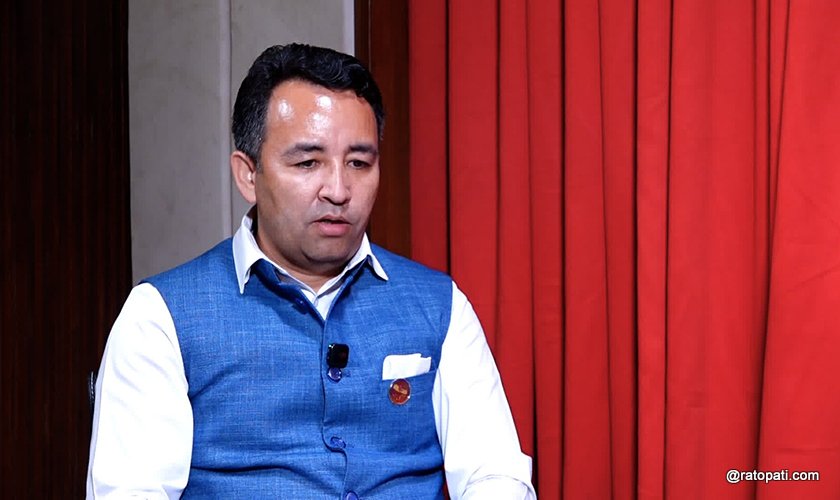
Kathmandu. The Deputy Leader of the Parliamentary Party of the ruling party, Rastriya Swatantra Party (RSP), Ganesh Parajuli, has clarified that there is no misunderstanding or awkward situation in the operation of the party and the government, and between the Prime Minister and the ministers. Parajuli stated that decisions are made through regular discussions and dialogues between party president Rabi Lamichhane and senior leader and Prime Minister Balendra (Balen) Shah on issues of good governance and service delivery. He claimed that there is no disagreement between the party and the government as rumored outside, and that the market rumors are untrue. Parajuli spoke in detail with Ratopati about the various speculations arising from the change of ministers, the dialogue between the party president and the prime minister, and the private conversation between the party president and the finance minister. Here is the edited excerpt of the conversation:
Looking at the recent activities and events, it seems there is some tension, rift, or distrust between the government and RSP. What is actually happening with RSP and the government?
Nothing has happened with RSP and the government as is being publicized outside. The rumors in the media are purely sponsored. The government and the party are moving forward with a coordinating role. Leaders are continuously discussing and dialoguing during the work process. Party president Rabi Lamichhane, Prime Minister Balendra Shah, and other leaders are constantly engaged in discussions and dialogues. Therefore, all the rumors being spread are baseless.
There have been various comments and speculations about the meeting between the party president and the prime minister on Asar 28. Subsequently, the 24-hour meeting between party president Lamichhane and Finance Minister Swarnim Wagle at a resort in Kavre on Saturday, Shrawan 2, has also been interpreted as an attempt to resolve the conflict between the prime minister and the finance minister. Doesn't this fuel the suspicion that something is indeed going wrong within RSP?
Because the meetings between the party president and the prime minister were not publicly disclosed or announced through press releases, speculations and personal opinions have been publicized. Similarly, news has appeared in the media. The party president and the prime minister meet regularly, but it is an old habit for the media to write and speculate when they learn about occasional meetings.
Not only meetings, but leaders also communicate frequently by phone. It is natural for someone to speculate when all these dialogues are happening. As for the party president going to a resort with the deputy leader, they also have their personal lives. They also have families. It should be understood that the deputy leader is not only the deputy leader of the party but also two friends before becoming the finance minister. Going somewhere with family based on family relationships is not unusual. If everything is connected to politics and analyzed from the perspective of 'has something happened, or is something about to happen?', it is no different from the political events that have been continuously happening in the past.
Therefore, in my understanding, this was a weekend outing with the family, and it is a normal process. When the party president, along with the deputy leader and the finance minister, sits down for a discussion, it is natural to talk about the future course of government operations, the voices of the people, and the path the party should take. Such discussions may have also taken place. However, I am not aware of what was discussed. Nothing has been made public about what was discussed.
As for your question, the speculations that there is internal discord within the party or a lack of coordination between the government and the party are purely baseless and just rumors.
At a time when there are rumors that the relationship between the party president and the prime minister has cooled down, how true is the claim that the meeting between the party president and the prime minister was publicized to show a brotherly relationship?
Party president Rabi Lamichhane is not just the guardian of RSP, but the guardian of everything. The prime minister is handling the reins of the government. The statement publicly made by the party president a few days ago, emphasizing the importance of 'how the intention should be' rather than the government's intention, has an impact, and it has already been publicly stated that there is no flaw in the intention. It is natural to criticize the actions taken to correct things when something goes wrong or a mature decision is not made during the course of work. We also acknowledge this. And, as opposition parties and formerly major parties shrink and become smaller, the RSP is being weakened, and there is a desire to play within RSP, to break and form RSP and this coalition to save their political future, but this is just a dream. All these propaganda created for such dreams will no longer work.
Serious questions have been raised about the government's performance on issues such as good governance, management of squatters, and people's livelihoods. Isn't it thought that this will ultimately backfire on the party?
There are no complaints about the orders of the respected court. I have no comments. However, if there are any legal procedural errors or weaknesses in the steps taken by the government in the aspect of good governance, they should be corrected. But the important thing is that we have come with a promise to lay the foundation of good governance, not just a promise, but a written agreement. The public has voted for us for good governance based on this agreement. So far, the most emphasis has been placed on good governance among the steps taken by the government. Whether it is in the aspect of diversification or digitalization. For a long time, the national identity card was intended to be implemented, but it could not be implemented until now. The system could not be integrated with the institution supplying the system, nor could the source code be obtained. However, the current government is accelerating this. It has obtained the source code and has started working to keep all aspects, including its operational process, within the security perimeter.
Along with this, those who have gained the capacity to run a parallel government in this country, those who have the capacity to break parties, form parties, form governments, and bring down governments, and those who have the capacity to mediate in all major contract processes and major decisions, are now standing in the dock. Claims of over 23-24 billion and over a trillion rupees in total have been made against a single individual, and lawsuits have been filed.
While taking such steps in the aspect of good governance, such issues have not been raised before, they have been raised. But we used to hear about where they slept midway and how much money was embezzled. The government has not faltered in any way from its side to bring these matters to a conclusion. Therefore, when the respected court works on legal procedures, there can be many loopholes in the law. We have heard the saying, 'The law has nine horns.' When interpreting that, if any decisions are made by the friends running the government or by the government's decisions by showing any flaws in the legal process, the respected court uses its discretion. The creation of trust in the judiciary is based on the justification of its decisions. However, if the government has made any procedural errors or weaknesses, it must correct them and move forward. This is also a kind of education. I have taken this positively.
However, the government's intention in the aspect of good governance is clear and pure. It has already been proven that the government will not falter in any way regarding good governance. It is natural to oppose this when the stick of good governance is wielded or when people become subject to punishment. Those involved in the administration of justice should also come within its scope, so those who have committed mistakes will be afraid, but those who have not made mistakes have no reason to be afraid.
There is talk of a cabinet reshuffle. Earlier, it was said that there was an understanding not to change ministers as the fiscal year was ending. The fiscal year has ended. There are rumors from the Prime Minister's side that the performance of 4-5 ministers has not been satisfactory, but the party's argument is that changing ministers in a short period will send the wrong message. Has there been any review regarding this?
A review of some of these issues took place during a brief meeting with the party leader and the honorable Prime Minister a few days ago. However, a decision to change ministers immediately has not been made or is not in place. If work cannot be done in terms of delivery and execution based on performance, and if results cannot be achieved, the public will not just watch us idly. Therefore, work must be done to achieve results in many areas. The ultimate goal of this may not be just to change ministers. That is, changing ministers may not be the only solution. Rather, we are ready to do whatever is necessary to empower the ministers from the parliamentary party.
It has been almost a month since the general convention, but the office bearers and central members have not yet been nominated. Why has it taken so long for a 'smart' party like RSP to nominate 51 people?
It takes time for anything to be finalized, and this is a natural process. Established political parties have a long history. They have a long political history of 80-85 years, while we have a political history of only 48 months.
After completing our first historic general convention, we have given the party president the authority through the statute to nominate 51 central members and office bearers. The sole purpose of this is to address the spirit of broad political consensus and the adjustment process. The process of electing office bearers or members was completed during the general convention itself. Due to the need to reconcile many aspects in the nomination process, some time may have been taken.
It is certainly true that some time has been taken because we have to manage the parliament as well as play a parallel role in the government. Just because this is a 'smart' party does not mean that nominations are made digitally, like 'click-click, this person for this position'. When nominating or deciding names, friends have to build consensus and do many other things. In my understanding, work is being done in that process, and much consensus has already been reached.
By when will the nominations be completed?
I don't think there are fixed deadlines for such matters. Mature decisions must be made. We need to consider the mistakes that may arise from making hasty decisions. If we make mistakes, the public will watch and evaluate us. It is not appropriate to give them such space. Therefore, in my understanding, the remaining tasks of the party will also be completed on time, understanding the time and the course of events.
From your statement, it can be understood that there is no conflict between the party and the government, and no ill will or suspicion between party president Rabi Lamichhane and the prime minister or parliamentary party leader Balen Shah. Is the reality also the same?
Yes, there is no suspicion about this. However, it should not be said that there is no conflict within the party at all. Without conflict and discussion, conclusions cannot be reached. Rather, it should be understood that all conflicts are positive and work to produce positive results. Conflict is not for disintegration, not for destruction, but for construction and for constructive matters through dialogue.
Dialogue can also be termed as conflict, but those dialogues yield all positive results. When making any decision or doing any work, if extensive adjustments are made and then corrections are needed, the party is ready to make corrections again. The government is also ready, as is evident from its actions. This will also be seen in the future.
In recent days, the honorable Prime Minister has initiated dialogue. As the dialogue continues with the private sector, various organizations, and personalities, and as the voices of the people are heard, it also sends a message that the government is listening to some issues that the public is not satisfied with. Therefore, all decisions made through dialogue and discussion within the party, and by listening to the people, will play a strong and effective role in the future. Those who dream of Rastriya Swatantra Party weakening or disintegrating will never see their dreams fulfilled.
Is the Prime Minister preparing to continue the dialogue with the private sector as well as leaders of various parties and foreign affairs experts?
Yes. The Prime Minister will also hold dialogues and discussions with constitutional experts, and experts on federalism and governance. Subsequently, the Prime Minister will also engage in dialogue, discussion, and continuous conversation with personalities who understand society.
This specific news has been automatically translated by AI. As a result, there may be some inaccuracies or language errors.