Karnali Chief Minister's Government in Crisis Amidst Political Stalemate

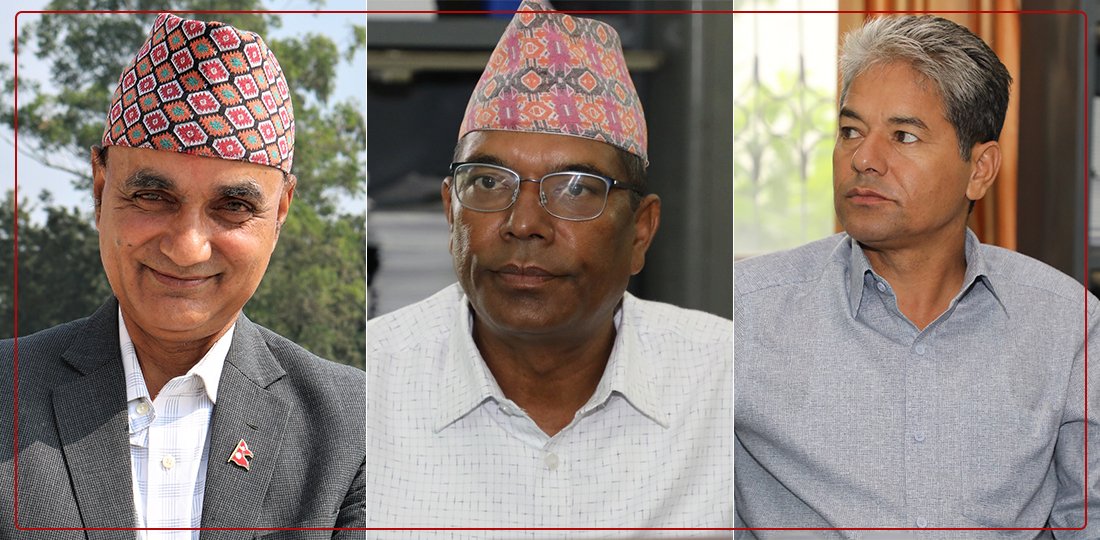
Surkhet. Four days have passed since Chief Minister Yamlal Kandel's government in Karnali is in crisis. However, there is no certainty whether his government will survive or fall. Chief Minister Kandel has not yet made any official statement regarding this.
Last Thursday, his coalition partner Nepali Congress, after convincing the main opposition party Nepali Communist Party (NCP), filed a no-confidence motion against him. Prior to that, on Wednesday, the Congress had recalled its ministers from the government. Along with filing the no-confidence motion, the NCP-Congress has proposed Jeevan Bahadur Shahi, leader of the Congress parliamentary party, as the Chief Minister.
However, Chief Minister Kandel, who is also the leader of the UML parliamentary party, is not making any efforts in the province to save his government. He is waiting for the conclusion to come from Kathmandu. He has not held any discussions with the Congress and NCP in the province.
'The coalition was not formed by us in the first place, it was formed from the center, so the government was formed accordingly,' a source close to him quoted Kandel as saying to Ratopati, 'The conclusion about the future of this government will also come from Kathmandu.'
That is why UML leaders say that Kandel remained silent even when a no-confidence motion was filed against him in the province. Government spokesperson Vinod Kumar Shah also said that since the decision regarding the province will be made at the center, no special efforts are being made in the province to save the government.
'Whatever happens, the decision will come from above, we will not make any separate efforts here,' Shah said. Furthermore, those who brought the no-confidence motion against Kandel are also paying attention to what will happen at the center.
Who committed the betrayal?
UML leaders and MPs claim that the coalition partner Congress has betrayed them. 'On one hand, they are in the government, but we have now learned that they have been colluding with the NCP,' says Tekraj Pachhai, chief whip of the UML parliamentary party, 'This is not good!'
However, the Congress says that a rebellion had to be staged because Chief Minister Kandel did not transfer power as per the understanding reached at the time. According to the understanding reached between Oli and Deuba at the center at that time, Jeevan Bahadur Shahi, leader of the Congress parliamentary party, should have become the Chief Minister in Karnali by last March.
Accordingly, the Congress Karnali Province Committee had already decided in February to suggest Shahi to lead the government. The Congress parliamentary party had also given full responsibility for this matter to Shahi. However, some Congress MPs say that due to problems within the Congress at that time, or for some other reason, Shahi did not show initiative to take leadership of the government.
'I don't know why, but he did not take the initiative to lead the government at that time,' says an MP, 'Later, when Congress President Gagan Kumar Thapa came to Surkhet, he said it was time to lead the government. But still, he did not take the initiative.'
On the other hand, Chief Minister Kandel also did not easily transfer power to Shahi even though the deadline had passed. Kandel's statement was: 'You discuss it at the center, there will be no problem here once the decision comes from above.'
However, the Shahi faction was not in a position to easily talk to the party center. This is because after the special general convention, the Deuba faction had gone to court against President Gagan Kumar Thapa, and the faction that recognized the president was not in favor. Jeevan Bahadur Shahi is a leader close to Deuba, and especially close to Purna Bahadur Khadka.
After Congress President Thapa came to Surkhet, another separate program was organized in the presence of Deuba faction leader Purna Bahadur Khadka. In that program, Shahi had expressed his anger towards the Thapa faction. Chief Minister Kandel, who closely observed all these developments, was using the 'center card' against the Congress instead of easily transferring power.
Kandel, knowing that it would be difficult for the Shahi faction to talk to the official faction of the party center, adopted a strategy to extend his government using that 'center card'. 'Even now, he was saying that there is an internal problem within the Congress, they themselves are not coming to lead the government, talk to the center and come,' says a UML source, 'On the other hand, if cooperation happens between the NCP and UML due to talks of communist unity at the center, Kandel analyzed that he could remain the Chief Minister himself.'
Rajkumar Sharma, who became the Chief Minister from the then NCP, had already left the NCP. There is no other leader in the NCP of Sharma's stature. A prominent UML leader claims that Kandel did not easily transfer power to the Congress because he was also looking at that possibility.
There was very little mutual discussion and meeting between Kandel and Shahi, the leader of the Congress parliamentary party.
'Otherwise, as the Chief Minister, he should have said, 'My term is over, I will transfer power to you,' that is political etiquette,' says the leader. Jeevan Bahadur Shahi, leader of the Congress parliamentary party, also told Ratopati in a conversation that the Chief Minister himself should have realized this. 'We did not ask the Chief Minister to resign, he should have realized it himself and paved the way,' Shahi said, 'He had already spent much more time than the stipulated period. But that was not seen in him.'
On the other hand, there was always a problem in the Congress-UML coalition government in Karnali. Even though the Congress was in power, it was opposing every policy and program brought by Kandel. Congress did not cooperate with Kandel on issues ranging from administrative restructuring to project selection procedures.
Congress MPs used to obstruct the government itself in the parliament.
When the Congress joined the UML-led government in July 2081 BS, Shahi was suspended. Shahi, who was suspended after a case was filed in the wide-body scam in the last week of March 2080 BS, returned to parliament in January 2081 BS after being acquitted in the case. In the very first meeting, party leader Shahi had threatened to leave the government from the parliament itself.
After that, by the time the budget for the fiscal year 2082/083 was presented, the Congress not only repeatedly threatened to leave the government but also tried to make the budget unsuccessful. UML and Chief Minister Kandel were fed up with such activities of the Congress.
The Congress had analyzed that it would be difficult to work if it went to lead the government in the UML coalition. Therefore, it was establishing relations with the NCP behind the scenes. The initiators were former Chief Minister and NCP leader Mahendra Bahadur Shahi and Congress leader Shahi.
At that time, Mahendra Bahadur Shahi's government was saved with the help of Congress's Shahi when his government was in crisis due to Yamlal Kandel. The two Shahis have had a good relationship since the past. Mahendra has the dominant influence within the NCP in Karnali recently.
It was he, Mahendra, who, immediately after the House of Representatives elections in February, came to Surkhet and advised Congress leader Shahi to take the leadership of the government. With the statement that the NCP was ready to support if the UML was not there, discussions for cooperation between Congress and NCP have been going on behind the scenes, according to sources.
Even though many NCP leaders are currently saying that they should not join the government, Mahendra is in favor of forming a Congress-NCP government in Karnali. 'It is not that a no-confidence motion was suddenly brought by colluding with the opposition, discussions with the NCP had already taken place,' the source says.
Karnali's decision creates ripples within the NCP!
The sudden move by the NCP to try to form a government by forming a coalition with the Congress in Karnali has created ripples within the NCP. Leaders at the central level of the party expressed dissatisfaction on social media, stating that the NCP was trying to join the government in the province against the party's central line. They are commenting that the decision is not right.
From Narayan Kaji Shrestha, Jhalanath Khanal, Shakti Basnet to Pampha Bhusal, they have all said that the NCP's line is not to join the government at present. They are questioning why the NCP is in a hurry to join the government in the province when federalism itself is being questioned.
However, Krishna Bahadur GC, chief whip of the NCP Karnali Province Parliamentary Party, says that the NCP itself is not taking the initiative to topple the government. He states that the NCP only provided an alternative after disagreements arose between the two coalition partners.
Furthermore, he said that even though the central leaders of the party are talking about the line on social media, no information has been conveyed to the province about the matter so far. 'It's nothing else, some of our leaders are eager to become UML soon,' he said, 'That's why they have written on social media. Now we have to move forward according to the NCP-Congress coalition.'
Another NCP MP, Ransingh Pariyar, said that the party center should create an environment for forming coalitions based on the needs of the province. However, according to the political scenario seen in Kathmandu, a coalition between UML and NCP seems possible.
NCP coordinator Pushpa Kamal Dahal is said to be holding discussions with UML Chairman KP Oli. While the NCP leaders in the center appear to be leaning towards the UML, there is tension within the NCP in Karnali. NCP leaders in Karnali are awaiting the decision of the party center. On the other hand, no official decision has been received from the Congress party center so far.
In the 40-member provincial assembly, 20 seats are required to form a government. Here, Congress has 15 seats, NCP has 14 seats, and UML has 10 seats. The government will be automatically formed if any two parties unite.


This specific news has been automatically translated by AI. As a result, there may be some inaccuracies or language errors.