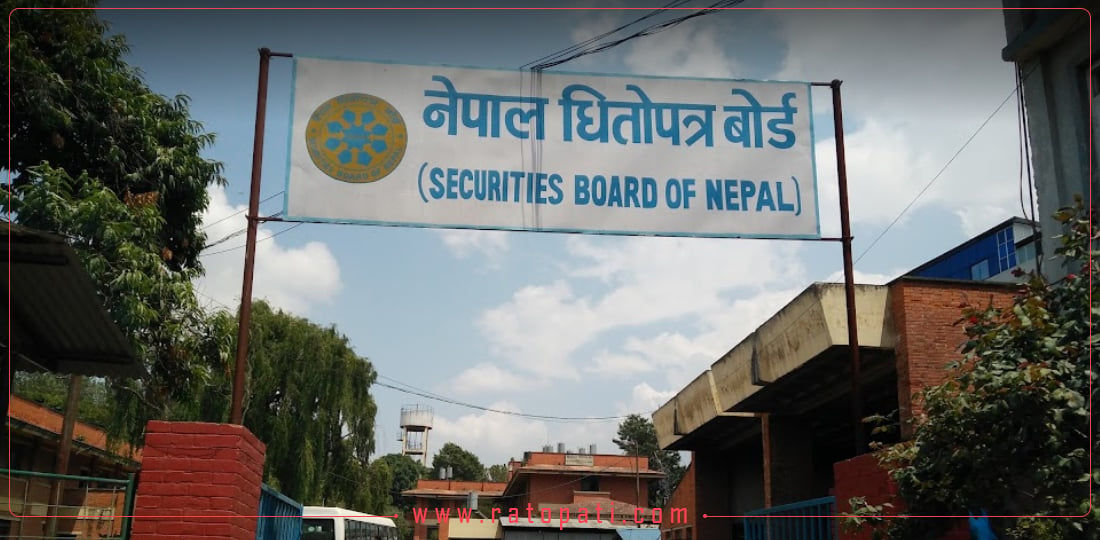
Nepal Securities Board Unveils 10-Year Capital Market Development Roadmap

Kathmandu. The Nepal Securities Board on Tuesday unveiled a 10-year roadmap for capital market development. The Board has brought such an action plan with a vision of what Nepal's capital market will look like in 2036. The roadmap unveiled by the Board aims to increase the market size to more than 150 percent of the Gross Domestic Product (GDP) in a decade, increase the number of listed companies to over 500, reach a daily trading volume of 30 billion, and increase the number of investors in the market to over 12 million. It is also mentioned that institutional investors will dominate the market more than individual investors, and institutional investors will account for 40 percent of the total turnover. These are quantitative goals. To achieve such goals, the Board's roadmap is to make the market multi-financial instrument-friendly. For this, instruments prevalent in the world such as derivatives, corporate bonds, green bonds, real estate investment, exchange-traded funds, and commodity exchanges will be used. Similarly, the market is aimed to be fully digital and technology-friendly. For this, a system of same-day settlement (T+zero) will be arranged, and AI, blockchain, and big data will be used. To facilitate the entry of foreign investors, non-resident Nepalis and cross-border transactions and settlements will be opened, and a separate SME exchange will be arranged for small and medium-sized companies. The Board has also clarified that all these systems and transactions will be operated according to international systems such as IOSCO, OECD, and IFRS. Board spokesperson Niranjay Ghimire said that the Board presented the 10-year roadmap as part of its regular work, policy, and programs, and as per its previous commitment. He said that this roadmap clarifies the path that capital market-related institutions should follow in the coming days. This is the goal of the roadmap New form of capital market The goal is to establish Nepal's capital market as one of the most reliable, transparent, technology-friendly, inclusive, and competitive financial systems in South Asia in the coming decade. Currently, the market is mainly limited to the buying and selling of shares, but after 10 years, it will become a major financial source for productive investment, infrastructure development, innovation, and entrepreneurship. SEBON has described this period not as a decade of "market expansion" but as a decade of "market transformation". After 10 years, the capital market will stand as the second major pillar of Nepal's national economic development. Main changes in indicators What leap is targeted in the main indicators of the market in the next 10 years. Main goals of capital market Indicator Current (2026) Goal for 2036 Market capitalization (compared to GDP) 70-80 percent More than 150 percent Number of listed companies Approximately 300 Over 500 Daily average turnover 8 billion rupees More than 30 billion Demat account numbers 8 million Over 12 million Institutional investment share Limited More than 40 percent of total turnover Corporate bond market Initial stage 20 percent of total capital market Mutual fund schemes 56 More than 150 SME listing Not listed Over 200 companies Green bond Initial Regular issuance Foreign investment Not present Phased institutional participation Digital Capital Market 2.0 In the next 10 years, Nepal's capital market will be fully technology-based. The roadmap envisions 'Digital Capital Market 2.0'. It will have the following features. a. Real-time settlement: The situation of having to wait for days to receive money after selling shares, as it is now, will end. Through the use of blockchain technology, shares and money will be settled in real-time. b. Use of Artificial Intelligence: An AI-based market surveillance system will be implemented to prevent insider trading and unusual fluctuations in the market. This will increase market reliability. c. Capital Market Super App: Investors will be able to trade shares, bonds, mutual funds, commodities, and derivatives from a single mobile app. d. Paperless and contactless services: All tasks, from opening a demat account to updating KYC, will be fully digital and biometric-based. New instruments and market diversification According to the Board's action plan, various new investment options will be available in the market after 10 years. a. Corporate and Municipal Bonds: Large industries and local governments will raise capital by issuing bonds from the market for development construction. b. Small investment in large infrastructure: Investors with small capital will also be able to invest in real estate and large infrastructure projects just like shares. c. Derivatives and Commodity Market: Besides shares, futures trading of commodities like gold, silver, tea, and coffee will be fully operationalized through a 'Commodity Exchange'. d. Green and Sustainable Finance: 'Green Bonds' will be issued for environmental protection and renewable energy, which will also attract international investors. Institutional investors and stability The Board understands that the main reason for the current volatility in the Nepali market is the dominance of individual investors. In 10 years, large entities like Employees Provident Fund, Citizen Investment Trust, and Social Security Fund will become anchor investors in the market. The roadmap aims to increase the share of institutional investors to 40 percent, which will protect the market from unnecessary fluctuations and provide stability. Door for small industries and startups It is difficult for small companies to get listed on NEPSE now. But after 10 years, there will be separate SME exchanges and startup boards in Nepal. This will enable small and medium-sized entrepreneurs and young people with innovative ideas to raise investment from the capital market instead of relying solely on bank collateral. The roadmap aims to list more than 200 small companies. Internationalization and foreign investment In the coming decade, Nepal's capital market will be connected with the international market. For this, the following tasks will be done. a. Non-resident Nepalis: Nepalis living abroad will have a legal way to invest in the Nepali market. b. Foreign institutional investors: Large global funds will be allowed to enter the Nepali market, which will help in bringing in foreign exchange. c. Cross-border listing: The basis will be prepared for Nepali companies to list shares on foreign stock exchanges and for foreign companies to list shares in Nepal. How practical is the roadmap brought by the Board? To understand how ambitious the Board's criteria are, one only needs to look at one of its goals. The Board has announced the introduction of a T+zero settlement system where transactions are settled on the same day. This is the fastest settlement system in the world to date. The New York Stock Exchange, the world's largest market, currently operates on T+1. India and China also have the same situation. However, they have started a system of settling some specific scripts on the same day. This means that SEBON has set an ambitious goal of introducing a system that even those countries have not been able to implement so far. Let's look at another aspect. It has been almost a decade since efforts were made to get a license for a commodity exchange market in Nepal. However, not a single market has received a license yet. SEBON, on the other hand, has announced the introduction of all types of financial instruments prevalent in the world. It is even planned to operate exchanges like REITs and ETFs, which are considered very ambitious. An even bigger issue is market participation. Currently, the majority of market trading is based on individual transactions. The presence of institutional investors in the market is low; in this situation, the Board's goal is for 40 percent of the turnover to be institutional. Furthermore, the goal of bringing in NRIs and foreign investors into the capital market has also been set. However, the goal of bringing in NRIs, which has been in place for a decade, has not yet been implemented. Former Executive Director of the Board, Niraj Giri, also considers the Board's roadmap to be correct but very ambitious. He states that while the goal can be considered good, its implementation is what matters. However, he says that considering the current situation, the implementation environment is easy. Nevertheless, some impractical facts are also visible in the guidelines brought by the Board. The Board has set a goal of adding only 400 companies to the capital market within the next 10 years. The action plan is to increase the number of companies from the current 300 to over 500 and list 200 companies under small and medium-sized enterprises. However, during this same period, the market capitalization is targeted to be increased to over 225 trillion, which is currently only 45 trillion. This is because the government has stated that it will make the country's economy $100 billion, or 150 trillion, within the next 10 years. Based on this, a market capitalization of 225 trillion is needed for the market capitalization ratio to be 1.5 times. According to this, the capitalization of the targeted companies may be almost impossible to reach that level. Share market expert Dev Guragain also says that there is a lack of coordination between the number of listed companies and the market capitalization target. He suggests the Board make this more credible. Implementation will be in three phases SEBON has divided this 10-year plan into three clear phases. Accordingly, the first phase will last for the next one and a half years. Legal, institutional, and regulatory reforms will be carried out in this phase. The second phase will be from 2028 to 2030. The Board plans to carry out market expansion, new instruments, and digital transformation work in this phase. The remaining 6 years will focus on internationalization, regional integration, and building a world-class market, according to the Board's action plan. If this roadmap is successfully implemented, scattered small savings will be mobilized in productive sectors, which will contribute to industrial development, reduce the compulsion for industrialists to rely only on banks for loans, and reduce the cost of capital. With the expansion of the capital market, thousands of new jobs will be created in the securities brokerage, merchant banking, rating agency, and information technology sectors, the Board expects. It is believed that this will contribute to financial inclusion, making citizens from villages and marginalized communities part of the investment through digital means, and transparency and accountability will increase as corporate governance will be mandatory in listed companies.
This specific news has been automatically translated by AI. As a result, there may be some inaccuracies or language errors.

_zDgGjQnBk0.jpg)