Nepal Faces Demographic Transition Challenges Amidst Shifting Population Dynamics
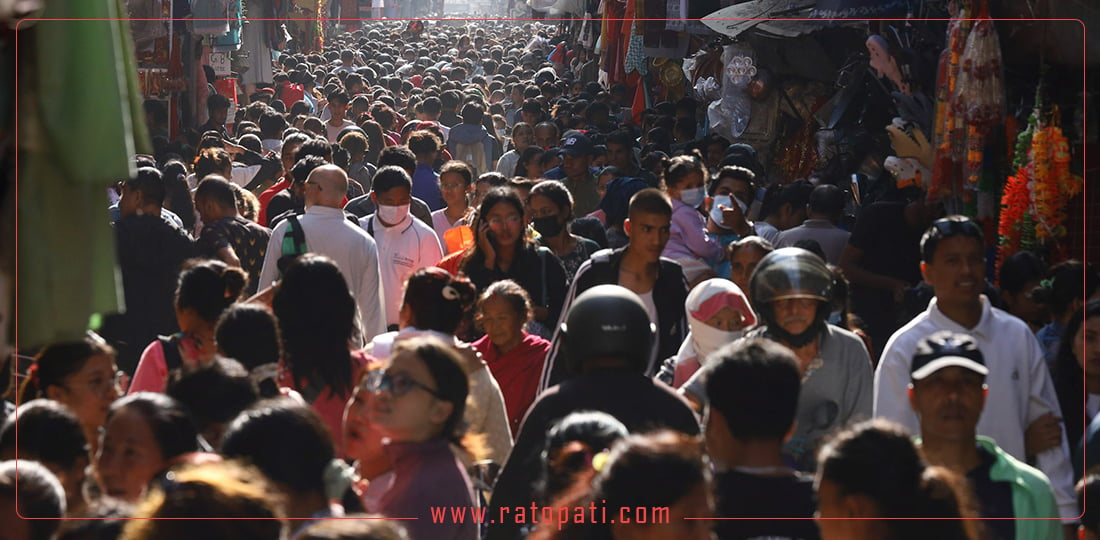
World Population Day, celebrated every year on July 11, is not just a formal occasion to measure population size. It is a global opportunity to self-reflect on human development, social justice, demographic changes, and a sustainable future.
The theme for World Population Day 2026 is 'Realizing the Hopes and Aspirations of Young People: Today and the Future.' This itself carries a profound message. A nation's future is not determined solely by its population size. It is determined by whether the youth of that nation can see opportunities, respect, security, and a future in their own country.
This message is even more relevant for Nepal. For the past five decades, the focus of Nepal's population-related discourse has been high birth rates, family planning, and population control. With improvements in health, education, and social development indicators, the birth rate has declined, maternal and child mortality rates have significantly decreased, average life expectancy has increased, and family size has become smaller. Today, Nepal's main challenge is not controlling population growth, but how to transform the changing population structure into a basis for economic, social, and national prosperity.
The National Census 2078 has clearly indicated the beginning of a new chapter in Nepal's demographic history. The country's annual population growth rate has fallen to 0.92 percent, and the total fertility rate is limited to about 1.9 children per woman, which is below the replacement level (around 2.1).
This means that if the current trend continues in the long term, the ability of the new generation to fully replace the old generation may weaken. Meanwhile, millions of youth have migrated abroad for foreign employment, rural settlements are gradually emptying, and the number of citizens above 60 years of age is rapidly increasing. These figures are not just census numbers; they indicate the future of Nepal's economy, society, and politics.
- Demographic Transition in the Mirror of Development
The theory of demographic transition is considered very useful for understanding the pace of development in any society. According to this theory, a society transforms from a state of high birth rates and high death rates to a state of low birth rates and low death rates. In the initial stage, health services are weak, average life expectancy is low, and a large family is a social and economic necessity.
With improvements in health services, nutrition, sanitation, and education, the death rate decreases. Subsequently, with the expansion of women's education, urbanization, employment, and reproductive rights, the birth rate also begins to decline. Eventually, society enters a phase of low birth rate, low death rate, and an increasing elderly population.
Nepal's demographic journey is an excellent example of this transition. In the 1970s and 1980s, a woman gave birth to an average of 5 to 6 children. Expansion of health services, immunization programs, safe motherhood, family planning, improvement in women's education, and access to communication brought about significant changes in reproductive behavior within a few decades.
Today, Nepali families are smaller, child mortality rates have decreased significantly, and average life expectancy has reached historically high levels. This is a significant achievement in public health and social development.
However, this achievement has also created new challenges. If the birth rate continues to decline, youth continue to migrate abroad in large numbers, and the elderly population increases, Nepal may face challenges such as labor shortages, increased social security expenses, and decreased economic productivity in the future. Thus, yesterday's policy success has today transformed into new policy challenges.
- Opportunity is Not an Achievement in Itself
The most important economic aspect of demographic transition is demographic dividend. When the working-age population is larger than the dependent population, the nation gets a historic opportunity for rapid economic development. But this opportunity does not automatically translate into economic prosperity. It requires quality education, a healthy workforce, skills, a production-oriented economy, industry, innovation, good governance, and an environment of adequate employment.
South Korea, Singapore, Taiwan, and Ireland transformed this opportunity into economic miracles. They continuously invested in human capital, from schools to industries, from research to entrepreneurship. As a result, the demographic structure accelerated economic productivity.
Nepal is also considered to be in a favorable phase to utilize the demographic dividend. The working-age population is still large. But the question arises, is this workforce being effectively utilized for Nepal's development and economic construction?
Unfortunately, the answer is not encouraging. The trend of a large number of youth going for foreign employment continues every year. Remittances have increased the income of millions of families and supported the economy. But a remittance-based economy cannot be a substitute for a production-oriented economy.
While income generated from products created abroad may meet immediate economic needs, it does not build the foundation for industry, agriculture, research, innovation, and sustainable employment within the country. Thus, it appears that Nepal is spending a large portion of its demographic dividend in the external labor market rather than on national production.
- The Real Basis of Development
Economists Theodore Schultz and Gary Becker argued that the basis of development lies more in human capital than in natural resources. According to them, investment in education, health, skills, research, and innovation is not an expense but a productive investment that yields high returns in the future.
In the context of Nepal, the issue of human capital has become extremely important. Access to schools and universities has expanded, and the number of youth pursuing higher education has increased, but the relationship between the education system and the labor market remains weak.
There is a significant gap between the human resources produced by universities and the skills demanded by industries, agriculture, technology, and service sectors. As a result, even highly educated youth are increasingly migrating abroad, seeing no future in their own country.
Now a serious question arises: are we building human capital or exporting human capital?
If Nepal's education system does not connect with research, technical skills, digital technology, green economy, artificial intelligence, and entrepreneurship, the demographic dividend may expire before it can be utilized. Therefore, the time has come to view education policy, labor policy, and economic policy not separately, but as an integrated human capital strategy.
- Message from the 2078 Census
The National Census 2078 has given five clear messages for Nepal's development. First, Nepal is no longer a country with high population growth; therefore, the development discourse needs to be transformed from population control to population management.
Second, the fertility rate falling below the replacement level indicates the need for long-term workforce planning, family-friendly policies, and a social security system.
Third, rapid foreign migration is weakening the demographic dividend. Therefore, it is necessary to link foreign employment with a national human capital strategy.
Fourth, with the rapidly increasing elderly population, the development of health services, social security, long-term care, and age-friendly infrastructure has become imperative.
Fifth, the emptying of hilly and mountainous regions and the excessive concentration of population in limited urban areas have become structural challenges related to development, food security, environment, and national security.
Therefore, the debate should no longer be limited to 'how many people?'. The main question should be 'what kind of population, where does the population live, what skills does the population have, and what kind of development model is the population linked to?'.
- From Population Policy to Demographic Governance
Nepal has achieved significant success in the past five decades through family planning, safe motherhood, women's education, and expansion of health services. However, today's need is not population control, but demographic governance that links the changing population structure with national development.
The National Population Policy 2082 has formally accepted demographic transition, healthy aging, migration, and population management. Although this is a positive change, the gap between policy and implementation is still wide. The mechanism for integrating population, education, health, labor, social security, and economic development has not yet become effective.
Today's population issue is not just a matter for the Ministry of Health. It is a national development issue directly linked to the economy, education, agriculture, employment, urbanization, climate change, and federal governance. Therefore, population policy should now be at the center of national development policy, not a sectoral one.
- Why is Population Still an Invisible Issue?
Major political parties in Nepal prioritize employment, economic development, good governance, social security, and infrastructure development. However, the demographic change, which is the basis of all these issues, has not yet become the center of political debate.
Various parties prioritize human development, social justice, production growth, infrastructure, entrepreneurship, and youth-friendly programs. However, a clear, long-term, and coordinated strategy regarding declining birth rates, shrinking workforce, aging population, internal and external migration, and effective utilization of demographic dividend is still not adequately developed.
Therefore, most debates related to Nepal's development are actually directly linked to the changing structure of the population, but the policy perspective that accepts population as the main driver of development is yet to mature.
- Conclusion
Nepal today stands at a decisive juncture of demographic transition, not population growth. This change is neither inherently positive nor negative. Its outcome will depend on the policies, investments, and governance adopted by the state.
If today's young workforce can be connected with quality education, skills, innovation, entrepreneurship, and dignified employment, the demographic dividend can become the foundation of Nepal's prosperity. Otherwise, this opportunity may transform into labor shortages, increasing elderly population, economic slowdown, and social security crisis.
Therefore, World Population Day 2026 has given Nepal a clear message. The national debate should no longer be limited to the question of 'how many people?'. Rather, it should focus on finding answers to the questions: 'what kind of population, where does the population live, what skills does the population have, and what kind of development model is the population linked to?'. This answer will determine the path of Nepal's development, prosperity, and social transformation for the next three decades.
(Adhikari is a professor at Ramswaroop Ram Sagar Multiple Campus, Janakpur.)
This specific news has been automatically translated by AI. As a result, there may be some inaccuracies or language errors.
_drOmyPMDMX.jpg)